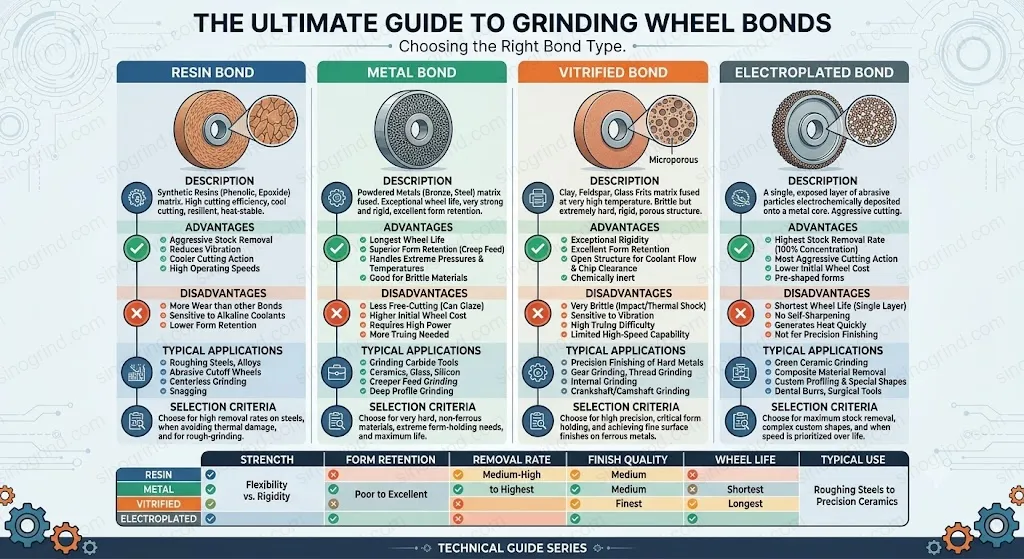
: +86 15874211461
Achieving the optimal surface finish is critical in precision manufacturing. Whether you're grinding aerospace components, automotive parts, or medical devices, surface quality directly impacts part performance, fatigue life, and customer satisfaction.
This comprehensive guide explains how to select the right grinding wheel and optimize your grinding parameters to achieve consistently superior surface finishes.
1. Understanding Surface Roughness
Surface roughness is typically measured using the Ra (arithmetic average) value, which represents the average deviation of the surface profile from the mean line:
Mirror
Fine
Medium
Rough
Coarse
| Surface Finish | Ra Value | Typical Applications | Grinding Method |
|---|---|---|---|
| Mirror Finish | 0.05 - 0.1 μm | Optical components, bearing races | Ultra-precision grinding, lapping |
| Fine Finish | 0.1 - 0.4 μm | Precision shafts, hydraulic components | Precision surface/cylindrical grinding |
| Medium Finish | 0.4 - 0.8 μm | General machine components | Standard surface/cylindrical grinding |
| Rough Finish | 0.8 - 1.6 μm | Non-critical mating surfaces | High-efficiency grinding |
| Coarse Finish | 1.6 - 3.2+ μm | Stock removal, preparatory grinding | Rough grinding operations |
2. Grinding Wheel Selection for Surface Finish
The grinding wheel is the most critical factor in determining surface finish. Key wheel parameters include:
Abrasive Grain Size
Grain size is the primary determinant of surface finish quality. Finer grains produce smoother finishes but remove material more slowly.
| Grain Size | Typical Ra | Material Removal | Best For |
|---|---|---|---|
| 80/100 mesh | 0.8 - 1.6 μm | High | Rough grinding, fast stock removal |
| 120/150 mesh | 0.4 - 0.8 μm | Medium | General purpose grinding |
| 200/220 mesh | 0.2 - 0.4 μm | Low | Fine finish grinding |
| 320/400 mesh | 0.1 - 0.2 μm | Very Low | Precision finish grinding |
| 600+ mesh | 0.05 - 0.1 μm | Minimal | Mirror finish grinding |

Abrasive Type
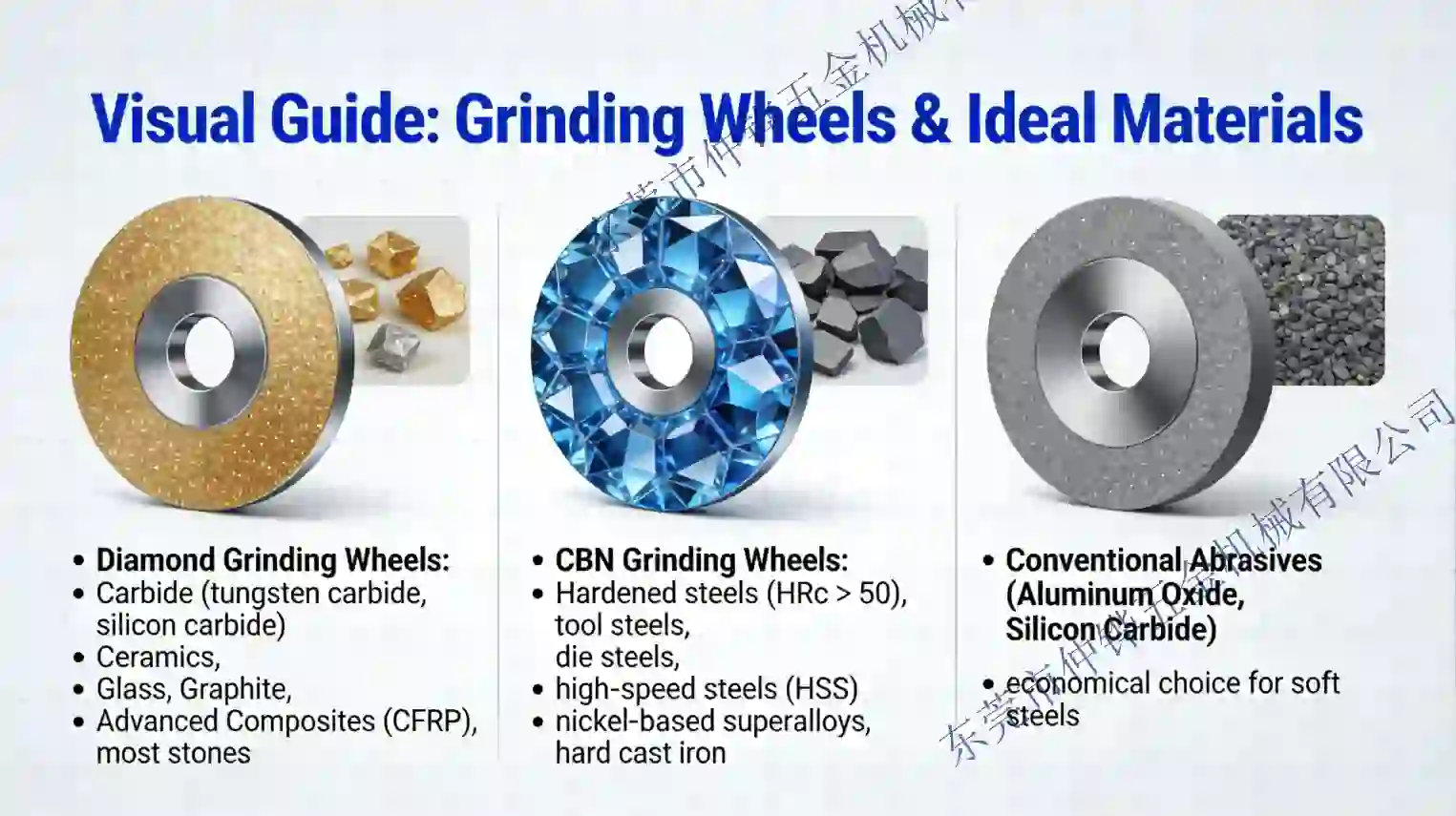
- Diamond: Best for hard materials (carbide, ceramic, glass). Excellent finish on non-ferrous materials.
- CBN: Superior for hardened steels and aerospace alloys. Maintains finish at high temperatures.
- Aluminum Oxide: Good for general-purpose grinding of ferrous materials.
- Silicon Carbide: Suitable for cast iron, non-ferrous metals, and non-metallic materials.
Wheel Grade (Hardness)
The grade (hardness) of the wheel affects surface finish:
- Softer grades (H-J): Release grains more readily, producing better finishes on hard materials
- Medium grades (K-M): Balanced performance for general applications
- Harder grades (N-S): Retain grains longer, better for soft materials but may produce rougher finishes
3. Grinding Parameters for Optimal Finish
Critical Parameters
Even the best grinding wheel will produce poor results if the grinding parameters are not optimized. The three key parameters are wheel speed, work speed, and feed rate.
| Parameter | Effect on Finish | Optimization Strategy |
|---|---|---|
| Wheel Speed | Higher speed = finer finish | Increase speed for finishing passes (within wheel rating) |
| Work Speed | Lower work speed = finer finish | Reduce work speed for final passes |
| Feed Rate | Lower feed = finer finish | Use light spark-out passes at zero feed |
| Depth of Cut | Shallower cut = finer finish | Use multiple light passes instead of one heavy cut |
| Coolant Flow | Higher flow = better finish | Ensure adequate coolant delivery to grind zone |
4. Two-Stage Grinding Strategy
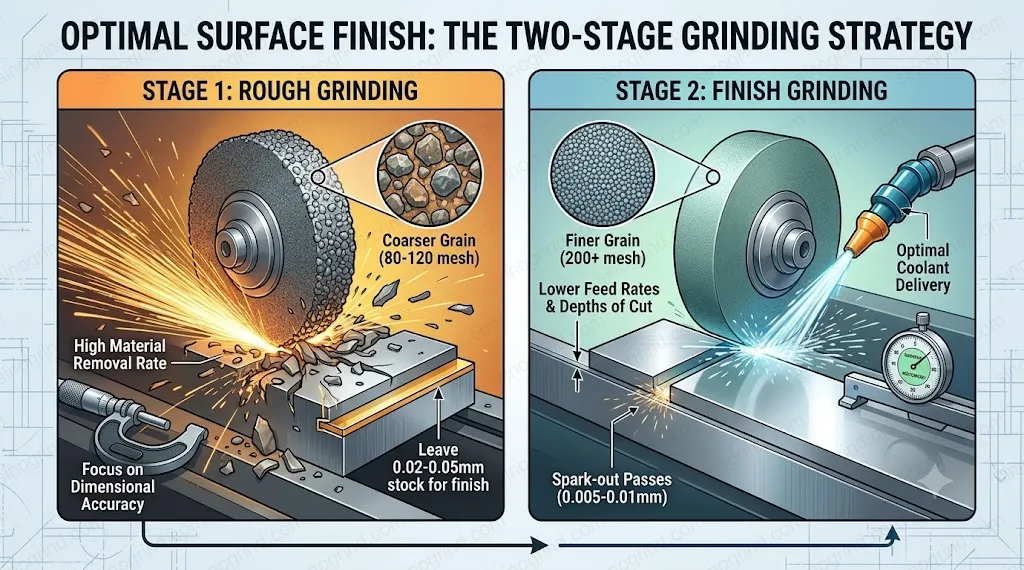
For optimal results, use a two-stage approach:
Stage 1: Rough Grinding
- Use coarser grain size (80-120 mesh)
- Higher material removal rate
- Focus on dimensional accuracy
- Leave 0.02-0.05mm stock for finish grinding
Stage 2: Finish Grinding
- Use finer grain size (200+ mesh)
- Lower feed rates and depths of cut
- Include spark-out passes (0.005-0.01mm)
- Optimize coolant delivery
5. Common Surface Finish Problems and Solutions
| Problem | Likely Causes | Solutions |
|---|---|---|
| Scratches | Contaminated coolant, loose abrasive | Filter coolant, dress wheel, check wheel balance |
| Burn marks | Insufficient coolant, dull wheel, high parameters | Increase coolant, dress wheel, reduce parameters |
| Chatter marks | Wheel imbalance, machine vibration, improper wheel choice | Balance wheel, check machine, use softer grade |
| Rough finish | Wheel too hard, grain too coarse, feed too high | Use softer grade, finer grain, reduce feed |
| Uneven finish | Wheel loading, uneven wear, coolant issues | Dress wheel, check coolant distribution |
6. Material-Specific Recommendations
Hardened Steel (HRC 50+)
- Wheel: CBN 150-220 mesh, Resin or Vitrified bond
- Speed: 30-40 m/s
- Expected finish: Ra 0.2-0.4 μm
Carbide
- Wheel: Diamond 150-320 mesh, Resin bond
- Speed: 20-30 m/s
- Expected finish: Ra 0.1-0.3 μm
Stainless Steel
- Wheel: CBN 120-180 mesh, Resin bond
- Speed: 25-35 m/s
- Expected finish: Ra 0.3-0.6 μm
Ceramic Materials
- Wheel: Diamond 200-400 mesh, Resin or Metal bond
- Speed: 15-25 m/s
- Expected finish: Ra 0.05-0.2 μm
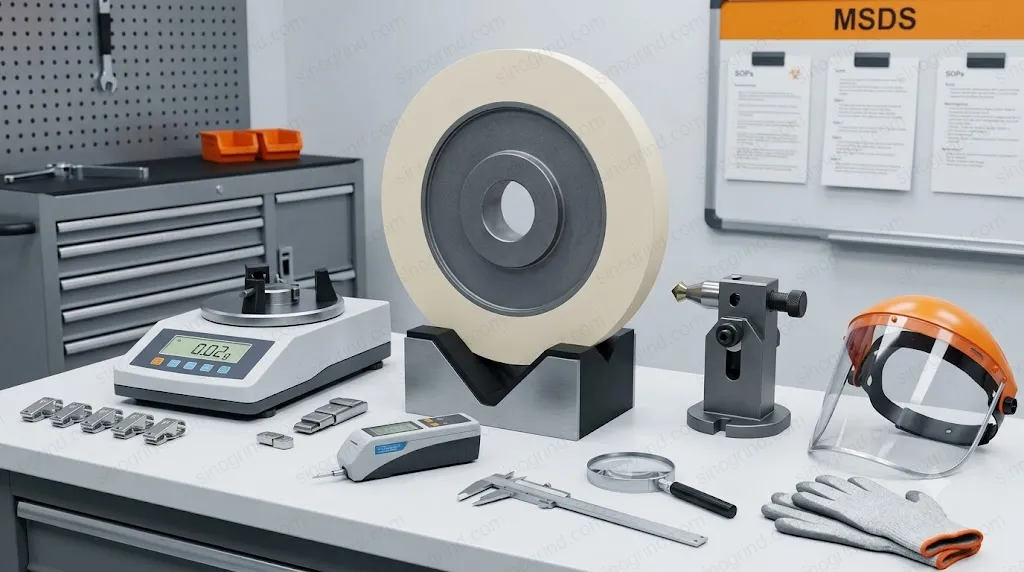
7. Measuring and Monitoring Surface Finish
Consistent surface finish requires regular measurement and process monitoring:
- Surface roughness testers: Use profilometers for accurate Ra measurements
- Visual comparison: Maintain reference samples for quick checks
- Process monitoring: Track grinding forces and power consumption
- Statistical control: Implement SPC to detect finish variations early
Conclusion
Achieving optimal surface finish requires careful selection of grinding wheels, parameters, and process strategies. By understanding the relationship between grain size, bond type, grinding parameters, and surface finish, you can consistently produce parts that meet the most demanding specifications.
At SinoGrind, we offer a comprehensive range of grinding wheels engineered for superior surface finish across all materials. Our technical team can help you select the optimal wheel specification and develop grinding parameters for your specific applications. Contact us to discuss your surface finish requirements.