: +86 15874211461

Understanding Grinding Wheel Bonds
In-depth article on bond types and their applications.
Read MoreSelect the optimal bond family for your diamond or CBN grinding application. Compare resin, vitrified, metal, and electroplated bonds based on your specific workpiece and process requirements.
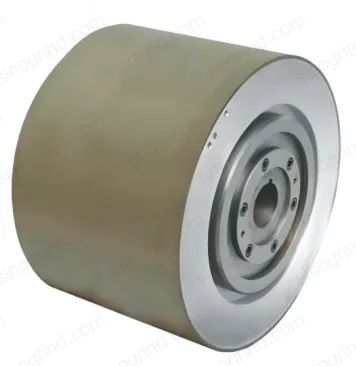
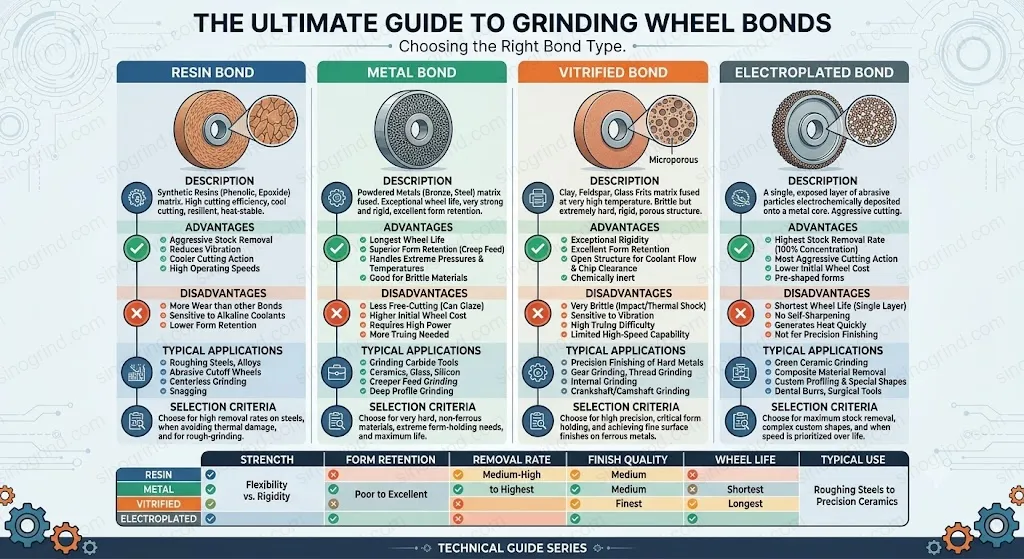
The four main grinding wheel bond types each offer distinct advantages: Resin bonds use organic resins (phenolic or polyimide) to hold abrasive grains, providing excellent surface finish, self-sharpening behavior, and vibration dampening — ideal for carbide and ceramic grinding. Vitrified bonds are glass-ceramic matrices with engineered porosity, offering superior form holding, dressability, and coolant flow — the preferred choice for precision production grinding of hardened steels and crankshaft or camshaft applications.
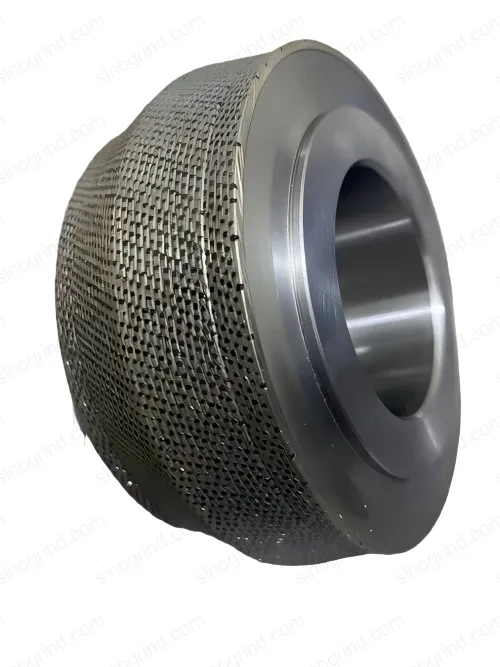
Metal bonds (bronze, copper, or sintered iron) deliver the strongest grain retention and longest wheel life, making them essential for grinding extremely hard materials like PCD, engineering ceramics, and ferrite. Electroplated bonds use a single nickel-plated layer of abrasive for maximum sharpness and complex wheel profiles — ready to use with no dressing required. For detailed bond type comparisons, read our grinding wheel bonds guide.
| Bond Type | Typical Strengths | Typical Limitations | Common Applications |
|---|---|---|---|
| Resin Bond | Excellent surface finish; good stock removal; self-sharpening; relatively forgiving; available in many hardness grades | Shorter wheel life than metal or vitrified; limited form retention; temperature sensitive; not ideal for heavy loads | Surface & cylindrical grinding of tungsten carbide, ceramics, glass; tool grinding; sharpening; general-purpose superabrasive work |
| Vitrified Bond | Precise form holding; open structure for coolant; excellent geometry control; dressable with diamond tools; good wheel life | Lower toughness than resin; more brittle; requires careful handling; higher initial cost; less forgiving on interrupted cuts | Precision surface & form grinding; crankshaft & camshaft grinding; gear grinding; profile grinding; creep-feed grinding |
| Metal Bond | Exceptional wheel life; high bond strength; excellent form retention; handles heavy loads; good thermal conductivity | Poor surface finish without dressing; difficult to dress; slow cutting; high risk of workpiece burn if overloaded | Hard materials (ceramics, PCD, ferrite); lapidary; heavy-duty stock removal; glass grinding; optical lens grinding |
| Electroplated | Single-layer extreme sharpness; complex profiles; full diameter usable immediately; no dressing needed; cost-effective for complex shapes | Single-layer only (no redress); once worn, wheel is discarded; limited grit exposure control; not suitable for heavy stock removal | Profile & form grinding; complex shapes; small-batch production; deburring; grinding of intricate contours; wood & composite machining |
Diamond grinding wheels use bond types selected based on the workpiece and operation. For tungsten carbide and ceramic grinding, resin bond provides a good balance of material removal rate and surface finish. When grinding PCD or very hard ceramics, metal bond provides the toughness needed. For precision profile and form grinding, vitrified bond offers superior geometry control and can be dressed to restore cutting ability. Electroplated diamond wheels are ideal for complex profiles and single-pass operations where a fresh, sharp cutting surface is needed.
CBN (cubic boron nitride) grinding wheels are primarily used on ferrous materials — hardened steel, tool steel, bearing steel, and high-speed steel. Resin bond CBN wheels dominate for surface and cylindrical grinding due to their forgiving nature, good finish, and moderate cost. Vitrified bond CBN is the go-to for precision crankshaft, camshaft, and gear grinding where exact geometry must be maintained over long production runs. Metal bond CBN is rarely used except in specialized heavy-duty applications. Electroplated CBN is useful for form grinding and sharpening where a complex profile is needed.
Resin bond uses phenolic or polyimide resins to hold abrasive grains. It is relatively soft, self-sharpening under load, and produces excellent surface finishes. However, it has limited form retention and degrades at elevated temperatures. Vitrified bond is a glass-like ceramic bond created by high-temperature sintering. It is rigid, precisely controllable in structure (porosity can be engineered), fully dressable with diamond tools, and holds form extremely well over long production runs. The trade-off is that vitrified wheels are more brittle and require more careful handling.
Metal bond (typically bronze, sintered iron, or copper-based alloys) provides the highest bond strength among all superabrasive bond types. This makes it essential for applications where the workpiece is extremely abrasive or hard — such as engineering ceramics, PCD compacts, ferrite cores, and optical glass. Metal bond wheels also have excellent thermal conductivity, which helps manage heat in dry or near-dry grinding. The downside is that they are slow-cutting, difficult to dress, and can cause workpiece burn if improperly applied. They are not the first choice for hardened steel grinding — resin or vitrified bond is usually more appropriate there.
Electroplated wheels are manufactured by electrochemically depositing a nickel layer that encapsulates abrasive grains onto a precision-machined metal core. This produces a wheel with maximum grain exposure (extreme sharpness), the ability to form complex profiles that would be impossible with other bond types, and no dressing required — the wheel cuts at full capacity from the start. Because only a single layer of grit is present, once the grains are worn or pulled free, the wheel is typically discarded rather than redressed. Common uses include profile grinding, contour grinding, small-batch precision work, and grinding of materials where a fresh sharp cut is critical.
Vitrified bond is the gold standard for form holding in grinding. Its rigid, glass-like structure resists deformation under load and maintains the wheel's dressed profile over extended grinding operations. This is why vitrified bond is preferred for gear grinding, thread grinding, crankshaft grinding, and any application where the wheel's dressed geometry must transfer precisely to the workpiece. Metal bond also holds form well but is less commonly used for precision form applications. Resin bond has moderate form retention — sufficient for general-purpose work but not ideal for high-precision form transfer. Electroplated wheels hold their as-manufactured profile well but cannot be redressed to restore form once worn.
The bond is the material that holds abrasive grains together in a grinding wheel and attaches them to the wheel core. It is one of the most critical factors determining how a grinding wheel performs. While the abrasive grain (diamond, CBN, aluminum oxide, etc.) does the actual cutting, the bond controls grain retention, chip clearance, wheel wear rate, surface finish, and thermal behavior. Choosing the right bond family is essential to achieving the desired grinding results safely and economically.
Bond characteristics influence virtually every aspect of the grinding process:
Resin and vitrified are the two most common bond types for diamond and CBN superabrasive wheels. Resin bond (phenolic or polyimide) is softer and more elastic — it provides excellent surface finish and moderate stock removal while being forgiving on the workpiece. It self-sharpens under load but has limited form retention and degrades above ~200–300°C. Vitrified bond (glass-ceramic) is rigid and porous. It offers superior form holding, can be dressed with a diamond stick or rotary dresser, and its open structure permits high coolant flow rates. Vitrified bond is the preferred choice for precision production grinding where geometry control is paramount.
Metal bonds (bronze, copper, sintered iron) provide the strongest grain retention and longest wheel life of any bond type. They excel when grinding extremely hard and abrasive materials like engineering ceramics, PCD, and ferrite. However, they cut slowly, are difficult to dress, and risk thermal damage to the workpiece if the grinding parameters are not carefully controlled. Resin bond, by contrast, cuts more freely, finishes better, and is far easier to dress — making it the default for most hardened steel and tool steel grinding. In summary: metal bond for hardest materials requiring maximum durability; resin bond for steels and softer materials requiring good finish.
Electroplated construction is unique in that a single layer of abrasive is nickel-plated onto a precision-machined metal core. This enables extremely complex wheel profiles that would be impractical or impossible to produce with sintered bond types. Electroplated wheels are also the sharpest cutting of any bond type, because nearly the full grain height is exposed. They require no dressing — the wheel is ready to cut at full capacity immediately. They are ideal for profile grinding, contour work, deburring, and small-batch production. The limitation is their single-layer construction: once the exposed grains wear, the wheel must be replaced.
Diamond and CBN are the two superabrasive grain types, and each interacts differently with bond materials. Diamond is the hardest known material and excels at grinding non-ferrous hard materials (carbide, ceramic, glass, PCD). CBN has lower hardness than diamond but is thermally stable and chemically inert to ferrous metals at high temperature — making it the correct choice for hardened steel, tool steel, and bearing steel. The bond must be matched not only to the abrasive but to the complete application: resin bond works well with both diamond and CBN for general-purpose work; vitrified bond is preferred when precision form control is needed with either abrasive; metal bond is most commonly paired with diamond for grinding ceramics and PCD.
No bond type is universally superior. The optimal bond depends on the intersection of multiple factors: workpiece material hardness and chemistry, the abrasive type and grit size, the grinding operation type (surface, cylindrical, profile, creep-feed), required surface finish and geometry tolerance, stock removal rate, wheel speed, coolant availability and type, and dressing method. Changing any one of these variables can shift the optimal bond choice. This is why bond selection should always be considered as part of the complete grinding process design — not as an isolated decision. The tool on this page provides a preliminary recommendation, but final validation should always consider your specific machine, workpiece, and process conditions. For application-specific guidance, contact SINOGRIND technical support.
These tools provide preliminary guidance based on general engineering principles. Every grinding application has unique variables — wheel specification, machine condition, coolant strategy, and process targets. With over 20 years of experience manufacturing diamond and CBN superabrasive wheels, the SinoGrind engineering team can review your application and recommend a wheel tailored to your exact requirements.
Free consultation • Custom wheel specifications • Global shipping
In-depth article on bond types and their applications.
Read More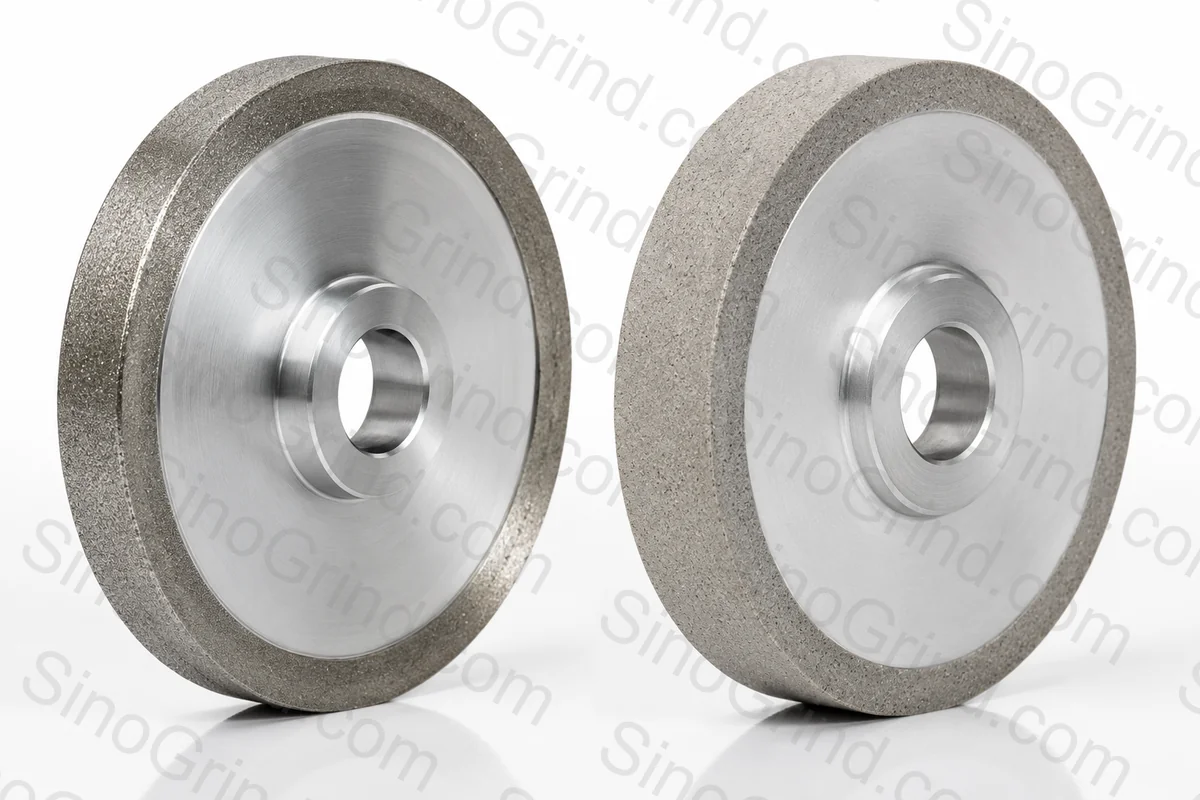
Detailed comparison of metal bond and vitrified bond diamond wheels for different grinding applications.
Read More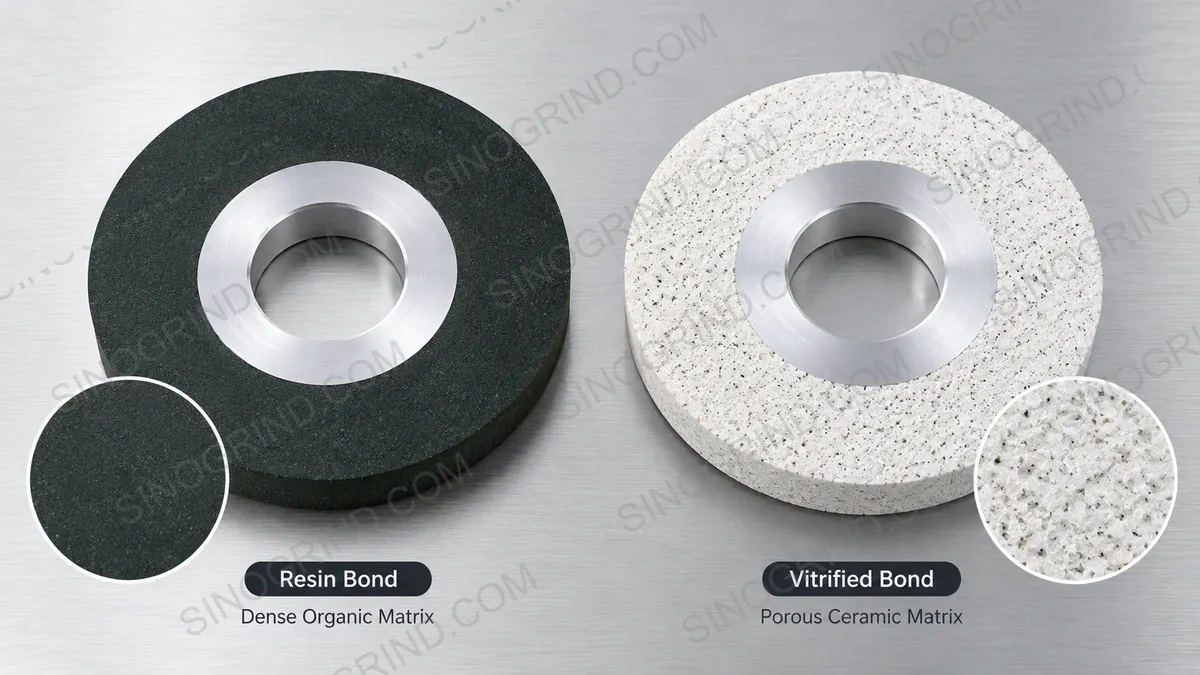
In-depth comparison of resin and vitrified bond grinding wheels for precision applications.
Read MoreOver 20 years of grinding expertise. Diamond, CBN, and conventional abrasive solutions for precision manufacturing worldwide.