: +86 15874211461

.webp)
.webp)
How to Choose Grinding Wheel
Step-by-step guide to grinding wheel selection.
Read MoreEnter your grinding parameters below to receive a preliminary recommendation for abrasive type, bond, grit size, concentration, and wheel specification direction.
Choosing the right bond is one of the most important decisions when selecting a diamond or CBN grinding wheel. The bond matrix holds abrasive grains in place and controls how the wheel wears, dresses, and cuts. Metal bond wheels provide the longest life and highest stock removal, making them ideal for rough grinding of carbide and ceramics. Vitrified bond wheels offer porosity and self-sharpening behavior, delivering finer surface finishes with excellent coolant flow for precision finishing. Resin bond wheels balance versatility with good damping, suited for general-purpose grinding and tool sharpening. Use the tool below to input your workpiece material, operation, and grinding conditions to receive a bond and abrasive recommendation tailored to your application.
| Criterion | Score | Bar |
|---|
Choosing the right grinding wheel involves matching abrasive type, grit size, concentration, bond, and operating parameters to your specific application. Below are the key selection factors.
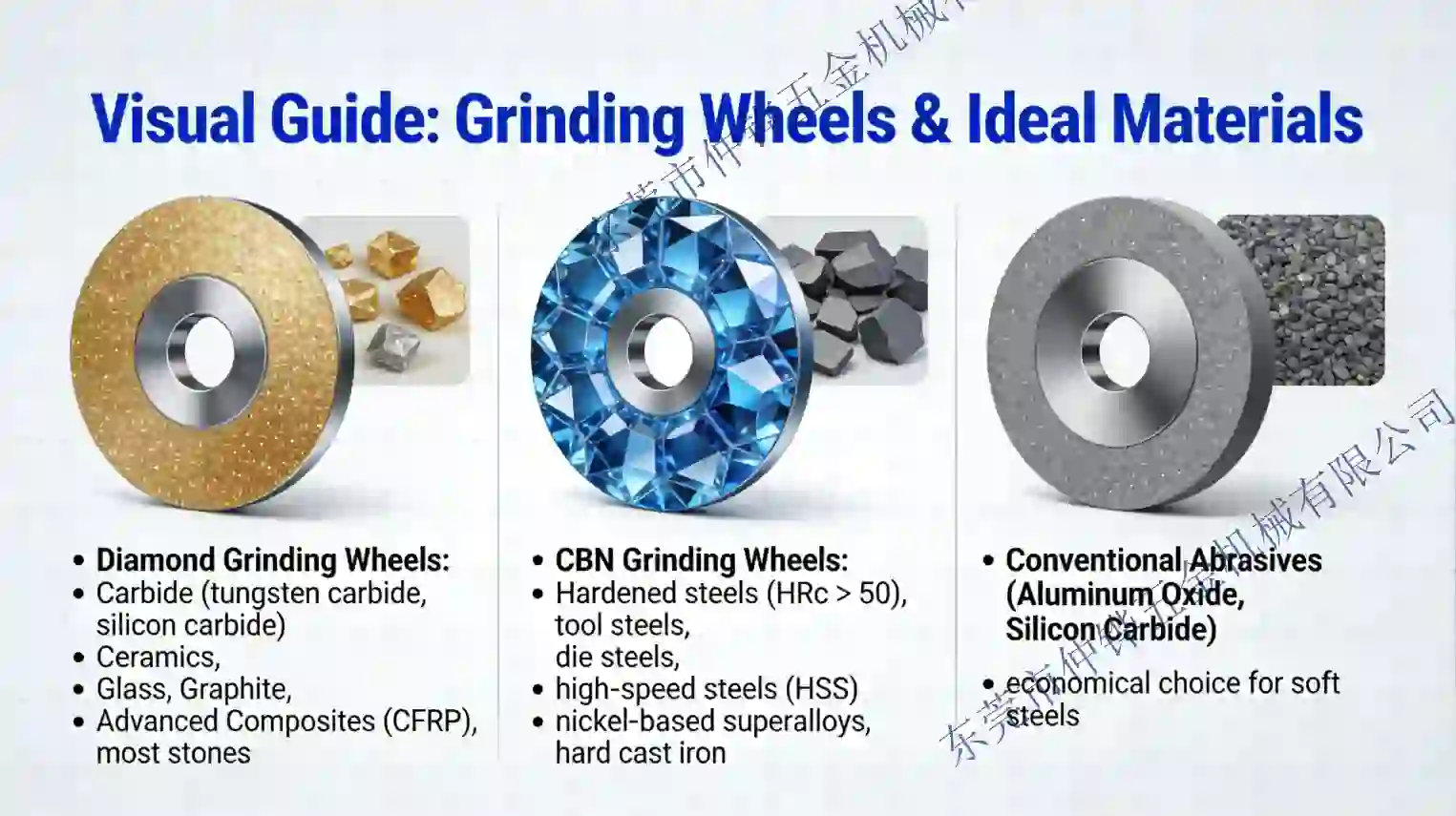
Use diamond for non-ferrous hard materials (carbide, ceramics, glass, PCD, graphite, ferrite). Use CBN for ferrous hard materials (hardened steel, bearing steel, tool steel, cast iron). Diamond reacts chemically with iron at grinding temperatures, making it unsuitable for ferrous metals. CBN is thermally stable and chemically inert with ferrous workpieces up to approximately 1,300°C.
Grit size determines the balance between material removal rate and surface finish quality.
Concentration indicates the volume percentage of abrasive in the grinding layer. Standard notation uses C-number coding where C100 = 25% abrasive volume by convention.
The bond holds abrasive grains together and controls wheel wear, dressing behavior, and cutting action.
Wheel grade indicates how strongly the bond holds abrasive grains. Softer grades release grains faster (self-dressing) while harder grades retain them longer. Use harder bonds for difficult-to-grind materials and lighter cuts. Use softer bonds for easy-to-grind materials and heavy cuts to prevent loading.
Superabrasive wheels typically run at 20–35 m/s for resin bond and up to ~60 m/s for vitrified bond (high-speed vitrified CBN systems can exceed this). Higher speeds improve surface finish but increase heat generation. Always verify your machine's maximum rated speed before selecting a wheel. Dry grinding typically requires lower speeds than wet grinding.
Coolant selection directly affects grinding performance and wheel life. Flood coolant is preferred for most superabrasive applications as it removes heat and chips effectively. Minimum Quantity Lubrication (MQL) is acceptable for some CBN applications on hardened steel. Dry grinding is generally not recommended for superabrasives except in specific tool-grinding applications with resin bond wheels and proper dust extraction.
Superabrasive wheels require different conditioning than conventional wheels. Resin bond wheels can be dressed with aluminum oxide dressing sticks or free-cutting silicon carbide. Metal bond wheels require diamond dressers or electro-discharge conditioning. Vitrified bond wheels can be dressed with conventional diamond dressers. Electroplated wheels do not require dressing but will lose their abrasive layer over time.
This tool provides preliminary selection guidance only. All recommendations should be validated through actual grinding trials under your specific machine conditions, workpiece geometry, and production requirements. Consult with SINOGRIND engineering team for application-specific support.
These tools provide preliminary guidance based on general engineering principles. Every grinding application has unique variables — wheel specification, machine condition, coolant strategy, and process targets. With over 20 years of experience manufacturing diamond and CBN superabrasive wheels, the SinoGrind engineering team can review your application and recommend a wheel tailored to your exact requirements.
Free consultation • Custom wheel specifications • Global shipping
Diamond is the first choice for grinding cemented carbide (tungsten carbide). Diamond is harder than CBN and provides better wear resistance and surface finish on non-ferrous hard materials. CBN is preferred for ferrous materials like hardened steel and cast iron.
For true mirror finishing (Ra < 0.1 µm), use ultra-fine diamond grits in the D10–D25 range with a resin bond, followed by fine dressing stages; ultra-fine grits beyond D25 can be added for optical-grade surfaces. As a starting point for precision work, D46–D64 typically achieves Ra 0.1–0.3 µm — combine with flood coolant to prevent thermal damage.
For grinding hardened ferrous materials (58 HRC and above), vitrified bond CBN wheels are often the best choice. Vitrified bond provides strong form retention and good chip clearance. For profile grinding of hard non-ferrous materials such as carbide or ceramics, electroplated diamond is preferred.
Flood coolant is recommended for most diamond and CBN grinding operations. It extends wheel life, improves surface finish, and prevents thermal damage. Dry grinding is generally not recommended for resin bond wheels.
For cast iron, use a CBN wheel with a vitrified or resin bond at grit sizes between B107 and B151 depending on the finish target. Gray cast iron's graphite inclusions make it ideal for CBN — the ferrite matrix grinds cleanly without the chemical wear diamond suffers on ferrous materials.
Glass and technical ceramics require diamond — never CBN. For sintered ceramics use a metal or resin bond diamond wheel at D64–D126; for glass optical work use fine resin-bond diamond at D9–D25 with flood coolant to prevent edge chipping.
Step-by-step guide to grinding wheel selection.
Read More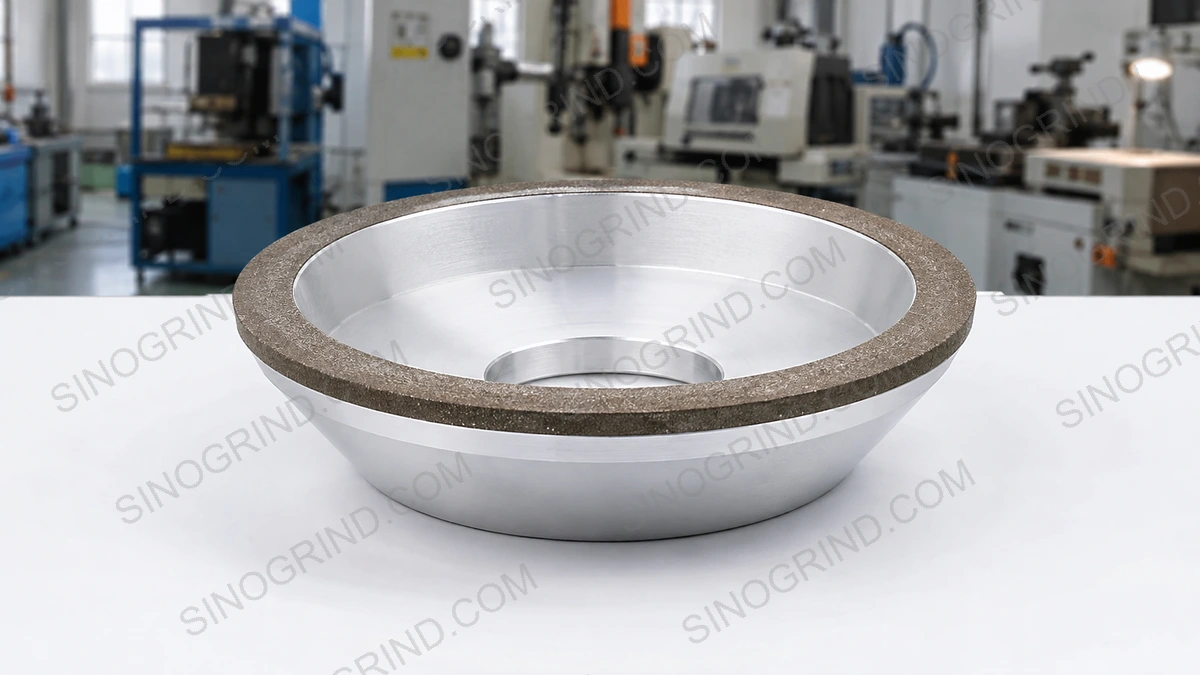
Complete guide to vitrified bond technology, porous structure, and precision grinding applications.
Read More
How to select the right grinding wheel for stainless steel and difficult-to-grind alloys.
Read MoreOver 20 years of grinding expertise. Diamond, CBN, and conventional abrasive solutions for precision manufacturing worldwide.