: +86 15874211461

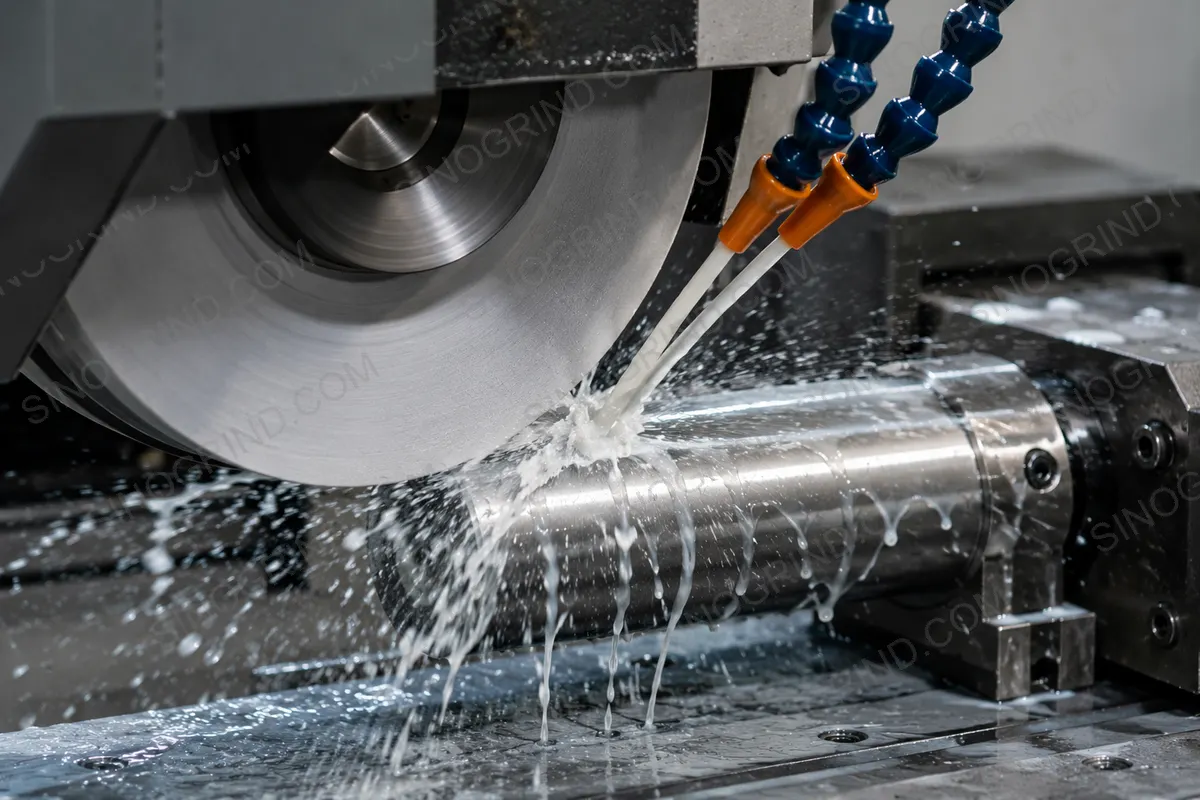
Quick answer: Coolant removes heat, flushes chips and lubricates the contact zone. For diamond grinding use flood water-based coolant at 4–8% concentration for general work, or neat grinding oil where the best finish and life are needed. Never grind diamond dry except for very light tool-room work.
Related reading: Diamond Grinding Wheel Troubleshooting · How to Dress a Diamond Grinding Wheel · Resin Bond Diamond Grinding Wheel.
Why coolant matters
Coolant does three jobs: it removes heat to protect the wheel and workpiece, flushes chips so they are not re-ground, and lubricates to reduce friction and improve finish. Poor coolant is one of the most common causes of diamond wheel problems — burn, loading and poor finish all often trace back to it.
Coolant types
| Type | Use | Pros | Cons |
|---|---|---|---|
| Water-based emulsion | General diamond grinding | Cooling, low cost, easy handling | Less lubrication than oil |
| Synthetic / semi-synthetic | General, cleaner | Long sump life, good cooling | Varies in lubrication |
| Neat grinding oil | Best finish and wheel life | Excellent lubrication and finish | Fire risk, waste handling, cost |
| Water + additives (glass/stone) | Glass, stone, ceramics | Excellent cooling and flushing | Corrosion control needed |
| Mist / MQL | Light tool-room work | Low volume, clean | Limited cooling; not for heavy work |
Match coolant to material and finish target; neat oil where finish and life matter most.
Choosing coolant by application
| Application | Recommended coolant | Concentration / note |
|---|---|---|
| Carbide tool grinding | Neat oil or 5-8% emulsion | Oil for best edge quality |
| Ceramics / glass | Water-based, high flow | Flush chips; avoid corrosion |
| PCD / PCBN | Neat oil preferred | Flush the small hot chips |
| Steel (CBN) | 5-8% emulsion | Use CBN, not diamond |
| Silicon / wafer | DI water, filtered | Ultra-clean, temperature control |
| Stone / quartz | Water, high flow | Remove swarf; stone always wet |
Flow rate and nozzle position often matter more than the coolant chemistry.
Flow and filtration
Aim for generous, well-directed flow at the contact zone (>10 l/min on many machines) and keep filtration clean. Fine, filtered coolant prevents scratches and loading; contaminated coolant causes most finish problems.
Practical rules
- Aim the nozzle directly at the contact zone, not at the wheel top.
- Use enough flow — more than most operators expect.
- Keep concentration in range and check it regularly (refractometer).
- Filter out fine swarf; it scratches the surface and loads the wheel.
- Control temperature in precision work — warm coolant moves the size.
- Handle neat oil safely: fire control, mist extraction and correct disposal.
Sub-table 2 — by grinding process
| Process | Typical bond | Grit (FEPA D) | Concentration | Common shapes | Notes |
|---|---|---|---|---|---|
| Tool & cutter grinding (flute, gash) | Resin / Metal | D91–D181 | 100–150% | 11V9, 12V9, 1A1 | Cool cutting protects carbide edges |
| Surface / flat grinding | Resin / Vitrified | D64–D151 | 75–125% | 1A1, 6A2 | Balance finish vs. removal |
| OD cylindrical | Metal / Vitrified | D91–D181 | 100–150% | 1A1, 1F1 | Even coolant coverage |
| ID / internal | Resin / Metal | D46–D126 | 75–125% | Cup, mounted points | Small wheels, high speed |
| Form / profile / creep-feed | Metal / Vitrified | D64–D151 | 100–150% | 6A2, 11V9, 12V9 | Profile retention is critical |
| Centerless | Metal / Resin | D91–D181 | 100–150% | 1A1, 6A2 | High volume, tight roundness |
| Back-grinding / wafer thinning | Electroplated / Resin | D126–D400+ | 100–200% | Cup, 1A1 | Ultra-fine finish, low damage |
| Glass edge / bevel / CNC | Metal / Resin | D64–D126 | 75–125% | 1A1, 1F1, 12A2 | Prevent edge chipping |
| Cut-off / slot / groove | Electroplated / Metal | D181–D400 | — | 1A1R, saw | Thin wheels, rigid setup |
| Dressing & truing (of other wheels) | — | D46–D181 | — | Pen, roller, block | Diamond tools, not diamond wheels |
Delivery matters more than chemistry
A premium coolant aimed at the wrong place performs worse than a basic coolant aimed at the contact arc. The fluid has to reach the point where the grain is cutting, displace the air film around the wheel and carry the heat away before the part leaves the zone.
That means a nozzle close to the contact, a coherent stream rather than a spray, and enough pressure to penetrate the boundary layer. On high-speed wheels, a coolant shoe or through-spindle delivery is often the difference between burning and not burning.
Setting up coolant delivery
- Position the nozzle. Aim at the contact arc, 20–50 mm away, angled slightly into the wheel rotation.
- Check the stream. It should be coherent and cover the full wheel width, not fan out before it arrives.
- Set the flow. Enough to flood the zone, not so much that it splashes away from the cut.
- Filter. 20 µm or finer for fine grinding; swarf scratches the part and the wheel.
- Control concentration. Check with a refractometer and top up with the correct mix, not neat water.
- Maintain. Skim tramp oil, clean the tank, and replace coolant on schedule.
Coolant problems and fixes
| Symptom | Likely cause | Fix |
|---|---|---|
| Burn despite flood | Stream not reaching the contact, or air film | Reposition the nozzle, raise pressure, use a shoe |
| Rust on the machine or part | Concentration too low or wrong product | Raise concentration, check the water quality |
| Foam and overflow | Soft water, contamination or too much detergent | Use an antifoam, check the mix, clean the tank |
| Smell and skin irritation | Bacterial growth, tramp oil | Skim oil, dose biocide, replace the charge |
| Scratches from the coolant | Swarf in the tank or filter bypass | Clean the tank, replace the filter, flush the lines |
Most coolant faults are maintenance faults, not product faults.
Coolant checklist
- Type: water-based, neat oil or synthetic, matched to the operation.
- Concentration: measured and logged weekly.
- Pressure and flow: enough to reach the contact arc at working speed.
- Filtration: sized for the finest grit in use.
- Compatibility: with the machine paint, seals and any downstream cleaning.
- Disposal: a documented route, because coolant is a controlled waste.
Browse the matching Grinding Accessories range for this application.
Boundary rule — when not to use diamond
Diamond is the hardest abrasive and the correct choice for hard, brittle, non-ferrous materials such as cemented carbide, ceramics, glass, silicon, sapphire, ferrite, graphite and composites. It must not be used on ferrous metals — steel, cast iron, and their alloys — because carbon in diamond reacts with iron at grinding temperatures (roughly above 700 °C / 1300 °F). This chemical affinity causes rapid, abnormal diamond wear (graphitisation) and destroys the wheel. For steel, hardened steel, cast iron and other ferrous workpieces, use CBN (cubic boron nitride) instead.