: +86 15874211461

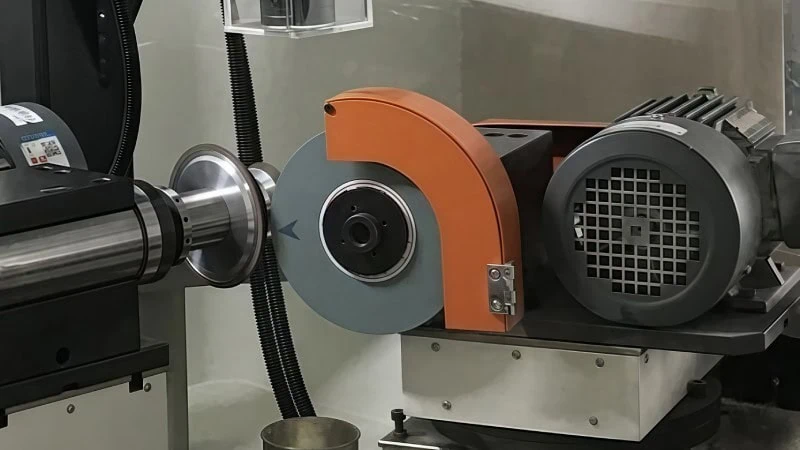
Quick answer: To dress a diamond grinding wheel: true it with a diamond tool to restore concentricity and profile, then open the bond by feeding a soft abrasive stick across the face at reduced speed to expose fresh diamond. Electroplated wheels are not dressable.
Related reading: Diamond Grinding Wheel Troubleshooting · Resin Bond Diamond Grinding Wheel · Metal Bond Diamond Grinding Wheel.
Why diamond wheels need dressing
Diamond wheels do not stay sharp by themselves. As the bond wears, the protruding diamond can become blunt (glazing) or the wheel can lose concentricity and profile (run-out). Dressing restores both. There are two distinct operations, often confused:
- Truing — restores geometry: roundness, concentricity and profile.
- Dressing — restores sharpness: removes glazed bond and exposes fresh diamond.
Method by bond type
| Bond | Dressable? | Method |
|---|---|---|
| Resin | Yes | Alumina stick or diamond tool; frequent, light |
| Vitrified | Yes | Diamond dressing tool, on-machine; re-profileable |
| Metal | Yes (hard) | Diamond roller/block; or ELID for conductive bonds |
| Electroplated | No | Single layer - replace when worn |
Never dress a diamond wheel with a hard tool at full speed; follow the maker's procedure.
Step-by-step dressing procedure
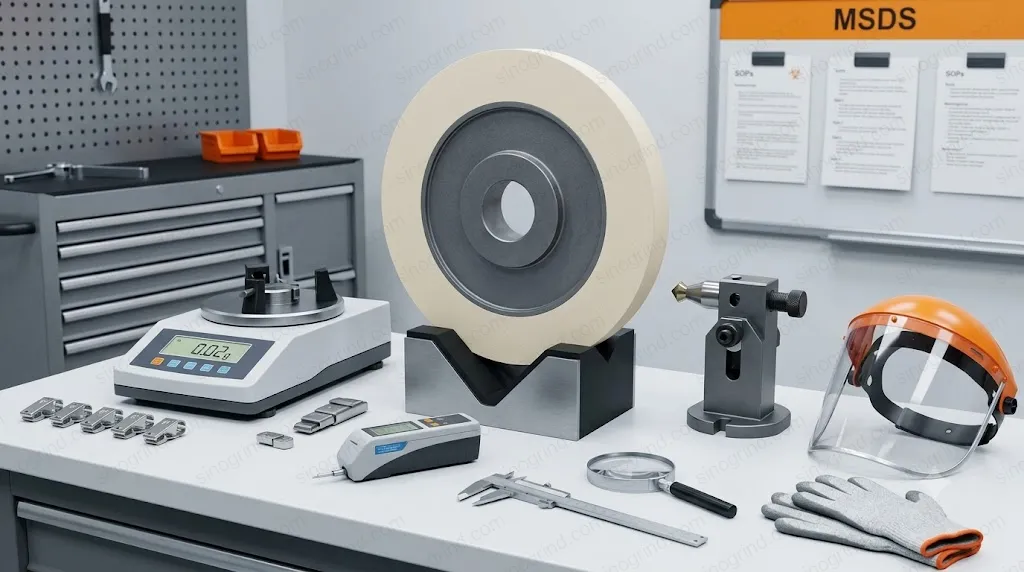
- Prepare Mount and balance the wheel; check the guard, coolant and spindle. Reduce speed and infeed for dressing.
- True the wheel Feed a sharp diamond dressing tool slowly across the face to restore roundness, concentricity and profile. Take light, repeated passes.
- Open the bond Feed a soft alumina abrasive stick (or the maker's recommended dresser) across the face at reduced speed to remove glazed bond and expose fresh diamond.
- Flush and inspect Run coolant to wash away dressing debris; inspect the face and check for a uniform, open, matte finish.
- Verify on the job Grind a test part and measure finish and size. If the finish still drifts, reduce dressing depth and check coolant concentration.
- Record Note the dressing intervals and depths that work for your process and repeat them.
Dressing frequency
Dress when the finish degrades, the sound changes, or the wheel stops cutting freely. Dressing 'little and often' beats heavy, infrequent dressing.
Common dressing mistakes
- Using too hard a dresser — it cannot open the bond.
- Dressing too deep — wastes wheel life and can damage the profile.
- Dressing without coolant — overheating and dust.
- Never dressing — glazing leads to burn and poor finish.
- Trying to dress an electroplated wheel — it cannot be done.
Sub-table 2 — by grinding process
| Process | Typical bond | Grit (FEPA D) | Concentration | Common shapes | Notes |
|---|---|---|---|---|---|
| Tool & cutter grinding (flute, gash) | Resin / Metal | D91–D181 | 100–150% | 11V9, 12V9, 1A1 | Cool cutting protects carbide edges |
| Surface / flat grinding | Resin / Vitrified | D64–D151 | 75–125% | 1A1, 6A2 | Balance finish vs. removal |
| OD cylindrical | Metal / Vitrified | D91–D181 | 100–150% | 1A1, 1F1 | Even coolant coverage |
| ID / internal | Resin / Metal | D46–D126 | 75–125% | Cup, mounted points | Small wheels, high speed |
| Form / profile / creep-feed | Metal / Vitrified | D64–D151 | 100–150% | 6A2, 11V9, 12V9 | Profile retention is critical |
| Centerless | Metal / Resin | D91–D181 | 100–150% | 1A1, 6A2 | High volume, tight roundness |
| Back-grinding / wafer thinning | Electroplated / Resin | D126–D400+ | 100–200% | Cup, 1A1 | Ultra-fine finish, low damage |
| Glass edge / bevel / CNC | Metal / Resin | D64–D126 | 75–125% | 1A1, 1F1, 12A2 | Prevent edge chipping |
| Cut-off / slot / groove | Electroplated / Metal | D181–D400 | — | 1A1R, saw | Thin wheels, rigid setup |
| Dressing & truing (of other wheels) | — | D46–D181 | — | Pen, roller, block | Diamond tools, not diamond wheels |
How often should a diamond wheel be dressed?
There is no fixed interval. Dress when the signal appears, not when the calendar says so. The reliable signals are a rise in spindle load at the same parameters, a finish that drifts in one direction, a size that stops holding, or visible glazing on the wheel face.
On production work, dressing is usually scheduled between batches so it never interrupts a run. On tool grinding it is often done at the start of each shift, because a freshly dressed wheel gives the most predictable first part.
| Operation | Typical dressing trigger | Note |
|---|---|---|
| Carbide tool grinding | Start of shift or when finish drifts | Light dress, minimal stock removed |
| Production surface grinding | Between batches or on load rise | Record diameter after each dress |
| Form and profile grinding | When the profile gauge shows drift | True the form, then light-dress |
| Ceramic and glass | When chipping or loading appears | Dress earlier rather than deeper |
| Metal bond heavy stock | When the face loads or burn appears | Condition, do not over-dress |
Intervals are process-specific; the trigger matters more than the number.
Choosing the dressing tool
| Bond | Usual tool | Why |
|---|---|---|
| Resin | Diamond dresser to true, alumina stick to open | The stick removes resin without pulling diamond |
| Vitrified | Diamond roll or single-point dresser | Holds form and opens the porous bond |
| Metal (sintered) | Silicon-carbide stick or diamond roll | The bond is too strong for a soft stick |
| Electroplated | None | Dressing removes the single layer |
| Hybrid / special | Supplier-recommended method | Wrong tool can destroy the working layer |
Match the tool to the bond, not to the wheel diameter.
Dressing safely
- Keep the guard in place and wear eye protection; dressing produces fine abrasive dust.
- Use coolant during dressing unless the supplier specifies dry.
- Take light passes; a deep dress removes more wheel than the job requires.
- Re-check run-out after dressing, before returning to production.
- Record the diameter and the dress depth so wheel life can be tracked.
Browse the matching Diamond Dressing Tools range for this application.
Recovering a wheel that is already out of profile
- Measure the damage. Check run-out and the profile with a gauge before touching the wheel; a small flat may only need a light true.
- True, do not dress. Restore geometry with a sharp diamond tool at reduced speed, 0.005–0.01 mm per pass.
- Confirm the form. Verify the angle or radius against the drawing before resuming.
- Open the face. Light-dress to expose fresh diamond; a trued wheel that is not opened will burn the first part.
- Re-set the offset. Update the size offset and record the new diameter.
- Fix the cause. A wheel rarely loses profile on its own; check coolant, load and dressing routine.
Boundary rule — when not to use diamond
Diamond is the hardest abrasive and the correct choice for hard, brittle, non-ferrous materials such as cemented carbide, ceramics, glass, silicon, sapphire, ferrite, graphite and composites. It must not be used on ferrous metals — steel, cast iron, and their alloys — because carbon in diamond reacts with iron at grinding temperatures (roughly above 700 °C / 1300 °F). This chemical affinity causes rapid, abnormal diamond wear (graphitisation) and destroys the wheel. For steel, hardened steel, cast iron and other ferrous workpieces, use CBN (cubic boron nitride) instead.