: +86 15874211461

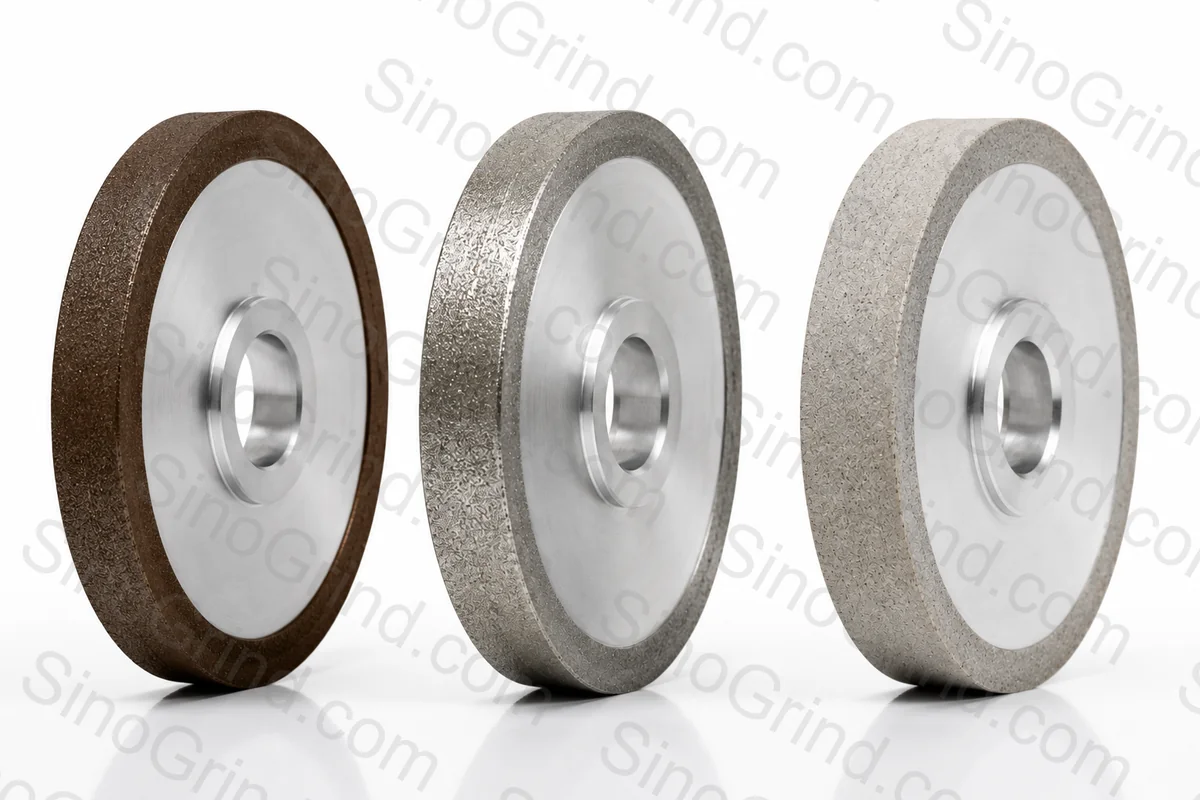
Quick answer: Choose diamond for hard, brittle, non-ferrous materials (carbide, ceramics, glass, silicon, ferrite, composites). Choose CBN for ferrous materials (steel, cast iron, hardened steel). The rule is chemical: carbon in diamond reacts with iron at grinding temperature, so diamond wears abnormally on steel.
Related reading: Diamond Wheel for Mold & Die Grinding · Diamond Wheel for Carbide Grinding · Diamond Grinding Wheel Glossary.
The single rule that decides it
The choice between diamond and CBN is almost always decided by whether the workpiece contains iron. Diamond is the hardest abrasive and wins on hard non-ferrous materials, but at grinding temperatures its carbon reacts with iron — so it fails on steel and cast iron. CBN is nearly as hard as diamond, is chemically stable against iron, and is the correct abrasive for ferrous work.
Boundary rule
Diamond for non-ferrous (carbide, ceramic, glass, silicon, ferrite, graphite, composites); CBN for ferrous (steel, cast iron, hardened steel). Never grind steel with diamond.
Side-by-side comparison
| Property | Diamond | CBN |
|---|---|---|
| Hardness | Hardest (~10 Mohs) | Very hard (~9.5 Mohs), second only to diamond |
| Best materials | Carbide, ceramics, glass, silicon, sapphire, ferrite, composites | Steel, cast iron, hardened steel, superalloys |
| With iron | Reacts; rapid abnormal wear | Chemically stable; correct choice |
| Thermal stability | Lower (graphitises at high temperature in air) | Higher; tolerates higher temperatures |
| Typical bond | Resin, metal, vitrified, electroplated | Resin, vitrified, metal, electroplated |
| Typical use | Tool grinding, wafer, optics, ceramics, stone | Cylindrical, internal, surface grinding of steel |
The material decides the abrasive; everything else is specification.
Where each abrasive is used
| Application | Diamond | CBN |
|---|---|---|
| Cemented carbide tools | Yes | No (use diamond) |
| Hardened steel / HSS tools | No | Yes |
| Ceramics & glass | Yes | Rarely |
| Silicon / sapphire wafers | Yes | No |
| Ferrite / magnetic cores | Yes | No |
| Cast iron | No | Yes |
| Superalloys (Ni/Co) | Sometimes | Yes |
| Composites / graphite | Yes | No |
| Stone / quartz | Yes | No |
Superalloys are a nuanced case; trial and consult the wheel maker.
Mixed-material parts
Many real parts mix materials — a steel shank with a carbide tip, or a mold with steel and carbide inserts. There is no single wheel for both: use CBN on the ferrous features and diamond on the non-ferrous features, or choose the abrasive for the feature that dominates the operation. See the mold & die guide for a worked example.
Sub-table 2 — by grinding process
| Process | Typical bond | Grit (FEPA D) | Concentration | Common shapes | Notes |
|---|---|---|---|---|---|
| Tool & cutter grinding (flute, gash) | Resin / Metal | D91–D181 | 100–150% | 11V9, 12V9, 1A1 | Cool cutting protects carbide edges |
| Surface / flat grinding | Resin / Vitrified | D64–D151 | 75–125% | 1A1, 6A2 | Balance finish vs. removal |
| OD cylindrical | Metal / Vitrified | D91–D181 | 100–150% | 1A1, 1F1 | Even coolant coverage |
| ID / internal | Resin / Metal | D46–D126 | 75–125% | Cup, mounted points | Small wheels, high speed |
| Form / profile / creep-feed | Metal / Vitrified | D64–D151 | 100–150% | 6A2, 11V9, 12V9 | Profile retention is critical |
| Centerless | Metal / Resin | D91–D181 | 100–150% | 1A1, 6A2 | High volume, tight roundness |
| Back-grinding / wafer thinning | Electroplated / Resin | D126–D400+ | 100–200% | Cup, 1A1 | Ultra-fine finish, low damage |
| Glass edge / bevel / CNC | Metal / Resin | D64–D126 | 75–125% | 1A1, 1F1, 12A2 | Prevent edge chipping |
| Cut-off / slot / groove | Electroplated / Metal | D181–D400 | — | 1A1R, saw | Thin wheels, rigid setup |
| Dressing & truing (of other wheels) | — | D46–D181 | — | Pen, roller, block | Diamond tools, not diamond wheels |
Decision sequence for a new job
- Identify the workpiece. Steel or cast iron → CBN. Carbide, ceramic, glass, stone, PCD, graphite, composites → diamond.
- Check for mixed materials. A steel body with a carbide insert needs two operations, not one wheel.
- Confirm the chemistry. Diamond reacts with iron at grinding temperature; CBN reacts with some carbide and ceramic systems. The workpiece, not the wheel price, decides.
- Match the bond to the load. Resin for finish and cool cutting, metal for form and life, vitrified for porosity and re-profiling.
- Set grit from the finish. Then confirm the removal rate is achievable in the cycle time.
- Verify with a trial. Grind a representative part and measure wear, finish and edge quality.
Common mistakes
| Mistake | What happens | Correct choice |
|---|---|---|
| Diamond on hardened steel | Rapid chemical wear, wheel stops cutting | CBN in the same bond family |
| CBN on carbide | Poor economics and indifferent finish | Diamond with a resin or metal bond |
| Diamond on a steel-backed composite | The steel section destroys the wheel | Separate operations, CBN for the steel |
| CBN on a nickel superalloy | Workable but often not optimal | Evaluate ceramic or CBN grades with the supplier |
| Same wheel for roughing and finishing | Compromise on both | Two specifications, or a two-step grit sequence |
The ferrous rule explains most of the failures in this table.
What should an RFQ include?
- Workpiece: material, hardness and whether it is homogeneous.
- Abrasive: diamond or CBN, with the reason stated.
- Bond and grit: matched to the operation and finish.
- Machine: speed range, power and coolant.
- Operation: roughing, finishing or both.
- Life target: parts per wheel or per dress.
Browse the matching Diamond & CBN Grinding Wheels range for this application.
One rule, no exceptions
Diamond must not grind steel or cast iron. Use CBN for every ferrous workpiece.
Switching an existing process from diamond to CBN
When a shop replaces a diamond wheel with CBN on hardened steel, the wheel is only half the change. CBN usually wants a slightly higher wheel speed, a sharper dress and a bond that matches the steel rather than the carbide it used to grind. Copying the old parameters onto the new wheel is the most common reason the switch appears to fail.
Run the first batch with the old cycle time, then reduce depth per pass and raise speed in small steps while watching burn and wheel wear. Record the load: CBN often draws more power at the same removal rate, and a machine that was comfortable on carbide may reach its limit.
Boundary rule — when not to use diamond
Diamond is the hardest abrasive and the correct choice for hard, brittle, non-ferrous materials such as cemented carbide, ceramics, glass, silicon, sapphire, ferrite, graphite and composites. It must not be used on ferrous metals — steel, cast iron, and their alloys — because carbon in diamond reacts with iron at grinding temperatures (roughly above 700 °C / 1300 °F). This chemical affinity causes rapid, abnormal diamond wear (graphitisation) and destroys the wheel. For steel, hardened steel, cast iron and other ferrous workpieces, use CBN (cubic boron nitride) instead.