: +86 15874211461

Quick answer: Molds and dies need both abrasives: use CBN for hard die steels (ferrous) and diamond for carbide or hard metal inserts and for fine finishing of non-ferrous features. The finishing grit is chosen for surface quality, at light force.
Related reading: Diamond vs CBN: Which Abrasive? · Diamond Wheel for Carbide Grinding · Resin Bond Diamond Grinding Wheel.
Two materials, two abrasives
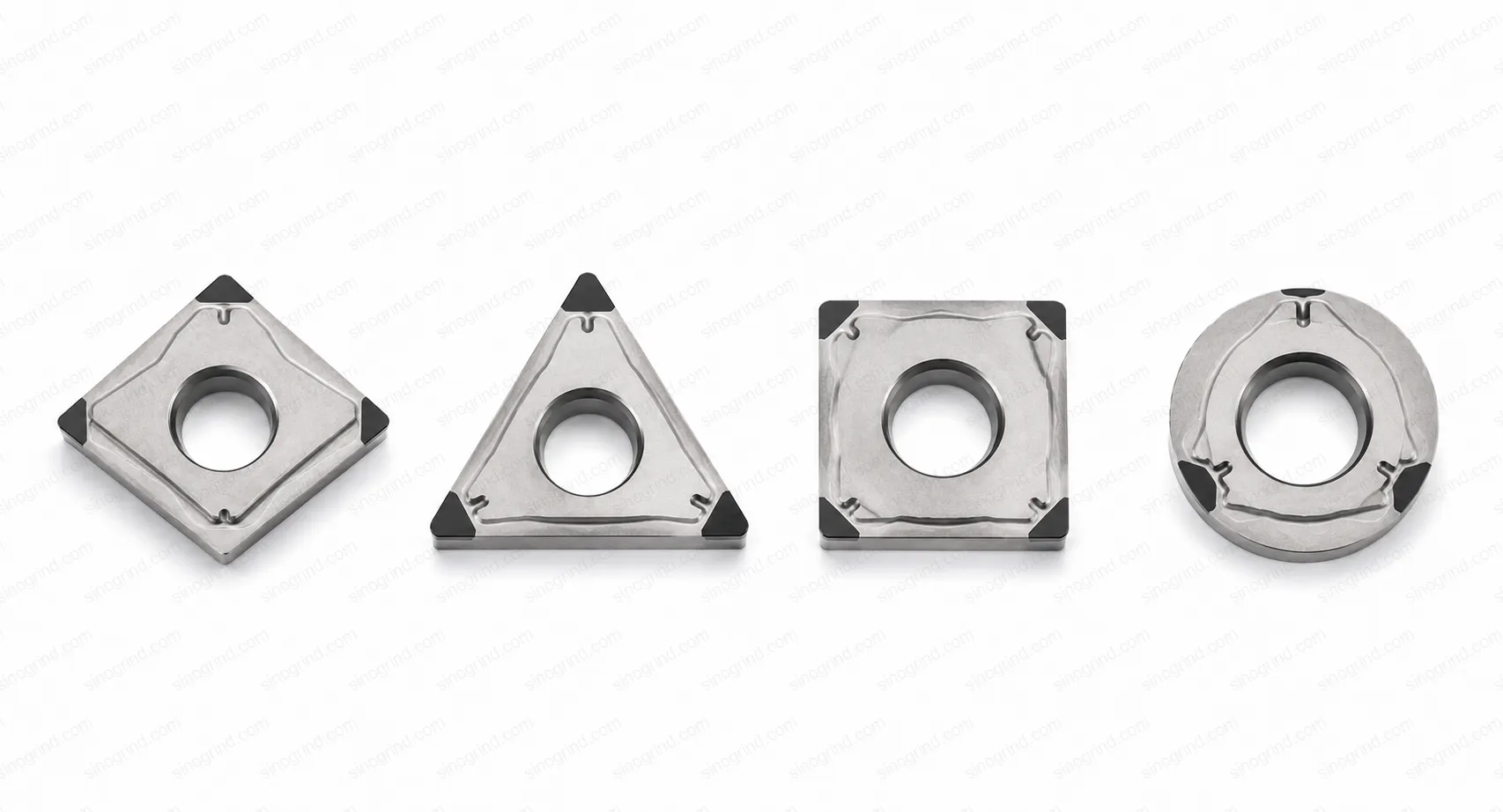
A mold or die usually mixes materials: a hardened die steel (ferrous) body and possibly carbide or hard inserts. The abrasive rule applies: CBN for the steel and diamond for carbide, ceramic or other hard non-ferrous features. Using diamond on the die steel would cause rapid, abnormal wheel wear.
Choosing grit and bond
| Feature | Abrasive / bond | Grit | Note |
|---|---|---|---|
| Hardened die steel | CBN (resin/metal) | B91–B181 | Do not use diamond |
| Carbide inserts | Diamond (resin) | D64–D126 | Fine finish, cool cut |
| Fine detail / ribs | Diamond (resin/metal) | D30–D91 | Profile accuracy |
| Polish preparation | Diamond / vitrified | D15–D46 | Low-damage surface |
CBN grit follows a similar FEPA B scale; keep CBN for steel and diamond for the non-ferrous features.
Protecting the polish and profile
- Fine grit and light force for the finishing pass.
- Flood coolant or neat oil to control heat.
- Keep the wheel sharp to avoid burnishing the surface.
- Respect the abrasive boundary — CBN on steel, diamond elsewhere.
- Match grit to the polish spec; coarser grit leaves deeper scratches.
Where is it used?
- Injection and blow molds.
- Forging and stamping dies.
- Carbide and hard-metal inserts.
- Die-casting dies and cores.
Which specification should I choose?
| Parameter | Typical value |
|---|---|
| Die steel (ferrous) | CBN, NOT diamond |
| Carbide inserts | Diamond, D64–D126, resin |
| Fine detail | Diamond, D30–D91 |
| Polish prep | Diamond/vitrified, D15–D46 |
| Coolant | Flood / neat oil |
| Priority | Surface quality, profile accuracy |
Never use diamond on the ferrous die steel; switch to CBN there.
Matching the abrasive to the cavity
A mould or die shop usually grinds two very different things: hardened tool steel, which needs CBN, and carbide or PCD inserts, which need diamond. Using the wrong one is the most common and most expensive mistake in the shop, because diamond dissolves into hot steel and the wheel stops cutting within minutes.
Within each family the target is the same: hold the profile, avoid chatter and leave a surface that can be polished without distortion. That means a rigid setup, a wheel that stays open and a finishing allowance that is actually removed.
How do I set up the job?
- Identify the workpiece. Hardened steel → CBN. Carbide, PCD, ceramic → diamond. Never use diamond on the steel.
- Check hardness and stock. Know the hardness and the heat-treatment state; a die that is still soft will load a hard wheel.
- Mount rigidly. Deep cavities amplify any run-out; indicate the wheel and support the part close to the cut.
- Grind with light passes. Small depth per pass with a steady feed avoids chatter on thin walls and ribs.
- Leave polishing stock. 0.03–0.08 mm is typical, removed with a finer wheel or by hand.
- Protect the surface. Cover the finished cavity; a dropped tool costs more than the wheel.
How do I fix common problems?
| Symptom | Most likely cause | What to change |
|---|---|---|
| Wheel stops cutting on steel | Diamond used on a ferrous workpiece | Switch to CBN immediately; dress the wheel |
| Chatter on a deep wall | Low rigidity or too much wheel contact | Support the part, reduce depth, use a smaller wheel |
| Burn marks on the die | Heat from a glazed wheel or dry pass | Dress, increase coolant, reduce speed |
| Profile drift | Bond wear or wheel not trued | Re-true, check the bond and concentration |
| Polishing reveals scratches | Too coarse a finishing wheel | Add a finer step before polishing |
The ferrous/non-ferrous rule decides the abrasive; everything else is tuning.
What should an RFQ include?
- Workpiece: steel grade and hardness, or carbide/PCD insert type.
- Feature: cavity, rib, edge or insert seat, with tolerance.
- Wheel: CBN or diamond, bond, grit and profile.
- Machine: spindle speed, rigidity and coolant.
- Finish: the polishing allowance and the final surface requirement.
- Volume: dies or inserts per month, and the current rework rate.
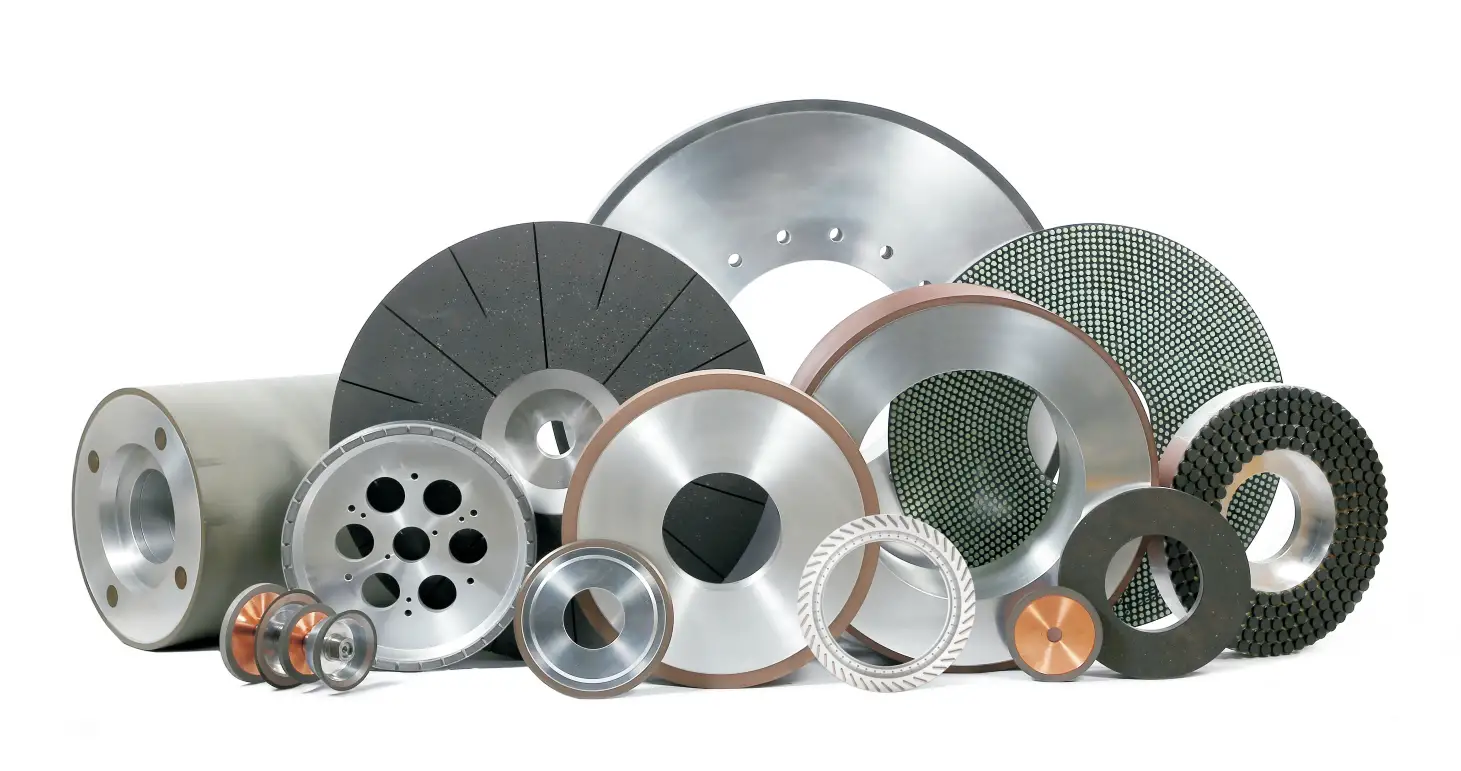
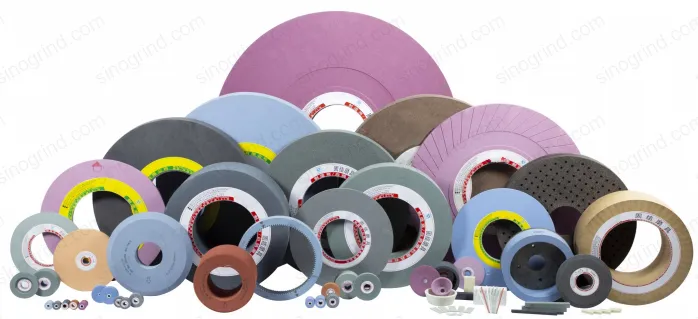
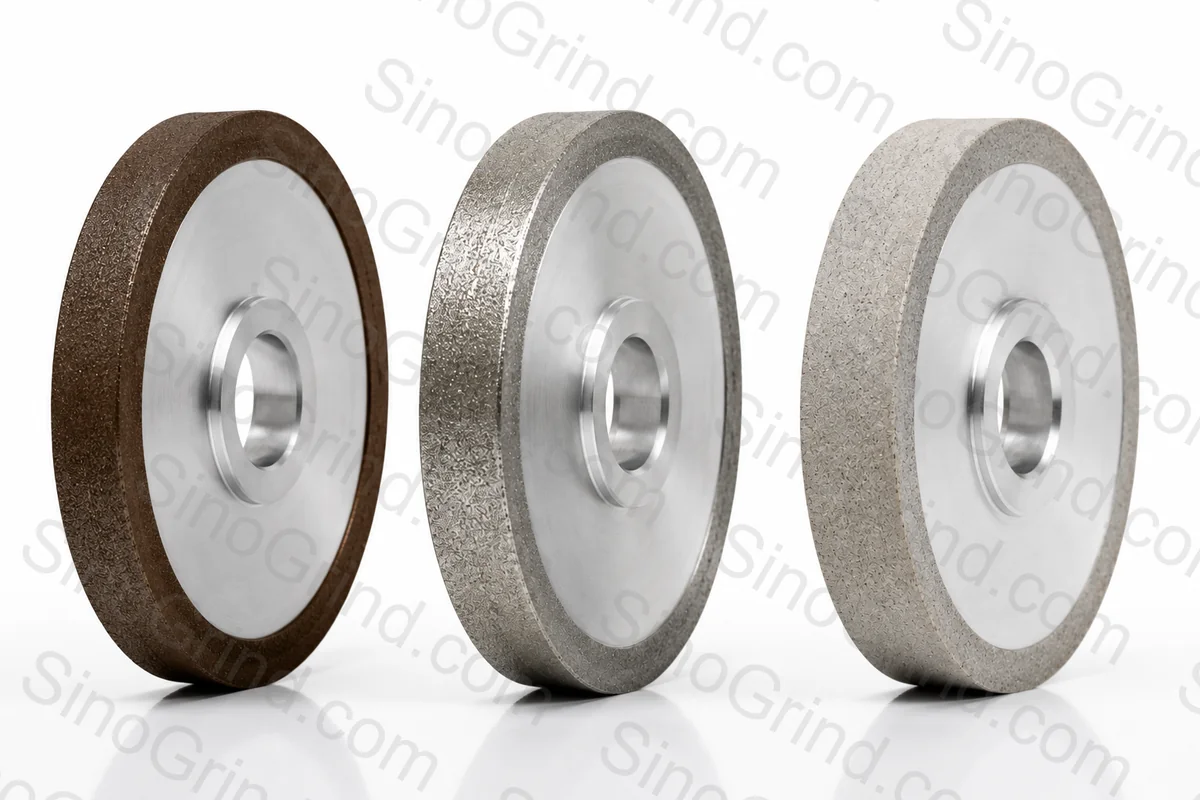
Browse the matching Diamond & CBN Grinding Wheels range for this application.
In die work the wheel is a small cost next to a scrapped cavity. Choose the abrasive by the workpiece, then spend the remaining effort on rigidity and coolant, which is where surface quality actually comes from.
Sub-table 1 — by material family
| Material | Typical operation | Recommended bond | Grit (FEPA D) | Concentration | Typical Ra |
|---|---|---|---|---|---|
| Cemented carbide (WC-Co) | Cutter & tool grinding | Resin / Metal | D91–D181 | 100–150% | 0.1–0.4 µm |
| PCD / PCBN | Edge prep, peripheral | Metal / Vitrified | D46–D91 | 125–150% | 0.05–0.2 µm |
| Advanced ceramics (Al₂O₃, ZrO₂, Si₃N₄) | Surface / form | Vitrified / Resin | D64–D151 | 75–125% | 0.2–0.6 µm |
| Optical / flat glass, quartz | Edge, bevel, CNC | Metal / Resin | D64–D126 | 75–125% | 0.05–0.3 µm |
| Semiconductor (Si, SiC, sapphire) | Back-grind, dicing | Electroplated / Resin | D126–D400+ | 100–200% | <0.02 µm (fine) |
| Ferrite / soft magnetic | Surface / form | Resin / Metal | D91–D181 | 100–150% | 0.2–0.8 µm |
| Graphite / carbon | Form / cut-off | Electroplated / Metal | D181–D301 | 75–125% | — |
| CFRP / composites | Cut, slot | Electroplated | D252–D400 | — | — |
| Thermal-spray coatings | Grind, polish | Resin / Metal | D126–D252 | 75–100% | 0.1–0.4 µm |
| Stone / engineered quartz | Edge, calibrate | Metal / Electroplated | D181–D400 | — | — |
| Zirconia (dental / medical) | Finish, polish | Resin / Vitrified | D46–D126 | 75–100% | 0.1–0.3 µm |
| Steel / cast iron (ferrous) | — | Not diamond — use CBN | — | — | — |
Representative values for planning; confirm final grit, concentration and bond with a grinding trial on your machine.
Boundary rule — when not to use diamond
Diamond is the hardest abrasive and the correct choice for hard, brittle, non-ferrous materials such as cemented carbide, ceramics, glass, silicon, sapphire, ferrite, graphite and composites. It must not be used on ferrous metals — steel, cast iron, and their alloys — because carbon in diamond reacts with iron at grinding temperatures (roughly above 700 °C / 1300 °F). This chemical affinity causes rapid, abnormal diamond wear (graphitisation) and destroys the wheel. For steel, hardened steel, cast iron and other ferrous workpieces, use CBN (cubic boron nitride) instead.