: +86 15874211461

Quick answer: This glossary defines the key terms used in diamond and CBN grinding — bond types, grit and concentration, wheel geometry, dressing terms and process measures — so specifications and technical discussions are unambiguous.
Related reading: Diamond Wheel Specification Code · Diamond Grit Size Selection · Diamond vs CBN: Which Abrasive?.
Wheel construction and materials
Diamond
The hardest abrasive, used for hard, brittle, non-ferrous materials such as carbide, ceramics, glass, silicon and composites. Not used on ferrous metals.
CBN (cubic boron nitride)
The second-hardest abrasive, chemically stable against iron, so it is used for ferrous materials such as steel and cast iron.
Bond
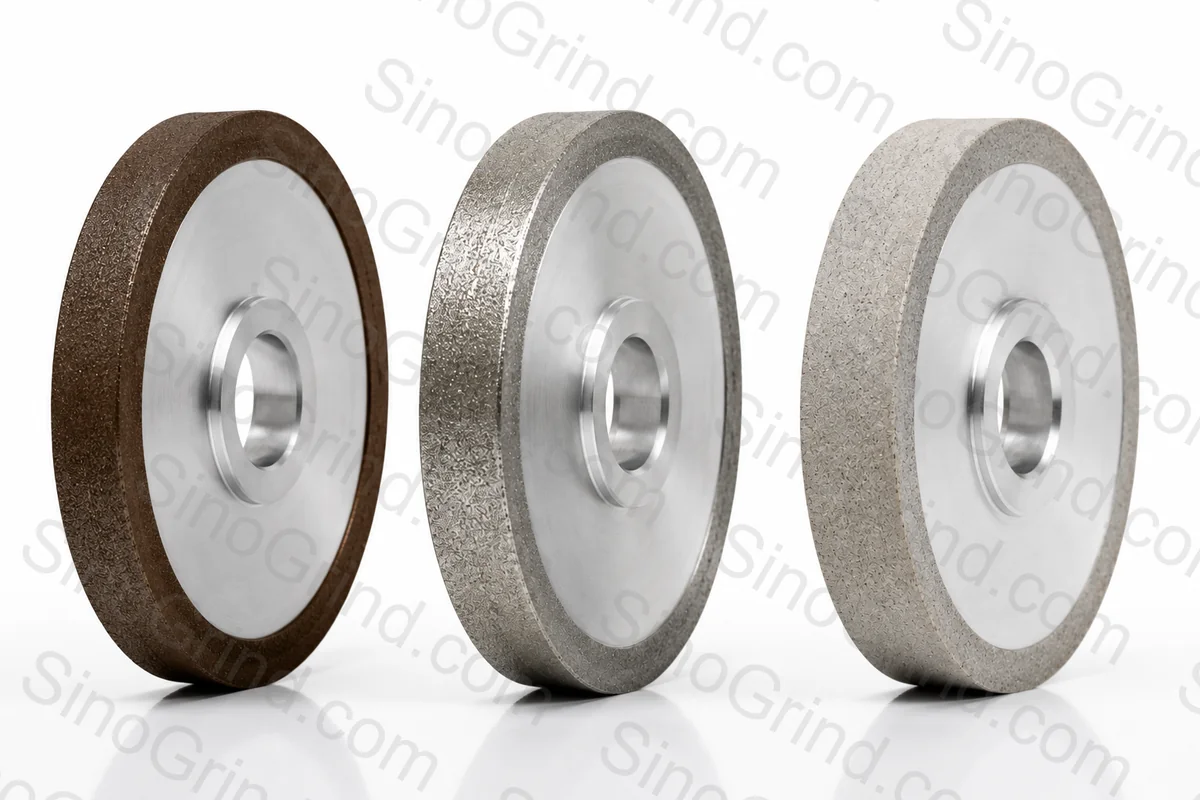
The material that holds abrasive grit in the wheel: resin, metal, vitrified or electroplated.
Resin bond
A phenolic resin bond that cuts cool and finishes finely; easy to dress and the tool-room default for carbide.
Metal bond
A sintered metal matrix that grips grit hard for long life and form retention; often dressed by diamond or ELID.
Vitrified bond
A fired glass/ceramic bond that is porous and rigid, giving cool free cutting and on-machine re-profiling.
Electroplated bond
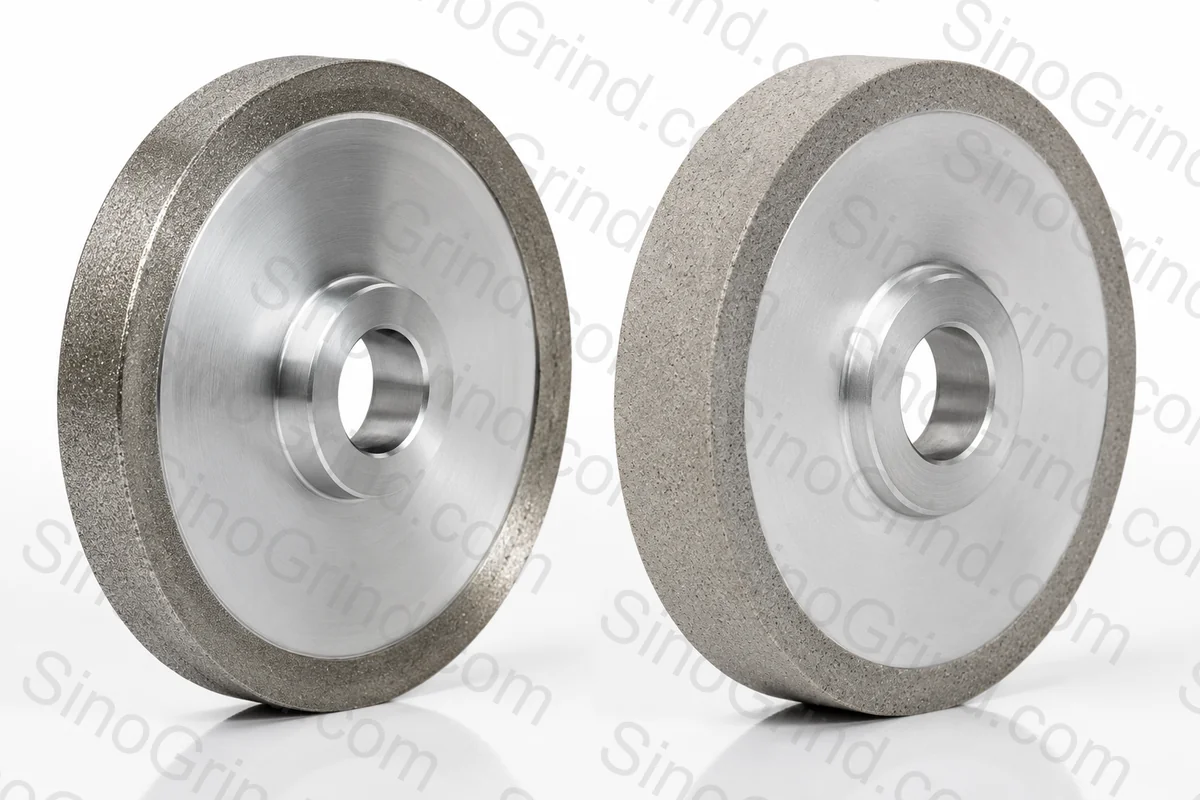
A single layer of diamond held by electro-deposited nickel; aggressive and not dressable.
Grit, concentration and performance
Grit size
The nominal diamond particle size, expressed on the FEPA D scale (micrometres). Larger number = coarser.
FEPA D
The grading standard for diamond grit sizes, expressed in micrometres (e.g. D91 is about 91 micrometres).
Concentration
The amount of diamond in the bond, where 100 = 4.4 carat per cubic centimetre of working layer.
G-ratio
The grinding ratio: volume of workpiece removed divided by volume of wheel worn. Higher is more efficient.
Dressing and wheel condition
Truing
Restoring a wheel's geometry - roundness, concentricity and profile - with a diamond dressing tool.
Dressing
Restoring a wheel's sharpness by removing glazed bond and exposing fresh abrasive.
Glazing
A blunt, shiny wheel face where bond has smeared over the diamond, so the wheel stops cutting freely.
Loading
Workpiece material welded into the wheel face, preventing the grit from cutting.
Self-sharpening
The controlled release of dull grit as the bond wears, keeping the wheel cutting - typical of resin bond.
Process parameters
Ra
Arithmetic mean surface roughness, in micrometres; a common measure of the finish produced by a wheel.
MRR (material removal rate)
The volume of workpiece removed per unit time; controlled by grit, concentration, speed and infeed.
Surface speed
The linear speed of the wheel's periphery, in m/s; a key process parameter.
Infeed / depth of cut
How deeply the wheel engages the workpiece per pass, usually in millimetres or micrometres.
Creep-feed grinding
Grinding with a very deep cut at very slow feed in a single pass; needs a strong, form-holding bond.
Form grinding
Grinding a profile or shape into the workpiece; demands good form retention from the bond.
Centerless grinding
Grinding the outside diameter of a part supported by a regulating wheel rather than centres.
ELID
Electrolytic in-process dressing: continuous on-machine dressing of a conductive metal bond wheel for fine, low-damage surfaces.
Wheels, tools and systems
Dressing tool
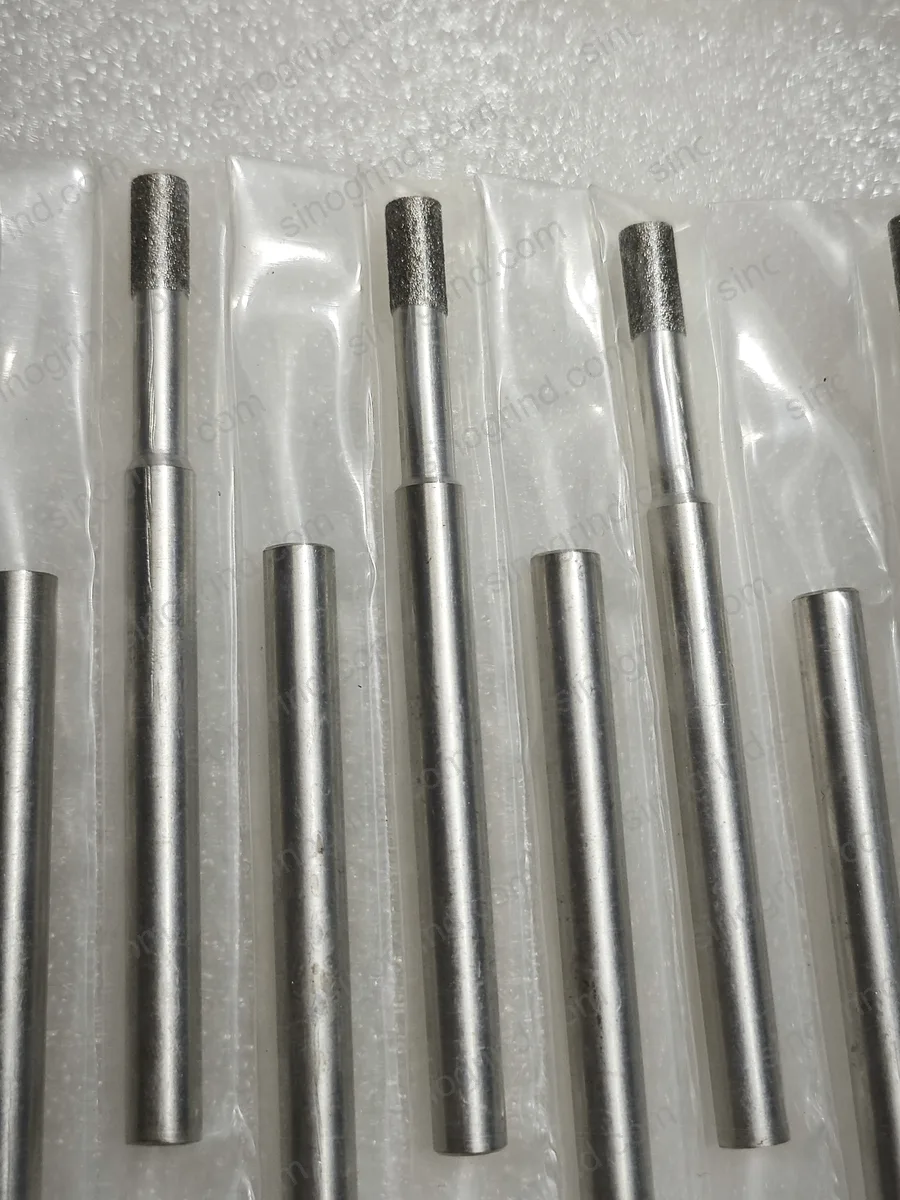
A diamond pen, block or roller used to true and dress a grinding wheel.
Wheel specification
The full marking of a wheel: abrasive, grit, concentration, bond, shape and dimensions.
Shape code
The profile code of a wheel such as 1A1, 11V9 or 6A2, which defines the feature it grinds.
Rim width (W)
The width of the abrasive section of the wheel, quoted in the dimensions D x T x H x W.
Run-out
The total indicated eccentricity of a mounted wheel; excessive run-out causes chatter and poor finish.
Coolant
The grinding fluid that removes heat, flushes chips and lubricates; water-based emulsion or neat oil.
Quick-reference scale: FEPA D grit
| Grit | Approx. size | Typical finish | Typical use |
|---|---|---|---|
| D181 | ~180 µm | 0.5–0.8 µm | Rough/semi-finish |
| D126 | ~125 µm | 0.3–0.5 µm | General grinding |
| D91 | ~90 µm | 0.2–0.4 µm | Carbide tool grinding |
| D64 | ~63 µm | 0.15–0.3 µm | Fine finishing |
| D46 | ~45 µm | 0.1–0.2 µm | Precision finish |
| D15 | ~15 µm | <0.05 µm | Polishing, lapping |
See the full grit size guide for the complete scale.
Use the glossary with the guides
Terms here link to practical guides: bond choice, grit size, concentration, shape codes and specification codes all have their own articles in this series.
Terms that are often confused
| Term pair | Difference | Why it matters |
|---|---|---|
| Diamond vs CBN | Two different abrasives; diamond for non-ferrous and non-metallic, CBN for steel | Choosing the wrong one destroys the wheel |
| Grit vs grade | Grit is grain size; grade is bond hardness | Changing the wrong one wastes a trial |
| Concentration vs density | Concentration is abrasive content; density is mass per volume of the bond | They are related but not interchangeable |
| Dressing vs truing | Dressing opens the face; truing restores geometry | A trued wheel still needs dressing to cut |
| Bond vs bond hardness | Bond is the material; hardness is how strongly it holds the grain | Two resin wheels can behave completely differently |
| Ra vs Rz | Two different roughness parameters | A specification written in the wrong one cannot be met |
These six pairs cause most of the confusion in wheel inquiries.
Reading a wheel marking
- Find the shape code. The letter-number prefix (1A1, 11V9, 6A2) describes the profile family.
- Read the dimensions. Diameter × thickness × bore, usually in millimetres.
- Read the abrasive. D for diamond, B for CBN, followed by the grit designation.
- Read the bond. Resin, metal, vitrified or electroplated, sometimes with a supplier letter.
- Check the speed. The maximum operating speed is a safety limit, not a target.
- Cross-check with the drawing. The marking summarises; the drawing specifies.
Browse the matching Diamond Dressing Tools range for this application.
How to use this glossary
Each term here links back to a guide that covers it in practice: bond pages for resin, metal and vitrified; material pages for carbide, ceramics, glass and the rest; and the selection pages for grit, concentration and specification codes. Read the term here, then follow the link to the process detail.
If a supplier uses a term differently, agree the definition in writing before ordering. Vocabulary differences between shops are a common source of rejected wheels that were actually made correctly.
Boundary rule — when not to use diamond
Diamond is the hardest abrasive and the correct choice for hard, brittle, non-ferrous materials such as cemented carbide, ceramics, glass, silicon, sapphire, ferrite, graphite and composites. It must not be used on ferrous metals — steel, cast iron, and their alloys — because carbon in diamond reacts with iron at grinding temperatures (roughly above 700 °C / 1300 °F). This chemical affinity causes rapid, abnormal diamond wear (graphitisation) and destroys the wheel. For steel, hardened steel, cast iron and other ferrous workpieces, use CBN (cubic boron nitride) instead.