: +86 15874211461

Quick answer: Grit size sets the trade-off between material removal rate and surface finish. In the FEPA D (diamond) scale, a larger number = coarser grit and a faster, rougher cut; a smaller number = finer grit and a smoother finish. Most diamond grinding starts between D91 and D151.
Related reading: Diamond Wheel Concentration Selection · Diamond Wheel Specification Code · Diamond Wheel for Carbide Grinding.
The FEPA D diamond grit scale
Diamond and CBN grits are graded on the FEPA D (or the equivalent ISO 6106 / US mesh) scale. The number is the nominal particle size in micrometres, so D91 is about 91 µm. FEPA F is used for conventional bonded abrasives and B for CBN in some systems; check the letter on the marking.
| FEPA D | Approx. size | Class | Removal | Finish (typical Ra) | Use |
|---|---|---|---|---|---|
| D426–D301 | 301–426 µm | Very coarse | Very high | >1.5 µm | Heavy stock removal, stone |
| D251 | ~250 µm | Coarse | High | 0.8–1.5 µm | Rough grinding, dicing |
| D181 | ~180 µm | Coarse | High | 0.5–0.8 µm | Rough/semi-finish |
| D151 | ~150 µm | Medium | Medium-high | 0.4–0.6 µm | General grinding |
| D126 | ~125 µm | Medium | Medium | 0.3–0.5 µm | Carbide tools |
| D91 | ~90 µm | Medium-fine | Medium | 0.2–0.4 µm | Tool grinding default |
| D64 | ~63 µm | Fine | Lower | 0.15–0.3 µm | Fine finish |
| D46 | ~45 µm | Fine | Low | 0.1–0.2 µm | Precision finish |
| D30 | ~30 µm | Very fine | Low | 0.05–0.15 µm | Fine edge prep |
| D15–D6 | 6–15 µm | Ultra-fine | Very low | <0.05 µm | Polishing, lapping |
Ra values are indicative; machine, bond, coolant and speed all shift the result.
How to choose grit size
- Start from the finish target. Finer grit for a better finish, coarser for faster removal.
- Balance removal and finish. Many jobs use a coarser grit to rough and a finer grit to finish.
- Consider the material. Hard, brittle materials (ceramics, glass) tolerate finer grit; harder materials may need higher concentration instead of coarser grit.
- Check the machine. Fine grit needs higher wheel speed and a rigid, vibration-free setup.
- Do not go coarser than needed — coarse scratches are hard to remove later.
Grit and concentration work together
Grit size controls the scratch depth; concentration controls how much diamond is present. Change grit to change finish, change concentration to change life and removal capacity. See the concentration guide.
Roughing and finishing sequences
| Stage | Grit (FEPA D) | Purpose |
|---|---|---|
| Rough | D151–D181 | Remove stock, establish geometry |
| Semi-finish | D91–D126 | Remove rough scratches, set size |
| Finish | D46–D64 | Achieve the surface specification |
| Polish / lap | D15–D30 | Final gloss, minimal damage |
A two- or three-step sequence usually beats one aggressive pass.
Sub-table 2 — by grinding process
| Process | Typical bond | Grit (FEPA D) | Concentration | Common shapes | Notes |
|---|---|---|---|---|---|
| Tool & cutter grinding (flute, gash) | Resin / Metal | D91–D181 | 100–150% | 11V9, 12V9, 1A1 | Cool cutting protects carbide edges |
| Surface / flat grinding | Resin / Vitrified | D64–D151 | 75–125% | 1A1, 6A2 | Balance finish vs. removal |
| OD cylindrical | Metal / Vitrified | D91–D181 | 100–150% | 1A1, 1F1 | Even coolant coverage |
| ID / internal | Resin / Metal | D46–D126 | 75–125% | Cup, mounted points | Small wheels, high speed |
| Form / profile / creep-feed | Metal / Vitrified | D64–D151 | 100–150% | 6A2, 11V9, 12V9 | Profile retention is critical |
| Centerless | Metal / Resin | D91–D181 | 100–150% | 1A1, 6A2 | High volume, tight roundness |
| Back-grinding / wafer thinning | Electroplated / Resin | D126–D400+ | 100–200% | Cup, 1A1 | Ultra-fine finish, low damage |
| Glass edge / bevel / CNC | Metal / Resin | D64–D126 | 75–125% | 1A1, 1F1, 12A2 | Prevent edge chipping |
| Cut-off / slot / groove | Electroplated / Metal | D181–D400 | — | 1A1R, saw | Thin wheels, rigid setup |
| Dressing & truing (of other wheels) | — | D46–D181 | — | Pen, roller, block | Diamond tools, not diamond wheels |
How grit changes the grind
Grit size sets two things at once: the depth each grain can take and the number of cutting points per square millimetre. Coarse grit removes stock quickly with fewer, deeper scratches; fine grit spreads the same force over many shallow cuts and leaves a better surface. The surface finish roughly follows the grit, but the relationship is not linear, because bond, concentration and spark-out matter just as much.
The practical consequence is that grit should be chosen from the finish requirement backwards, not from the removal rate forwards. Start with the finest grit that can still remove the stock in an acceptable time, then confirm it on a trial part.
Running a grit trial, step by step
- Fix everything except the grit. Same bond, concentration, speed, coolant and machine; otherwise the trial measures the wrong variable.
- Prepare three wheels. One grit coarser, the target grit and one finer, all trued and dressed the same way.
- Grind identical coupons. Same stock removal, same number of passes, same spark-out.
- Measure Ra and edge quality. Record both; a grit that finishes well but chips the edge is not the answer.
- Check cycle time. Compare total time including dressing, not just the grinding pass.
- Lock the choice. Write the grit into the process sheet together with the dressing routine.
Troubleshooting by grit
| Symptom | Grit signal | Action |
|---|---|---|
| Finish too rough, edges sound | Grit too coarse for the requirement | Move one or two steps finer (for example D126 → D91 → D64) |
| Finish good but cycle time too long | Grit too fine for the stock | Rough with a coarser grit, finish with the fine one |
| Edge chipping with a fine grit | Not grit - usually bond too hard or run-out | Check mount and dressing before changing grit |
| Wheel loads quickly | Fine grit in a hard bond, poor coolant | Open the bond, improve flow, consider one step coarser |
| Scratches deeper than the grit predicts | Stray coarse grain or contaminated coolant | Clean the machine and filter the coolant |
Change one variable at a time; grit trials fail when speed or coolant changes with the wheel.
What should an RFQ include?
- Grit: FEPA D value and, if relevant, the equivalent US mesh.
- Bond: the bond that will carry the grit, since grit and bond are chosen together.
- Concentration: the percentage that goes with the grit.
- Finish target: the Ra and edge condition the part must meet.
- Stock: how much material the grit must remove per pass.
- Dressing: how often the wheel will be dressed, because that limits how fine it can run.
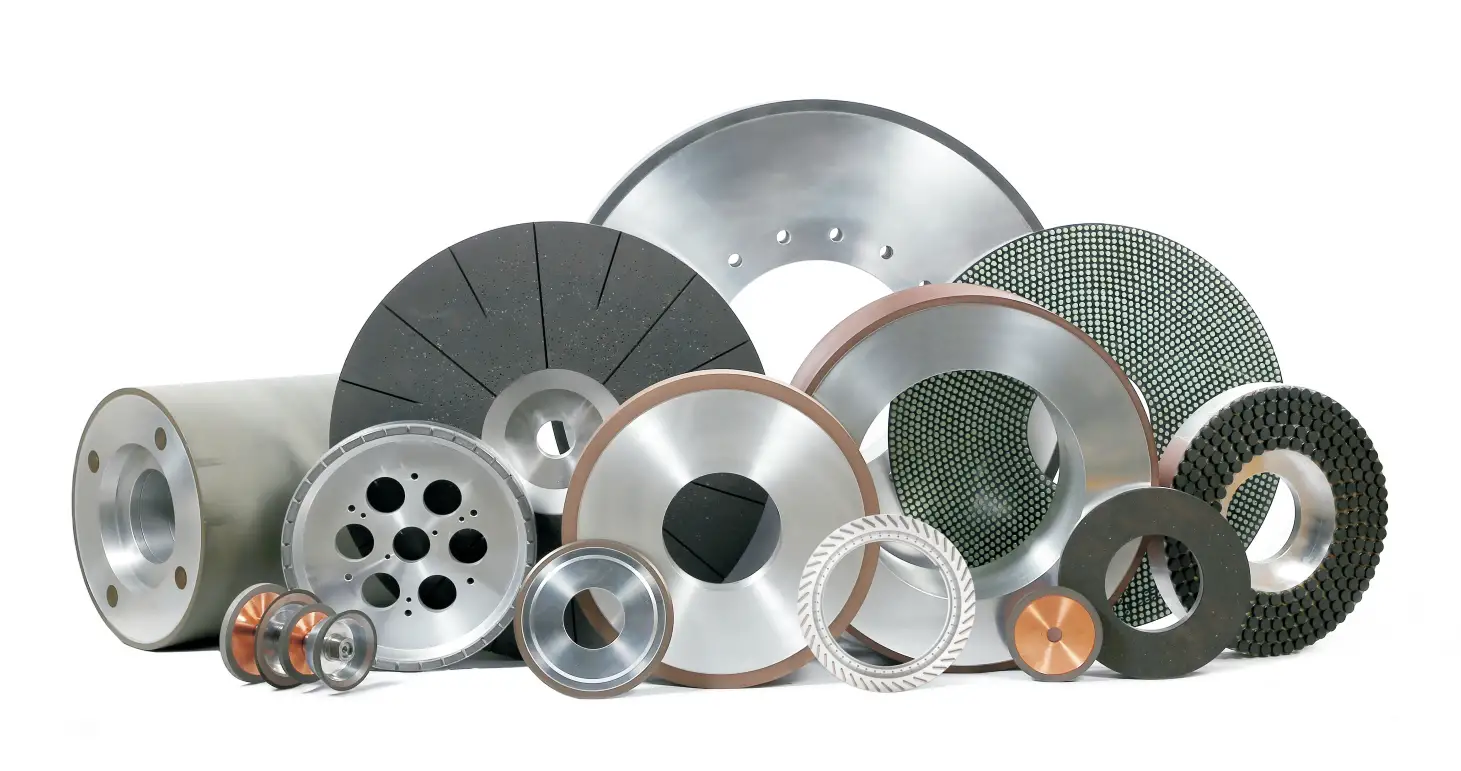
Browse the matching Diamond & CBN Grinding Wheels range for this application.
Boundary rule — when not to use diamond
Diamond is the hardest abrasive and the correct choice for hard, brittle, non-ferrous materials such as cemented carbide, ceramics, glass, silicon, sapphire, ferrite, graphite and composites. It must not be used on ferrous metals — steel, cast iron, and their alloys — because carbon in diamond reacts with iron at grinding temperatures (roughly above 700 °C / 1300 °F). This chemical affinity causes rapid, abnormal diamond wear (graphitisation) and destroys the wheel. For steel, hardened steel, cast iron and other ferrous workpieces, use CBN (cubic boron nitride) instead.