: +86 15874211461

Quick answer: A diamond wheel marking such as D91 C100 B reads as: D91 = diamond grit size (~91 µm), C100 = concentration 100, B = resinoid bond. Add a shape and dimensions — e.g. 1A1 150×10×31.75×5 D91 C100 B — for a complete, orderable specification.
Related reading: Diamond Grit Size Selection · Diamond Wheel Concentration Selection · Diamond Wheel Shapes Guide (1A1, 11V9, 6A2, 12V9).
The parts of a diamond wheel specification
| Element | Meaning | Example |
|---|---|---|
| Abrasive | Diamond (D) or CBN (B) | D |
| Grit | FEPA D size in micrometres | D91 |
| Concentration | Diamond content (100 = 4.4 ct/cm3) | C100 |
| Bond | Bond type letter | B = resinoid |
| Shape | Profile code | 1A1 / 11V9 / 6A2 |
| Dimensions | D × T × H × W | 150×10×31.75×5 |
Order of elements varies by supplier; quote all of them to avoid ambiguity.
Bond letters and grit letters
Bond is often shown by a letter or short code. Common conventions: B for resinoid (some suppliers use R for resin), M or BZ for metal (bronze), V for vitrified, and E/Ni for electroplated. Grit letter D = diamond, B = CBN, and conventional abrasives use FEPA F. Always confirm the supplier's specific code, because some use their own lettering.
| Code (common) | Bond | Note |
|---|---|---|
| B | Resin | Phenolic; cool cut, fine finish |
| M / BZ | Metal (bronze) | Sintered; long life, form retention |
| V | Vitrified | Ceramic; cool, free cutting |
| E / Ni | Electroplated | Single layer; not dressable |
| D | Diamond grit | Non-ferrous, hard brittle materials |
| B | CBN grit | Ferrous materials (steel, cast iron) |
Conventions differ between makers - always confirm the bond letter you are quoting.
Worked examples
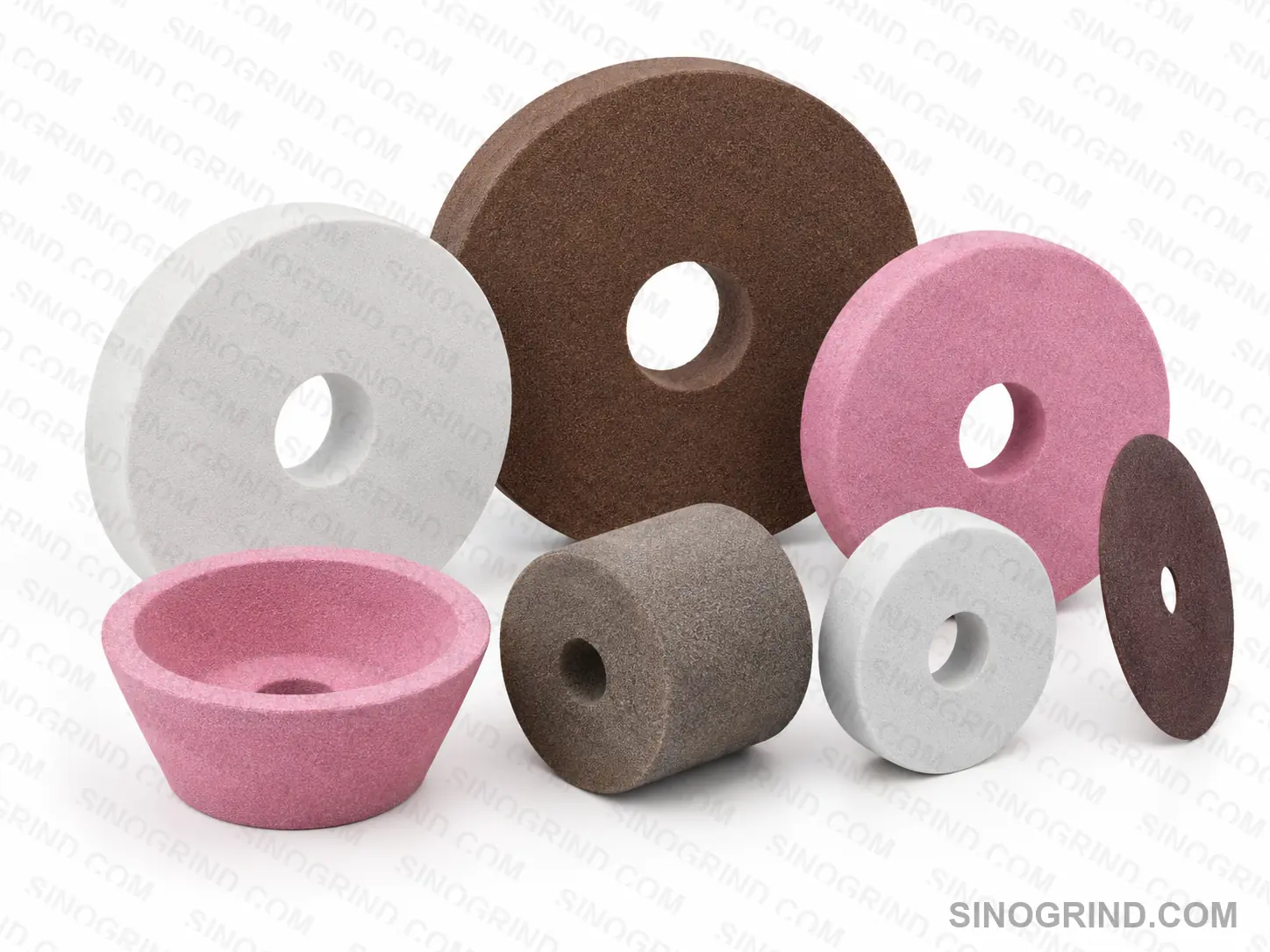
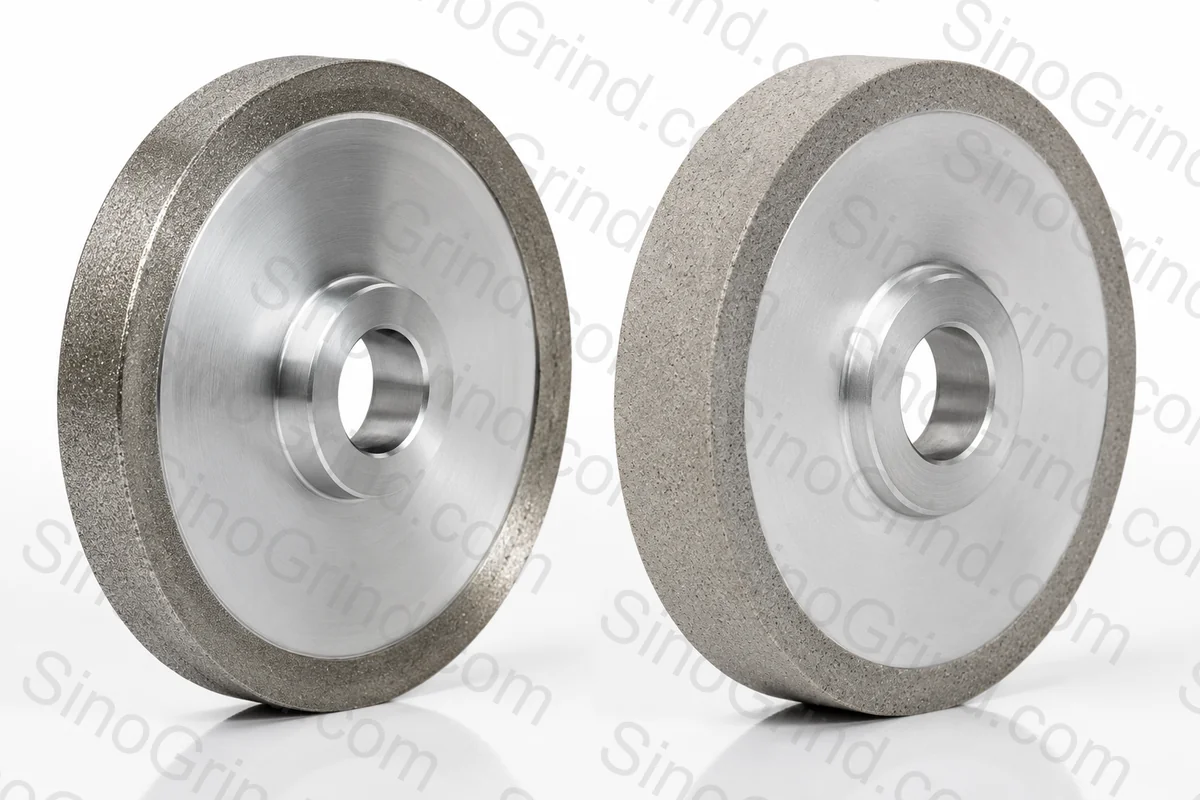
- 1A1 150×10×31.75×5 D91 C100 B — straight flat wheel, 150 mm OD, 10 mm thick, 31.75 mm bore, 5 mm rim; diamond D91, concentration 100, resin bond.
- 11V9 100×10×31.75×3 D126 C125 R — tapered cup for flute grinding, coarser D126 at 125% for stock removal.
- 6A2 150×20×31.75×10 D64 C75 M — straight cup, fine D64 at 75%, metal bond for life and form.
- 1A1R 100×0.5×20 D181 E — thin electroplated cut-off blade.
When you order
Give the application and material as well as the code. A specification that is correct on paper can still be wrong for your machine, coolant and finish target.
Sub-table 2 — by grinding process
| Process | Typical bond | Grit (FEPA D) | Concentration | Common shapes | Notes |
|---|---|---|---|---|---|
| Tool & cutter grinding (flute, gash) | Resin / Metal | D91–D181 | 100–150% | 11V9, 12V9, 1A1 | Cool cutting protects carbide edges |
| Surface / flat grinding | Resin / Vitrified | D64–D151 | 75–125% | 1A1, 6A2 | Balance finish vs. removal |
| OD cylindrical | Metal / Vitrified | D91–D181 | 100–150% | 1A1, 1F1 | Even coolant coverage |
| ID / internal | Resin / Metal | D46–D126 | 75–125% | Cup, mounted points | Small wheels, high speed |
| Form / profile / creep-feed | Metal / Vitrified | D64–D151 | 100–150% | 6A2, 11V9, 12V9 | Profile retention is critical |
| Centerless | Metal / Resin | D91–D181 | 100–150% | 1A1, 6A2 | High volume, tight roundness |
| Back-grinding / wafer thinning | Electroplated / Resin | D126–D400+ | 100–200% | Cup, 1A1 | Ultra-fine finish, low damage |
| Glass edge / bevel / CNC | Metal / Resin | D64–D126 | 75–125% | 1A1, 1F1, 12A2 | Prevent edge chipping |
| Cut-off / slot / groove | Electroplated / Metal | D181–D400 | — | 1A1R, saw | Thin wheels, rigid setup |
| Dressing & truing (of other wheels) | — | D46–D181 | — | Pen, roller, block | Diamond tools, not diamond wheels |
Building a code from a drawing, step by step
- Start with the shape. Read the profile from the drawing and pick the standard code (1A1, 11V9, 12V9, 6A2, 14A1…). If the profile does not match a standard, say so explicitly.
- Add the dimensions in a fixed order. Outside diameter × thickness × bore, then rim width or angle where the shape needs it.
- Name the abrasive. Diamond or CBN, and the grit in FEPA D. State the scale, because FEPA D and FEPA F are not interchangeable.
- Add concentration. The percentage, tied to the bond system.
- Add the bond. Resin, metal, vitrified or electroplated, with filler or grade if the supplier uses one.
- Add the machine limit. Maximum operating speed, and the coolant the wheel will see.
Write the code in that order every time. A supplier can resolve a missing detail by asking; they cannot resolve an ambiguous code that reads differently in two places. Adding the drawing reference and the revision number removes most of the remaining doubt.
Where specification codes go wrong
| Problem | What happened | How to prevent it |
|---|---|---|
| Grit scale mixed up | D91 quoted as if it were F91 | Always state FEPA D or FEPA F next to the number |
| Shape code does not match the profile | Nearest standard code used for a custom form | Send a section drawing when the profile is not standard |
| Bore tolerance omitted | Wheel fits loosely or will not seat | State bore and tolerance, plus the flange diameter |
| Concentration quoted without the bond | Same percentage behaves differently in another bond | Quote concentration and bond as one pair |
| Speed limit missing | Wheel ordered for a slower machine | State the maximum spindle speed on the RFQ |
A specification is only complete when a supplier could make the wheel without asking a question.
What should an RFQ include?
- Shape: standard code plus drawing reference and revision.
- Dimensions: OD × T × H, plus rim width, angle or radius.
- Abrasive: diamond or CBN, grit and scale.
- Concentration and bond: quoted together.
- Speed and coolant: maximum operating speed and wet or dry.
- Application: material, operation and finish target, so the supplier can sanity-check the code.
Browse the matching Diamond & CBN Grinding Wheels range for this application.
The code is a summary, not the specification
A code identifies the family and the main parameters. The drawing and the RFQ text carry the tolerances, and those are what the wheel is actually made to.
Boundary rule — when not to use diamond
Diamond is the hardest abrasive and the correct choice for hard, brittle, non-ferrous materials such as cemented carbide, ceramics, glass, silicon, sapphire, ferrite, graphite and composites. It must not be used on ferrous metals — steel, cast iron, and their alloys — because carbon in diamond reacts with iron at grinding temperatures (roughly above 700 °C / 1300 °F). This chemical affinity causes rapid, abnormal diamond wear (graphitisation) and destroys the wheel. For steel, hardened steel, cast iron and other ferrous workpieces, use CBN (cubic boron nitride) instead.