: +86 15874211461


Quick answer: Graphite and carbon are soft but highly abrasive, so they quickly wear conventional tools. Use a diamond wheel — often electroplated or metal bond at D181–D301 grit — to hold profile and cut cleanly, with strong dust extraction.
Related reading: Electroplated Diamond Grinding Wheel · Diamond Wheel for CFRP & Composites · Diamond Wheel Shapes Guide (1A1, 11V9, 6A2, 12V9).
Why diamond suits graphite
Graphite is soft but extremely abrasive. Carbide and HSS tools dull quickly and lose dimension. Diamond resists this abrasion, so a diamond wheel or tool holds its profile and size over a long run — critical for EDM electrodes and precision carbon parts.
Which bond and grit should I use?
| Operation | Bond / type | Grit (FEPA D) |
|---|---|---|
| Profile / form grinding | Electroplated / Metal | D181–D301 |
| Electrode finishing | Metal / Resin | D126–D181 |
| Cut-off / slotting | Electroplated | D181–D400 |
| Fine electrode detail | Resin | D91–D126 |
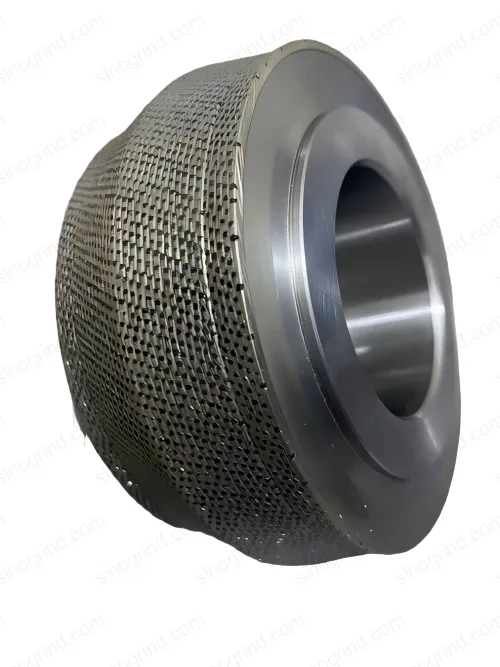
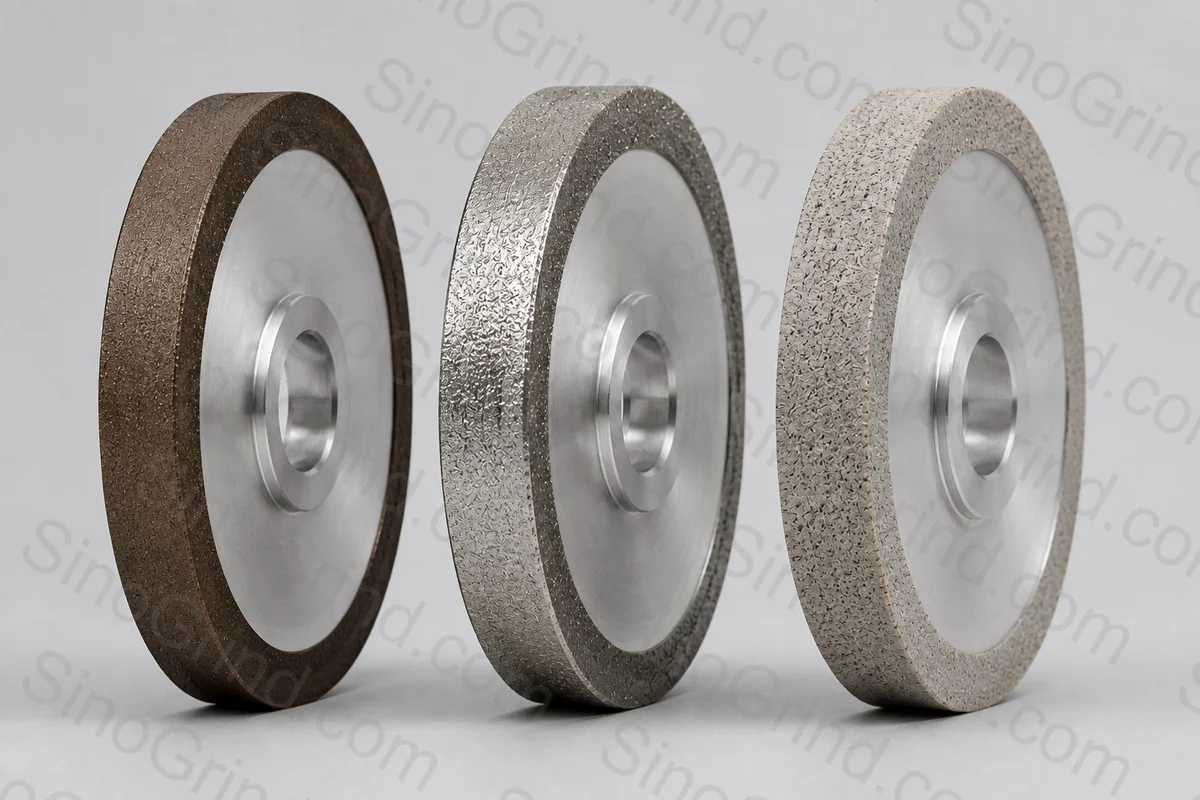
Electroplated tools are common for complex electrode profiles because they hold form and can be made in fine detail.
Dust control is essential
Graphite machining produces fine conductive dust that is a health and machine risk. Use local dust extraction and filtration, and where possible machine wet. Never blow dust with compressed air indoors.
Where is it used?
- EDM electrodes — profiled and finished with diamond.
- Carbon seals and bearings.
- Graphite moulds and fixtures.
- Carbon composite components (see the CFRP guide).
Which specification should I choose?
| Parameter | Typical value |
|---|---|
| Bond | Electroplated / Metal |
| Grit (FEPA D) | D126–D301 |
| Concentration | 75–125% (bonded wheels) |
| Coolant | Dry with extraction, or wet |
| Priority | Profile retention, dust control |
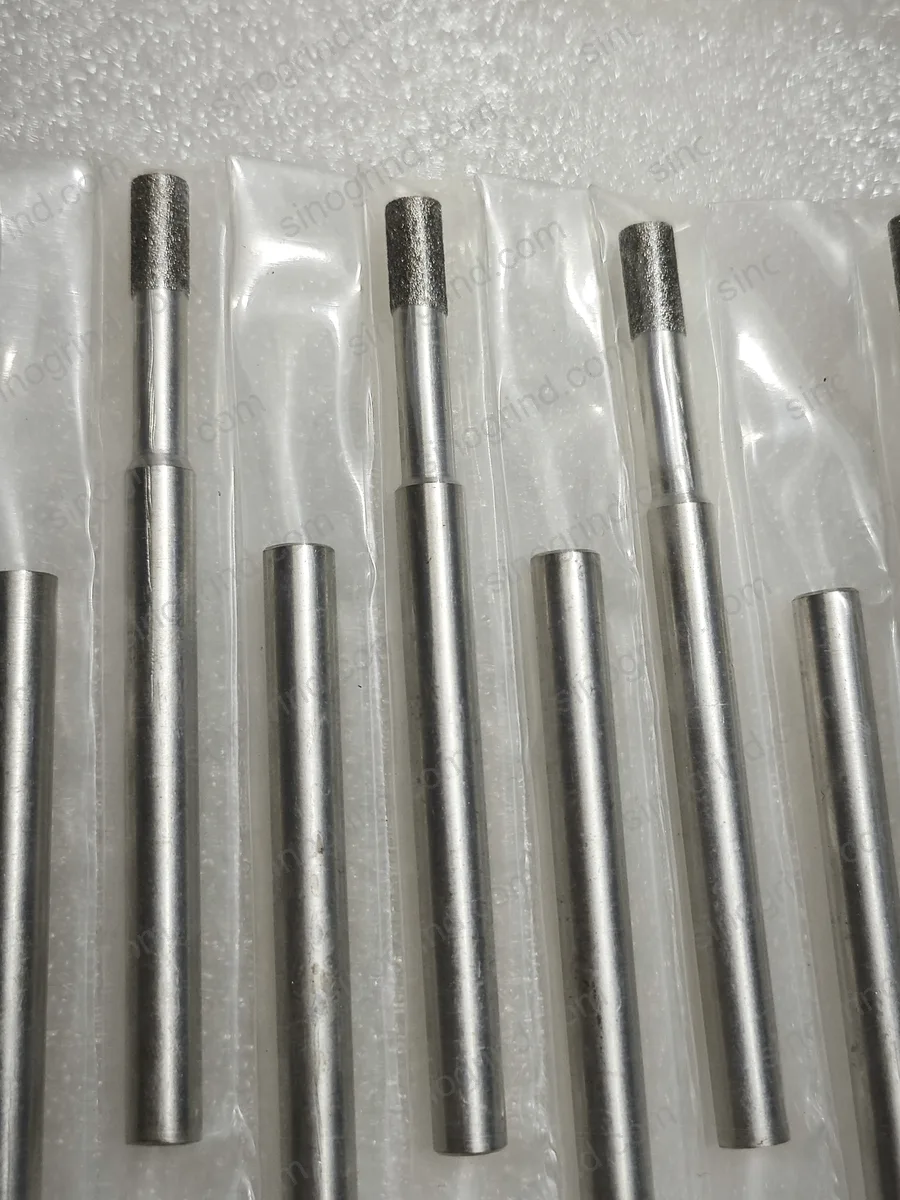
| Wheel type | Form wheels, thin blades, rods |
Electroplated form tools hold graphite electrode profiles for long runs.
Graphite cuts easily and ruins machines
Graphite is soft enough to machine at high speed, but it is abrasive and it produces a conductive dust that finds its way into every bearing and electrical cabinet. The tooling answer is a sharp diamond edge with generous clearance; the process answer is extraction, extraction and extraction.
Because the material does not smear or work-harden, the main quality risks are edge fraying on fine features and dust-induced shorts on finished electrodes. A light finishing pass at high spindle speed and low depth per tooth leaves a clean wall without loading the tool.
How do I set up the job?
- Enclose and extract. Fit brush guards and a dust extractor rated for conductive dust; do not rely on the machine's general extraction.
- Use sharp, coated tooling. Diamond-coated carbide with high helix and polished flutes clears dust without packing it into the slot.
- Set high speed, low depth. High spindle speed with 0.05–0.2 mm depth per pass keeps the cutting force low and the edge clean.
- Avoid coolant unless specified. Most graphite is cut dry; if mist is used, keep it minimal and filter the air.
- Clean before measuring. Dust on the surface reads as size. Blow off with dry, filtered air before inspection.
- Protect finished electrodes. Bag or box them immediately; settled dust is a scrap risk.
How do I fix common problems?
| Symptom | Most likely cause | What to change |
|---|---|---|
| Frayed edges on fine ribs | Tool wear or too much depth per pass | Reduce depth, use a fresh diamond-coated tool |
| Dust packing in the slot | Poor chip evacuation, wrong flute geometry | Increase extraction, use a polished high-helix tool |
| Dimensional drift | Thermal growth of the spindle at high speed | Allow warm-up, measure after a stabilising pass |
| Short circuits on the finished part | Conductive dust left in blind features | Ultrasonic or filtered-air clean before assembly |
| Tool breaks in a corner | Corner load and vibration | Program a radius, reduce feed at direction changes |
Graphite tool life is usually limited by edge wear and dust, not by heat.
What should an RFQ include?
- Material: fine-grain graphite grade, density and whether it is impregnated.
- Feature: ribs, slots, threads or 3D surfaces, with the smallest internal radius.
- Tool: diamond-coated or PCD, diameter, flute count and coating.
- Machine: maximum spindle speed, extraction and dust rating.
- Quality: dimensional tolerance and surface finish on the working faces.
- Volume: electrodes per week and current tool breakage rate.
Browse the matching Diamond & CBN Grinding Wheels range for this application.
For graphite the cheapest gain is usually better extraction rather than a more expensive tool. Dust that stays in the cut dulls the edge, packs the flutes and contaminates the part, so extraction pays for itself in tool life and scrap.
Diamond-coated carbide or PCD?
Diamond-coated carbide is the usual choice for graphite: sharp, available in small diameters, and cheap enough to replace when the coating wears. PCD is tougher and holds an edge far longer in abrasive graphite, but it is more expensive and needs a brazed or indexable body.
For long runs on abrasive grades, PCD usually wins on cost per part. For prototypes, fine detail and small internal radii, coated carbide is more practical. Either way, the edge must stay sharp: a worn tool presses the graphite instead of shearing it, and the dust it makes is the least of the problems.
Sub-table 1 — by material family
| Material | Typical operation | Recommended bond | Grit (FEPA D) | Concentration | Typical Ra |
|---|---|---|---|---|---|
| Cemented carbide (WC-Co) | Cutter & tool grinding | Resin / Metal | D91–D181 | 100–150% | 0.1–0.4 µm |
| PCD / PCBN | Edge prep, peripheral | Metal / Vitrified | D46–D91 | 125–150% | 0.05–0.2 µm |
| Advanced ceramics (Al₂O₃, ZrO₂, Si₃N₄) | Surface / form | Vitrified / Resin | D64–D151 | 75–125% | 0.2–0.6 µm |
| Optical / flat glass, quartz | Edge, bevel, CNC | Metal / Resin | D64–D126 | 75–125% | 0.05–0.3 µm |
| Semiconductor (Si, SiC, sapphire) | Back-grind, dicing | Electroplated / Resin | D126–D400+ | 100–200% | <0.02 µm (fine) |
| Ferrite / soft magnetic | Surface / form | Resin / Metal | D91–D181 | 100–150% | 0.2–0.8 µm |
| Graphite / carbon | Form / cut-off | Electroplated / Metal | D181–D301 | 75–125% | — |
| CFRP / composites | Cut, slot | Electroplated | D252–D400 | — | — |
| Thermal-spray coatings | Grind, polish | Resin / Metal | D126–D252 | 75–100% | 0.1–0.4 µm |
| Stone / engineered quartz | Edge, calibrate | Metal / Electroplated | D181–D400 | — | — |
| Zirconia (dental / medical) | Finish, polish | Resin / Vitrified | D46–D126 | 75–100% | 0.1–0.3 µm |
| Steel / cast iron (ferrous) | — | Not diamond — use CBN | — | — | — |
Representative values for planning; confirm final grit, concentration and bond with a grinding trial on your machine.
Boundary rule — when not to use diamond
Diamond is the hardest abrasive and the correct choice for hard, brittle, non-ferrous materials such as cemented carbide, ceramics, glass, silicon, sapphire, ferrite, graphite and composites. It must not be used on ferrous metals — steel, cast iron, and their alloys — because carbon in diamond reacts with iron at grinding temperatures (roughly above 700 °C / 1300 °F). This chemical affinity causes rapid, abnormal diamond wear (graphitisation) and destroys the wheel. For steel, hardened steel, cast iron and other ferrous workpieces, use CBN (cubic boron nitride) instead.