: +86 15874211461


Quick answer: CFRP and composites are abrasive and delaminate easily. Use a diamond tool — usually electroplated at D252–D400 grit — to cut with low force and clean edges, and always use dust extraction.
Related reading: Electroplated Diamond Grinding Wheel · Diamond Wheel for Graphite & Carbon · Diamond Wheel Shapes Guide (1A1, 11V9, 6A2, 12V9).
Why composites are machined with diamond
Carbon-fibre and glass-fibre composites are highly abrasive to tools but soft and weak in shear, so they delaminate, fray and pull out fibres if cut with a blunt or highly loaded tool. A sharp diamond edge cuts with low force, giving clean edges and far longer tool life than carbide.
Tool and grit choice
| Operation | Tool | Grit (FEPA D) |
|---|---|---|
| Edge trimming | Electroplated wheel / router | D252–D400 |
| Slotting / grooving | Electroplated thin wheel | D252–D400 |
| Surface grinding | Metal / Electroplated | D181–D301 |
| Hole making | Electroplated drill / core | D252–D400 |
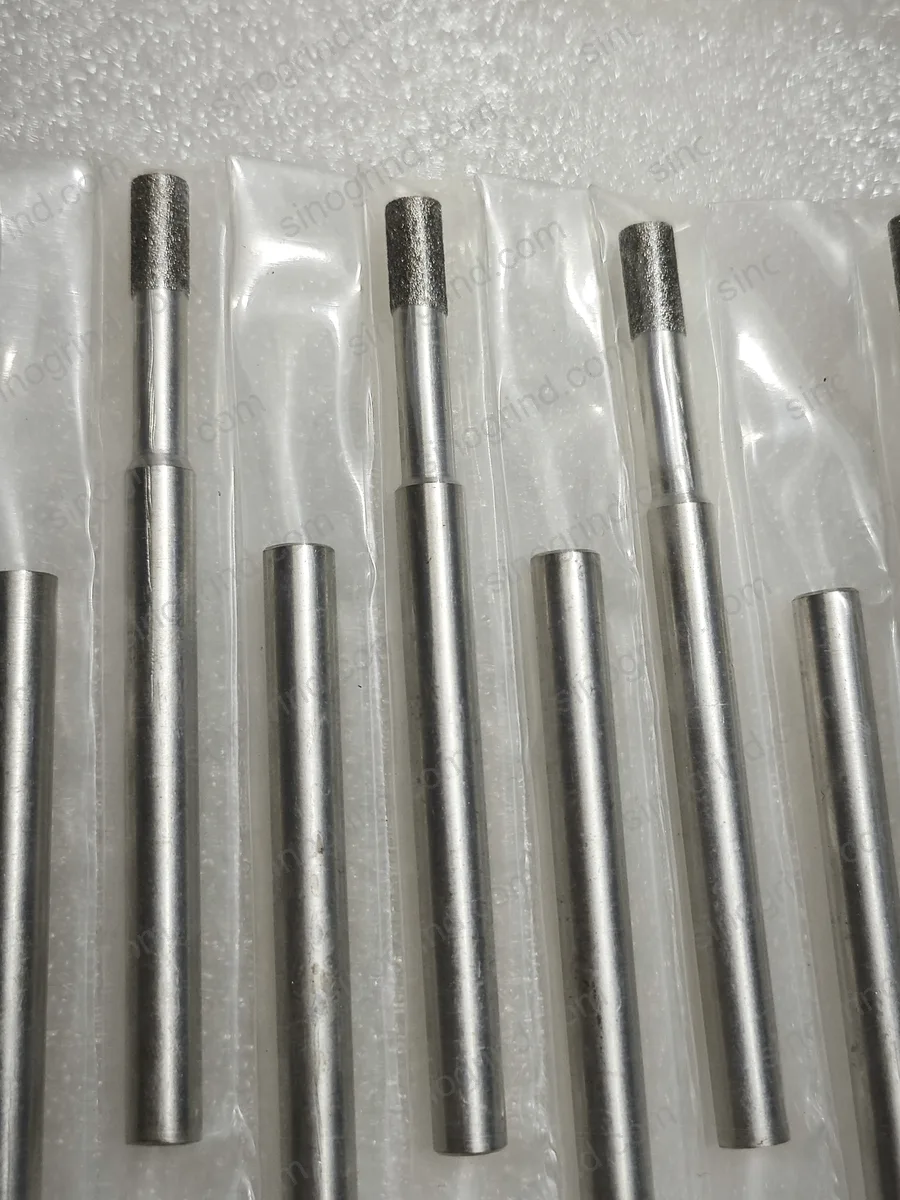
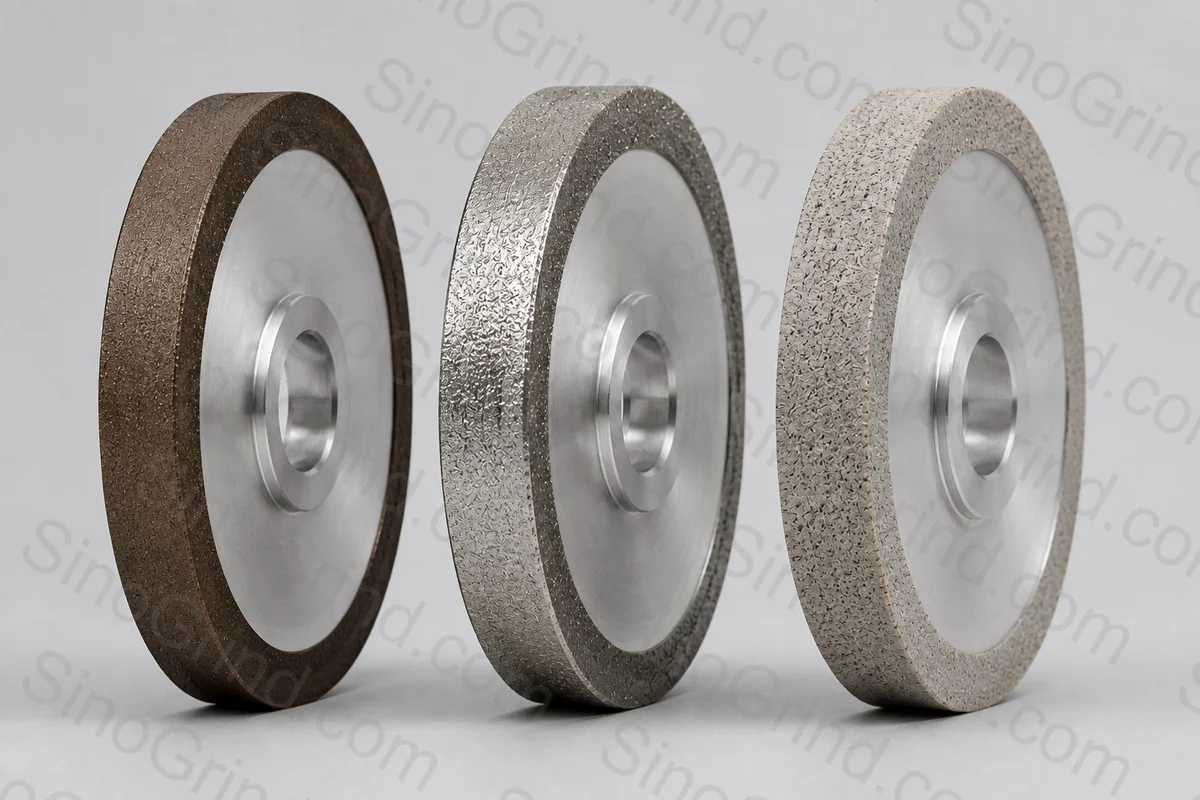
Electroplated tools dominate because they combine a sharp edge with form retention and can be made in thin, complex geometries.
Controlling delamination and dust
- Sharp tool, low force — feed the tool into the cut, do not dwell.
- Support the laminate to stop the outer plies lifting.
- Extract and filter dust — CFRP dust is a serious health hazard.
- Avoid excessive heat; the resin matrix can soften and smear.
- Use climb cutting / correct direction to keep edges clean.
Where is it used?
- Aerospace composite structures — trim and drill.
- Automotive CFRP parts.
- Sports and industrial composites — tubes, plates, profiles.
- GFRP and hybrid laminates.
Which specification should I choose?
| Parameter | Typical value |
|---|---|
| Tool | Electroplated wheel / router |
| Grit (FEPA D) | D181–D400 |
| Cutting mode | Sharp, low force, climb |
| Coolant | Dry with extraction (or wet) |
| Priority | No delamination, clean edges |
| Safety | Dust extraction mandatory |
Tool geometry and sharpness control edge quality more than grit alone.
Cutting fibres without pulling them out
CFRP is strong in the fibre direction and weak between layers. A cutting edge that pushes before it shears will lift a ply, and the delamination it leaves is often invisible from the machined side. Diamond is used because it stays sharp far longer than carbide in the abrasive carbon matrix, and a sharp edge is the main defence against delamination.
Heat is the second constraint. The resin matrix softens and burns at temperatures well below those of the fibres, so feed and speed have to be balanced to keep the cut cool while still shearing cleanly. Dust extraction is mandatory for health as well as for finish.
How do I set up the job?
- Support the exit side. Back the laminate with a sacrificial plate or a fitted support so the fibres are cut against something, not pushed out.
- Use a sharp diamond edge. Diamond-coated router or a PCD edge with a positive rake; worn tools delaminate even at the right feed.
- Set the chip load. Feed per tooth high enough to cut rather than rub, with a spindle speed that keeps the edge cool.
- Extract at the cut. Local extraction at the tool, plus PPE; carbon dust is a health hazard.
- Inspect the exit side. Look for white fibre pull-out and delamination before trimming; they will not disappear in the next pass.
- Retire on edge condition. Change the tool on edge wear, not on a fixed part count.
How do I fix common problems?
| Symptom | Most likely cause | What to change |
|---|---|---|
| Delamination at the exit | Unsupported laminate, dull tool | Add support, change to a fresh diamond edge |
| Frayed edges | Feed too low (rubbing) or too high (pushing) | Tune feed per tooth; cut a test coupon |
| Burn marks and resin smell | Heat from rubbing or a worn edge | Reduce spindle speed, increase feed per tooth, improve extraction |
| Hole taper | Tool deflection in a long drill | Peck drill, use a stiffer tool, reduce feed |
| Dust in the machine | Extraction not at the source | Fit local extraction and enclose the work zone |
Delamination and heat are the two failure modes; both are process problems before they are tool problems.
What should an RFQ include?
- Laminate: fibre type, lay-up, thickness and cure state.
- Feature: trim, slot, hole or edge, with the delamination limit.
- Tool: diamond-coated or PCD, geometry and diameter.
- Machine: spindle speed, rigidity and extraction.
- Quality: inspection method for delamination and hole tolerance.
- Volume: parts per week and current rework rate.
Browse the matching Diamond & CBN Grinding Wheels range for this application.
In composites the cost of a delaminated part dwarfs the cost of the tool. Specify the delamination limit, then choose a sharp diamond edge and a support plate that can meet it.
Still non-ferrous
CFRP is non-metallic, so diamond is correct. The moment the workpiece is steel or cast iron, the abrasive must switch to CBN.
Sub-table 1 — by material family
| Material | Typical operation | Recommended bond | Grit (FEPA D) | Concentration | Typical Ra |
|---|---|---|---|---|---|
| Cemented carbide (WC-Co) | Cutter & tool grinding | Resin / Metal | D91–D181 | 100–150% | 0.1–0.4 µm |
| PCD / PCBN | Edge prep, peripheral | Metal / Vitrified | D46–D91 | 125–150% | 0.05–0.2 µm |
| Advanced ceramics (Al₂O₃, ZrO₂, Si₃N₄) | Surface / form | Vitrified / Resin | D64–D151 | 75–125% | 0.2–0.6 µm |
| Optical / flat glass, quartz | Edge, bevel, CNC | Metal / Resin | D64–D126 | 75–125% | 0.05–0.3 µm |
| Semiconductor (Si, SiC, sapphire) | Back-grind, dicing | Electroplated / Resin | D126–D400+ | 100–200% | <0.02 µm (fine) |
| Ferrite / soft magnetic | Surface / form | Resin / Metal | D91–D181 | 100–150% | 0.2–0.8 µm |
| Graphite / carbon | Form / cut-off | Electroplated / Metal | D181–D301 | 75–125% | — |
| CFRP / composites | Cut, slot | Electroplated | D252–D400 | — | — |
| Thermal-spray coatings | Grind, polish | Resin / Metal | D126–D252 | 75–100% | 0.1–0.4 µm |
| Stone / engineered quartz | Edge, calibrate | Metal / Electroplated | D181–D400 | — | — |
| Zirconia (dental / medical) | Finish, polish | Resin / Vitrified | D46–D126 | 75–100% | 0.1–0.3 µm |
| Steel / cast iron (ferrous) | — | Not diamond — use CBN | — | — | — |
Representative values for planning; confirm final grit, concentration and bond with a grinding trial on your machine.
Boundary rule — when not to use diamond
Diamond is the hardest abrasive and the correct choice for hard, brittle, non-ferrous materials such as cemented carbide, ceramics, glass, silicon, sapphire, ferrite, graphite and composites. It must not be used on ferrous metals — steel, cast iron, and their alloys — because carbon in diamond reacts with iron at grinding temperatures (roughly above 700 °C / 1300 °F). This chemical affinity causes rapid, abnormal diamond wear (graphitisation) and destroys the wheel. For steel, hardened steel, cast iron and other ferrous workpieces, use CBN (cubic boron nitride) instead.