: +86 15874211461

Quick answer: PCD and PCBN are nearly as hard as diamond, so grinding is slow and requires fine diamond grit (D30–D91) at 100–150% concentration, a metal or vitrified bond, and a very stiff machine with flood coolant.
Related reading: Metal Bond Diamond Grinding Wheel · Diamond Wheel for Carbide Grinding · Diamond vs CBN: Which Abrasive?.
Why PCD and PCBN are hard to grind
PCD (polycrystalline diamond) and PCBN (polycrystalline cubic boron nitride) are sintered superhard composites. Only diamond will grind PCD efficiently. Stock removal is small and slow, so the priority is a sharp, high-concentration fine diamond and a machine rigid enough to avoid vibration marks on the finished edge.
Bond and grit choice
| Task | Bond | Grit (FEPA D) | Concentration |
|---|---|---|---|
| Rough edge prep | Metal | D64–D91 | 125–150% |
| Semi-finish | Metal / Vitrified | D46–D64 | 100–125% |
| Finish / lapping | Vitrified / Resin | D30–D46 | 75–125% |
| CVD diamond | Metal / Vitrified | D15–D46 | 75–125% |
Higher concentration resists the pressure of grinding these hard materials; finer grit controls edge quality and reduces micro-chipping.
Machine and process requirements
- Rigid, high-precision machine with fine infeed control.
- High wheel speed and low depth of cut, multiple passes.
- Flood coolant or neat oil to remove the small, hot chips.
- Frequent dressing (metal/vitrified) to keep the grit sharp.
- Inspect the finished edge; PCD edge quality directly sets tool life.
PCD edge quality drives tool life
The PCD cutting edge is the tool. Micro-chipping introduced during grinding becomes the initiation site for edge failure in service, so the finishing passes matter as much as the roughing. Use a fine, freshly dressed grit for the last passes and inspect under magnification.
Which specification should I choose?
| Parameter | Typical value |
|---|---|
| Bond | Metal (metal/vitrified for finish) |
| Grit (FEPA D) | D30–D91 |
| Concentration | 100–150% |
| Depth of cut | 0.002–0.02 mm |
| Coolant | Flood / neat oil |
| Machine | Stiff, high-speed, fine-infeed |
PCD/PCBN grinding is a precision process; trial the finishing grit on your machine.
Why the edge, not the diameter, is the job
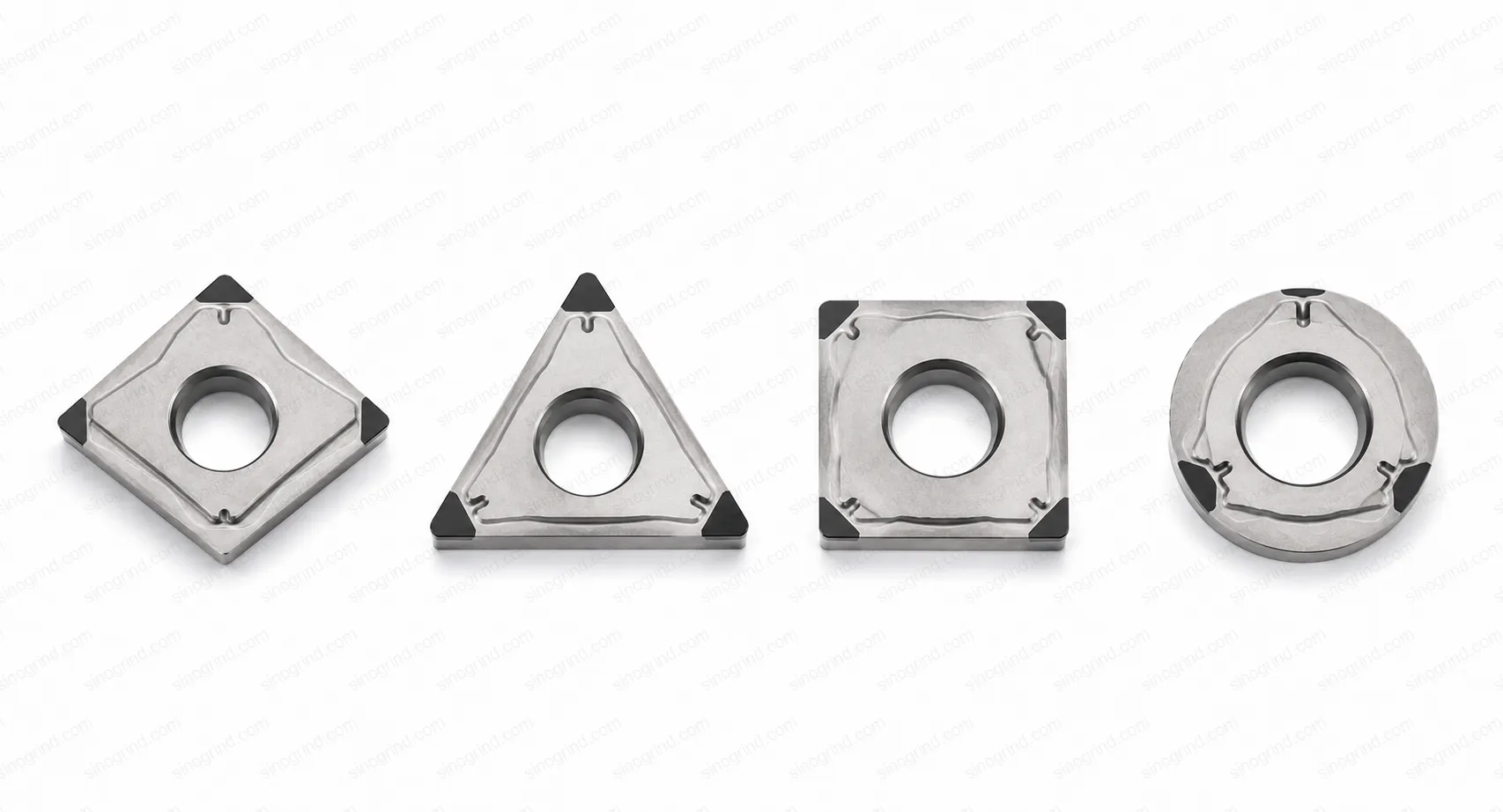
PCD and PCBN inserts are supplied as near-net blanks. Grinding removes only a few tenths of a millimetre, but it defines the cutting edge that the tool will live or die by. A 20 µm chip on a PCD edge becomes a crack under cutting load, and the insert fails long before the edge wears.
Both materials are superhard: PCD is a diamond skeleton in cobalt, PCBN is cubic boron nitride in a ceramic or metal binder. Diamond wheels cut both, but the heat generated at the edge is enormous for the volume removed. The process is therefore designed around cooling and edge protection, not around removal rate.
How do I set up the job?
- Start from a rigid machine. A tool-and-cutter grinder with low spindle run-out and fine feed resolution is essential; a worn machine shows up immediately as edge chipping.
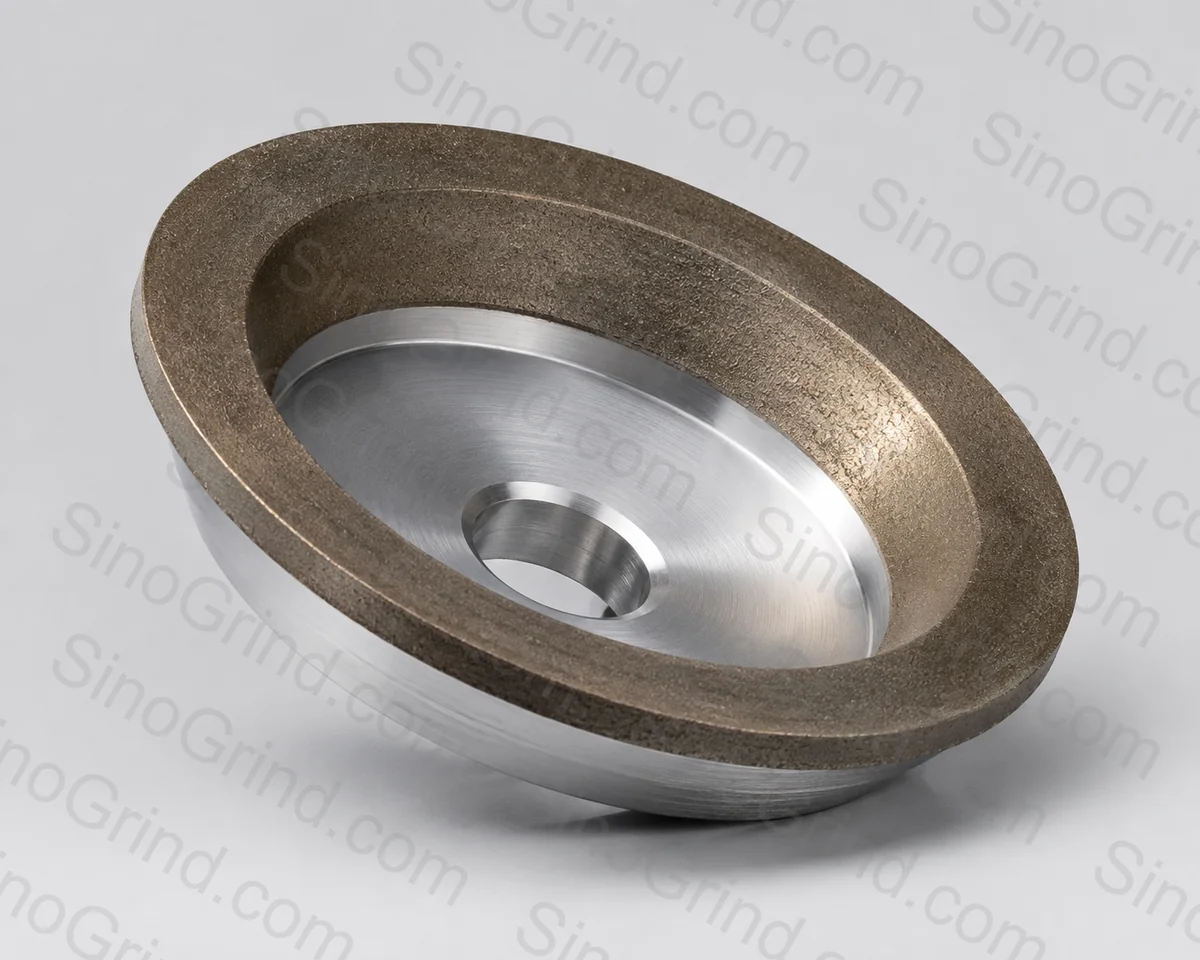
- Choose the wheel. Metal or vitrified bond, D30–D64, 125–150% concentration for edge preparation; finer grit for a polished edge.
- Indicate everything. Wheel, fixture and insert. On PCD a 0.005 mm run-out can double the edge damage.
- Take light passes. 0.002–0.01 mm depth, slow feed, and several spark-out passes at the end to remove the damaged layer.
- Cool continuously. Flood or high-pressure mist from the first contact; never let the edge cool in air between passes.
- Inspect the edge. Check at 200× or better. If the edge is chipped, change the wheel or the setup before running another insert.
How do I fix common problems?
| Symptom | Most likely cause | What to change |
|---|---|---|
| Chipped edge on PCD | Vibration, run-out or too aggressive a first pass | Re-indicate, halve the depth, add spark-out passes |
| Brown or black discolouration on PCD | Heat damage to the diamond skeleton | Increase coolant, reduce speed, reduce pass depth |
| Edge looks good but tool life is short | Subsurface damage left by the wheel | Finish with a finer grit and more spark-out |
| Wheel glazes on PCBN | Bond too hard for the small contact area | Dress more often, use a softer bond or a finer grit |
| Size varies insert to insert | Thermal growth and inconsistent spark-out | Let the machine stabilise, fix the spark-out count |
Edge preparation is a finishing operation: if the cycle time is being pushed, quality is being spent.
What should an RFQ include?
- Insert type: PCD or PCBN, grain size and binder, and the edge prep drawing.
- Stock to remove: radial and axial allowance, and the required edge radius.
- Wheel: bond, grit, concentration and the shape that reaches the edge.
- Machine: run-out, coolant delivery and available in-process gauging.
- Acceptance: edge chipping limit and the inspection method.
- Volume: inserts per month and the current scrap rate, which sets the value of a better edge.
Browse the matching CNC Tools range for this application.
For PCD and PCBN the cost of a wheel is trivial next to the value of the insert. Buy the wheel that protects the edge, then work on cycle time by improving the machine and the coolant, not by taking heavier passes.
Do not use diamond on steel
PCBN inserts are ground with diamond because the work is boron nitride, not steel. When the workpiece itself is steel or cast iron, the abrasive must be CBN.
Sub-table 1 — by material family
| Material | Typical operation | Recommended bond | Grit (FEPA D) | Concentration | Typical Ra |
|---|---|---|---|---|---|
| Cemented carbide (WC-Co) | Cutter & tool grinding | Resin / Metal | D91–D181 | 100–150% | 0.1–0.4 µm |
| PCD / PCBN | Edge prep, peripheral | Metal / Vitrified | D46–D91 | 125–150% | 0.05–0.2 µm |
| Advanced ceramics (Al₂O₃, ZrO₂, Si₃N₄) | Surface / form | Vitrified / Resin | D64–D151 | 75–125% | 0.2–0.6 µm |
| Optical / flat glass, quartz | Edge, bevel, CNC | Metal / Resin | D64–D126 | 75–125% | 0.05–0.3 µm |
| Semiconductor (Si, SiC, sapphire) | Back-grind, dicing | Electroplated / Resin | D126–D400+ | 100–200% | <0.02 µm (fine) |
| Ferrite / soft magnetic | Surface / form | Resin / Metal | D91–D181 | 100–150% | 0.2–0.8 µm |
| Graphite / carbon | Form / cut-off | Electroplated / Metal | D181–D301 | 75–125% | — |
| CFRP / composites | Cut, slot | Electroplated | D252–D400 | — | — |
| Thermal-spray coatings | Grind, polish | Resin / Metal | D126–D252 | 75–100% | 0.1–0.4 µm |
| Stone / engineered quartz | Edge, calibrate | Metal / Electroplated | D181–D400 | — | — |
| Zirconia (dental / medical) | Finish, polish | Resin / Vitrified | D46–D126 | 75–100% | 0.1–0.3 µm |
| Steel / cast iron (ferrous) | — | Not diamond — use CBN | — | — | — |
Representative values for planning; confirm final grit, concentration and bond with a grinding trial on your machine.
Boundary rule — when not to use diamond
Diamond is the hardest abrasive and the correct choice for hard, brittle, non-ferrous materials such as cemented carbide, ceramics, glass, silicon, sapphire, ferrite, graphite and composites. It must not be used on ferrous metals — steel, cast iron, and their alloys — because carbon in diamond reacts with iron at grinding temperatures (roughly above 700 °C / 1300 °F). This chemical affinity causes rapid, abnormal diamond wear (graphitisation) and destroys the wheel. For steel, hardened steel, cast iron and other ferrous workpieces, use CBN (cubic boron nitride) instead.