: +86 15874211461


Quick answer: Stone is shaped with a grit sequence of diamond wheels — coarse metal or electroplated for profiling, then progressively finer for finishing — with heavy water cooling and no ferrous materials involved.
Related reading: Electroplated Diamond Grinding Wheel · Metal Bond Diamond Grinding Wheel · Diamond Grit Size Selection.
How stone is ground
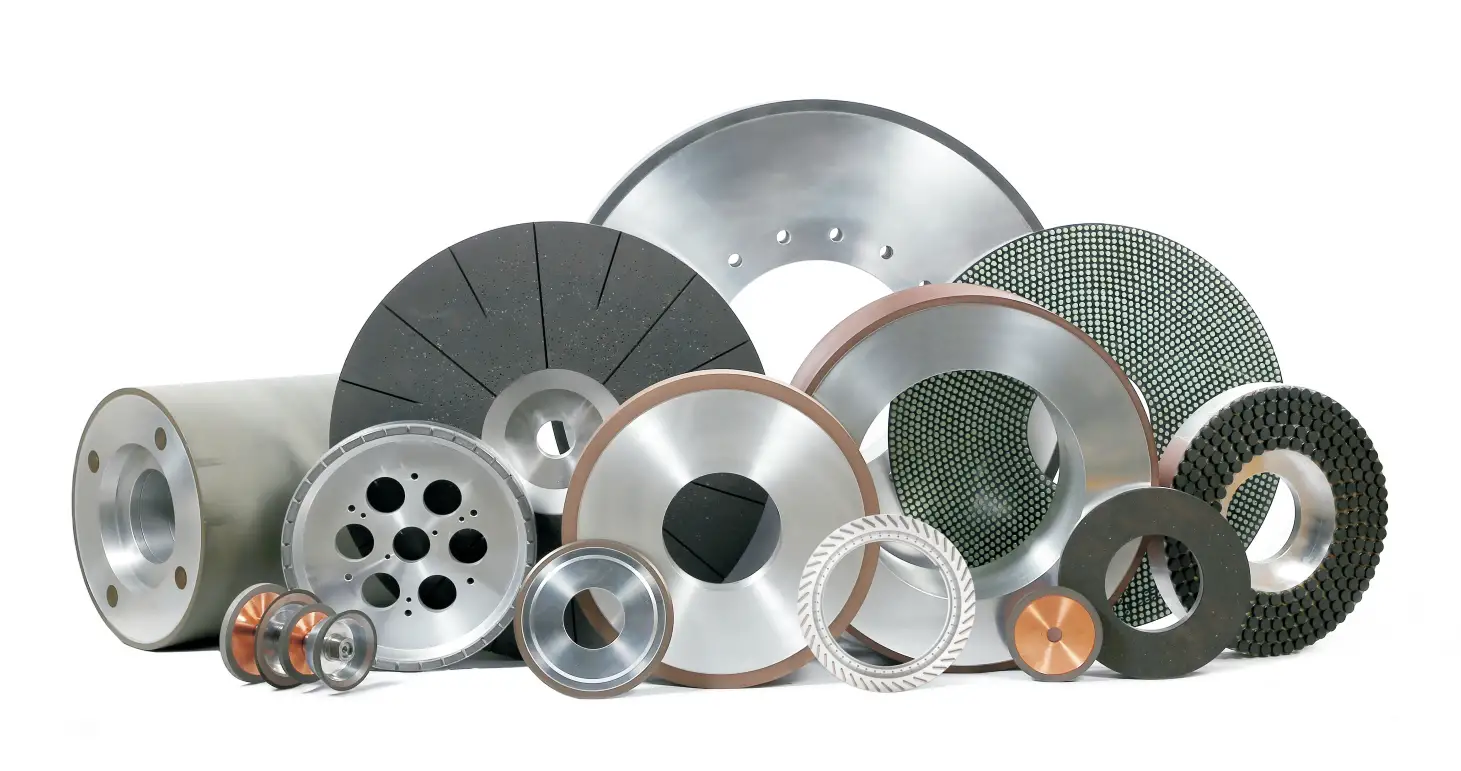
Stone and engineered quartz are hard and abrasive, and are almost always processed with diamond wheels run wet. The work is done as a sequence of grits: a coarse wheel profiles and calibrates, then successively finer wheels remove the scratches left by the previous stage, ending in a polish. Skipping a grit leaves visible scratches.
Bond and grit sequence
| Stage | Bond / type | Grit (FEPA D) | Purpose |
|---|---|---|---|
| Profiling / calibrating | Metal / Electroplated | D301–D600 | Set size and shape |
| Pre-finish | Metal / Electroplated | D181–D301 | Remove coarse scratches |
| Fine | Resin / Metal | D91–D181 | Prepare for polish |
| Polish | Resin / Vitrified | D15–D64 | Gloss finish |
Engineered quartz is harder and more abrasive than natural marble and demands more aggressive diamond and durable tooling.
Water cooling and edge quality
- Heavy water flow — stone grinding is always wet.
- Follow the grit sequence; never skip a grit.
- Match bond to hardness — harder stone needs harder bond.
- Keep the wheel sharp to avoid burning or glazing the surface.
Where is it used?
- Countertop edge profiling — granite and quartz.
- Floor and slab calibration.
- Monument and architectural stone.
- Tiles and engineered-stone finishing.
Which specification should I choose?
| Parameter | Typical value |
|---|---|
| Bond | Metal / Electroplated (rough), Resin (finish) |
| Grit (FEPA D) | D15–D600 across the sequence |
| Sequence | Coarse → fine, no skipped grits |
| Coolant | Heavy water, essential |
| Priority | Scratch-free, glossy finish |
| Note | No ferrous material - diamond is ideal |
Grit sequence, not aggressiveness, controls the final finish.
Stone is ground with segments, water and sequence
Most stone work is not precision grinding; it is high-volume shaping and calibration. Diamond segments brazed or sintered onto a steel core do the cutting, water carries the heat and the sludge away, and the finish comes from running a sequence of progressively finer segments rather than from one perfect wheel.
The two things that go wrong are water starvation and skipping a grit. A segment that runs dry glazes in seconds and then polishes the stone instead of cutting it; a missing intermediate step leaves scratches that no amount of polishing will remove.
How do I set up the job?
- Match the segment to the stone. Hard granite needs a softer bond that wears to expose diamond; soft marble needs a harder bond that does not disappear.
- Set the water first. Flow must reach the full contact arc before the wheel touches the stone; run the pump for a few seconds before infeeding.
- Calibrate the sequence. Coarse segments to establish thickness, then finer for finish; do not jump two grits.
- Check the core. Segments must be seated and the core must run true; a loose segment breaks and can injure the operator.
- Keep a steady feed. Constant feed with adequate water beats a fast pass followed by a dwell.
- Flush the sludge. Settled stone dust hardens in the tank and blocks the pump; clean regularly.
How do I fix common problems?
| Symptom | Most likely cause | What to change |
|---|---|---|
| Segments glaze and stop cutting | Not enough water or a bond too hard for the stone | Increase flow, use a softer segment |
| Deep scratches after finishing | A grit step was skipped | Add the intermediate segment, do not polish over scratches |
| Uneven thickness | Machine calibration or worn segments | Re-calibrate, replace segments as a set |
| Segment loss | Overheating the braze or mechanical impact | Check water, avoid shock loads, inspect the core |
| Burn marks on marble | Dwelling in one spot | Keep the head moving, increase feed |
Water flow and grit sequence solve most stone-grinding problems before the segment is blamed.
What should an RFQ include?
- Stone: granite, marble, engineered quartz or concrete, and its hardness.
- Machine: head type, segment mounting and water flow available.
- Segment: bond, diamond grit and the number of segments per core.
- Sequence: the grits you run and the finish each must deliver.
- Throughput: square metres per shift.
- Cost driver: segment life in square metres, not price per segment.
Browse the matching Diamond & CBN Grinding Wheels range for this application.
For stone, cost per square metre is segment price divided by segment life in square metres. A cheap segment that glazes early costs more in labour and rework than a premium segment that cuts freely all shift.
Sub-table 1 — by material family
| Material | Typical operation | Recommended bond | Grit (FEPA D) | Concentration | Typical Ra |
|---|---|---|---|---|---|
| Cemented carbide (WC-Co) | Cutter & tool grinding | Resin / Metal | D91–D181 | 100–150% | 0.1–0.4 µm |
| PCD / PCBN | Edge prep, peripheral | Metal / Vitrified | D46–D91 | 125–150% | 0.05–0.2 µm |
| Advanced ceramics (Al₂O₃, ZrO₂, Si₃N₄) | Surface / form | Vitrified / Resin | D64–D151 | 75–125% | 0.2–0.6 µm |
| Optical / flat glass, quartz | Edge, bevel, CNC | Metal / Resin | D64–D126 | 75–125% | 0.05–0.3 µm |
| Semiconductor (Si, SiC, sapphire) | Back-grind, dicing | Electroplated / Resin | D126–D400+ | 100–200% | <0.02 µm (fine) |
| Ferrite / soft magnetic | Surface / form | Resin / Metal | D91–D181 | 100–150% | 0.2–0.8 µm |
| Graphite / carbon | Form / cut-off | Electroplated / Metal | D181–D301 | 75–125% | — |
| CFRP / composites | Cut, slot | Electroplated | D252–D400 | — | — |
| Thermal-spray coatings | Grind, polish | Resin / Metal | D126–D252 | 75–100% | 0.1–0.4 µm |
| Stone / engineered quartz | Edge, calibrate | Metal / Electroplated | D181–D400 | — | — |
| Zirconia (dental / medical) | Finish, polish | Resin / Vitrified | D46–D126 | 75–100% | 0.1–0.3 µm |
| Steel / cast iron (ferrous) | — | Not diamond — use CBN | — | — | — |
Representative values for planning; confirm final grit, concentration and bond with a grinding trial on your machine.
Boundary rule — when not to use diamond
Diamond is the hardest abrasive and the correct choice for hard, brittle, non-ferrous materials such as cemented carbide, ceramics, glass, silicon, sapphire, ferrite, graphite and composites. It must not be used on ferrous metals — steel, cast iron, and their alloys — because carbon in diamond reacts with iron at grinding temperatures (roughly above 700 °C / 1300 °F). This chemical affinity causes rapid, abnormal diamond wear (graphitisation) and destroys the wheel. For steel, hardened steel, cast iron and other ferrous workpieces, use CBN (cubic boron nitride) instead.