: +86 15874211461

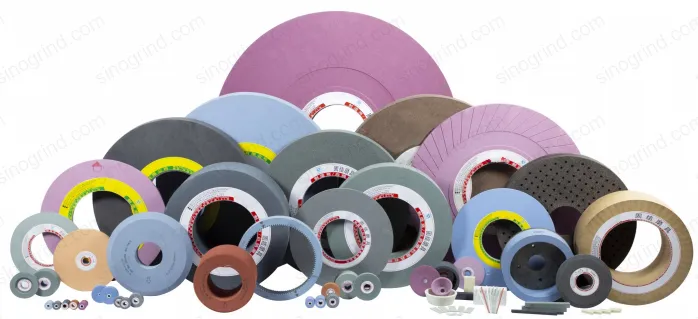
Quick answer: most aluminum oxide wheel faults come from dressing, coolant, speed or grade — not from a defective wheel. Burn points to a hard or glazed wheel, too much infeed or starved coolant. Loading is material smeared into the pores, common on stainless and soft steel. Glazing is a shiny face where dull grains are held too long. Dress first, then check coolant, then speed and grade.
Related reading: Dressing and truing guide · Grit and grade selection · Aluminum oxide grinding wheels · Corundum wheel guide.
Diagnose in the right order
Troubleshooting goes wrong when the first suspicion becomes the only investigation. A burn mark can be caused by a hard wheel, a blunt dresser, weak coolant, too much infeed or a worn spindle, and changing the wheel before checking the other four wastes time and money. Work through the list below in order, and change one variable at a time.
- Confirm the wheel matches the job. Check abrasive type, grit, grade and bond against the material and operation. A brown wheel in a hard grade on stainless is a specification problem no amount of dressing will fix.
- Inspect and dress the face. Look for glaze, loading, out-of-round, a worn edge or a polished strip. Dress with a sharp tool and re-test before changing anything else.
- Check coolant. Flow, pressure, concentration, filtration and nozzle aim. A nozzle that misses the contact arc is a common cause of burn that looks like a wheel fault.
- Calculate wheel speed. Confirm the spindle RPM gives a surface speed within the wheel rating, and recheck as the wheel diameter wears.
- Review infeed, traverse and dwell. Too much depth, too slow a traverse or a pause in the cut all raise local temperature.
- Check the machine. Spindle run-out, balance, flange condition, fixture rigidity, table play and tailstock pressure.
Symptom, cause and fix
| Symptom | Most likely cause | First fix | If it persists |
|---|---|---|---|
| Blue or brown burn marks on the part | Hard or glazed wheel, excessive infeed, low coolant | Dress the wheel; reduce infeed; aim coolant at the arc | Softer grade or more open structure |
| Wheel face shiny and hard, little spark | Glazing; bond too hard for the material | Dress with a sharp single-point diamond | Softer grade, coarser grit or more open wheel |
| Metal smeared across the wheel face | Loading; gummy workpiece, poor coolant, dense wheel | Dress; increase coolant flow and pressure | More open structure, softer grade, white WA for stainless |
| Chatter marks or regular ripples | Imbalance, run-out, loose fixture or worn spindle | Stop, check mounting and balance; true the wheel | Machine inspection; reduce wheel overhang |
| Poor surface finish | Dull wheel, too coarse grit, wrong dressing, vibration | Dress; check grit and traverse | Finer grit or better finishing wheel |
| Wheel wears very fast | Grade too soft, excessive pressure, wrong bond | Reduce infeed; check grade | Harder grade or tougher grain |
| Wheel will not cut after dressing | Dresser dull, depth too light, face polished | Use a sharp dresser and a slightly deeper pass | Replace the dresser; check dressing method |
| Wheel out of round | Poor mounting, spindle play, uneven wear | True the wheel and recheck run-out | Inspect spindle bearings and flanges |
| Taper on the workpiece | Machine alignment, uneven wheel wear, fixture deflection | Check alignment and wheel wear pattern | Correct machine geometry; adjust dressing |
| Dark sparks and heavy heat | Too much pressure, wheel too hard, coolant starved | Reduce depth and feed; restore coolant | Re-specify grade and structure |
| Wheel cracks or chipped edge | Impact, wrong handling, overspeed or thermal shock | Stop. Remove the wheel from service. | Review storage, mounting and speed limits |
| Part discolours after grinding | Heat-affected layer, insufficient coolant, dwell | Reduce heat input; improve cooling | Check wheel grade and process parameters |
A guide to the most common causes, not an exhaustive fault tree. Always investigate safety-related symptoms before running again.
Burn: heat where it should not be
Burn is a thermal problem first and a wheel problem second. The grinding zone gets hotter than the workpiece can tolerate, and the surface tempers, oxidises or cracks. The visible mark may be blue, brown or straw-coloured, but the damage can extend below the surface as a softened or stressed layer. On hardened parts, that layer may not show until the part fails in service.
The most common mistake is to blame the wheel when the coolant is the problem. Check that the nozzle is close to the contact arc, that flow is sufficient, that the fluid is clean and that the concentration is in the supplier’s range. A full stream aimed two inches away from the cut is not cooling the cut. After coolant, look at infeed and dwell: a pause at the end of a pass can do more damage than a slightly high feed rate.
If the process is already wet and the infeed is sensible, the wheel is probably too hard or too fine. A softer grade releases dull grains sooner and keeps fresh edges in the cut. An open structure gives coolant and chips somewhere to go. On hardened steel, white WA in a soft grade is the usual direction to move.
Loading: when the wheel fills up
Loading is workpiece material welded or smeared into the wheel pores. The face looks grey or shiny with metal, the wheel stops cutting, and heat rises quickly. It is common on stainless steel, soft low-carbon steel, aluminum and gummy alloys, and it is more likely with a dense wheel, a fine grit or a hard grade.
The fix has three parts. First, open the face with a sharp dresser so the pores are exposed. Second, increase coolant flow and make sure it reaches the contact zone; loading is often a chip-evacuation problem. Third, consider a more open structure or a softer grade. On stainless, white alumina is usually better than brown because it is more friable and cuts cooler. Avoid dwelling: a wheel that rubs will load even if the specification is right.
If loading appears only on the leading edge, check the wheel alignment and the direction of rotation. If it appears in a band, check the coolant coverage and the workpiece hardness variation. A loaded wheel can look like a glazed wheel, but the fixes are different, so inspect the face closely before changing the grade.
Glazing: the shiny wheel that will not cut
Glazing is the opposite of loading in one respect: the pores are not full of metal, but the grains have dulled and the bond has not released them. The face takes on a polished, glassy look and the wheel skates over the work. Sparks become small and bright, the part heats up, and finish deteriorates.
The immediate fix is dressing: a sharp single-point diamond at a sensible depth removes the dull layer and exposes fresh grain. The longer-term fix is to match the grade to the workpiece. A hard wheel on hard steel is the classic glazing combination, because the grain dulls before the bond lets it go. Go softer, or open the structure, or use a more friable grain such as white WA.
Wheel speed also matters. Running too slow for the work can make the wheel rub rather than cut, while running above the rated speed is a safety issue and can change the effective hardness. Use the marked maximum as a limit and calculate the actual surface speed at the current diameter.
Dressing checks
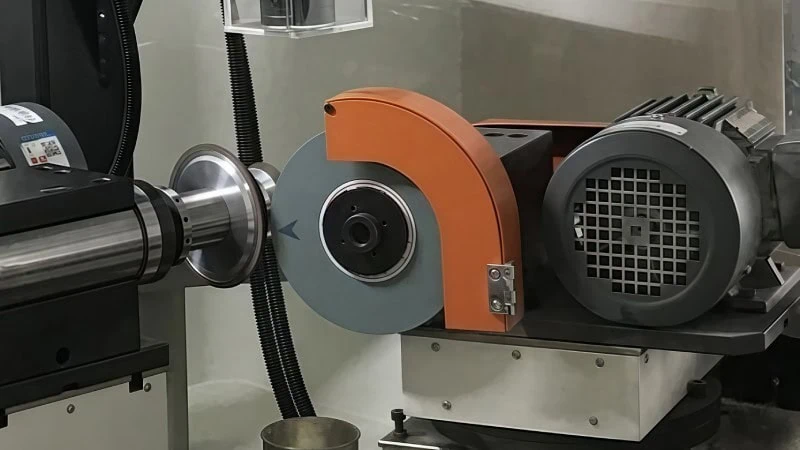
Dressing is the single most common fix for burn, loading and glazing, and it is also a common cause of them when done badly. A dull diamond polishes the wheel face instead of cutting it, sealing the pores and leaving the wheel looking dressed but acting glazed. A traverse that is too fast leaves a spiral pattern; a depth that is too light does not remove the loaded layer.
- Use a sharp dresser. Rotate or index a single-point diamond so a fresh edge does the work, and replace it when it dulls.
- Use enough depth. For precision work, a few hundredths of a millimetre per pass is typical; for rough dressing, deeper. Confirm with the wheel and dresser maker.
- Keep the traverse steady. A consistent traverse gives a uniform face. Too fast leaves ridges; too slow can burnish.
- Use coolant if the process uses it. Dressing with coolant reduces thermal shock and flushes debris.
- Dress before the wheel is fully glazed. Frequent light dressing is usually better than a heavy rescue pass.
The dressing and truing guide covers star versus diamond dressers, depth and feed starting points, and conditioning in more detail.
Coolant checks
Coolant does three jobs: it removes heat, flushes chips and lubricates the contact. If any one is missing, the wheel looks worse than it is. Check the following before changing the specification:
- Flow and pressure. Is the stream reaching the contact arc with enough force to penetrate the boundary layer?
- Nozzle position. Move it close to the wheel and aim it at the entry side of the contact, not at the guard.
- Concentration. Mix water-soluble coolant to the supplier’s range and check it with a refractometer.
- Filtration. Dirty coolant carries fines back into the cut and scratches the finish.
- Temperature and flow stability. A coolant system that surges or runs hot makes the process inconsistent.
- Compatibility. Use the coolant recommended for the workpiece and wheel bond; some processes prefer neat oil.
Speed and feed checks
Wheel surface speed is calculated from diameter and RPM:
v (m/s) = π × D (mm) × n (rpm) ÷ 60,000
For example, a 250 mm wheel running at 1,800 rpm gives about 23.6 m/s. As the wheel wears, the diameter falls and the surface speed drops at the same spindle RPM, which can change the cut and the finish. Recalculate after dressing or after significant wear. The wheel calculator does the arithmetic and also estimates removal rate and power.
For infeed and traverse, there is no universal number: it depends on wheel width, material, machine rigidity and coolant. Start conservative, then increase until the wheel starts to load or burn, and back off. A stable process is one where the wheel stays sharp and the part stays cool across a full shift, not one that looks fast on the first pass.
Vibration, chatter and balance
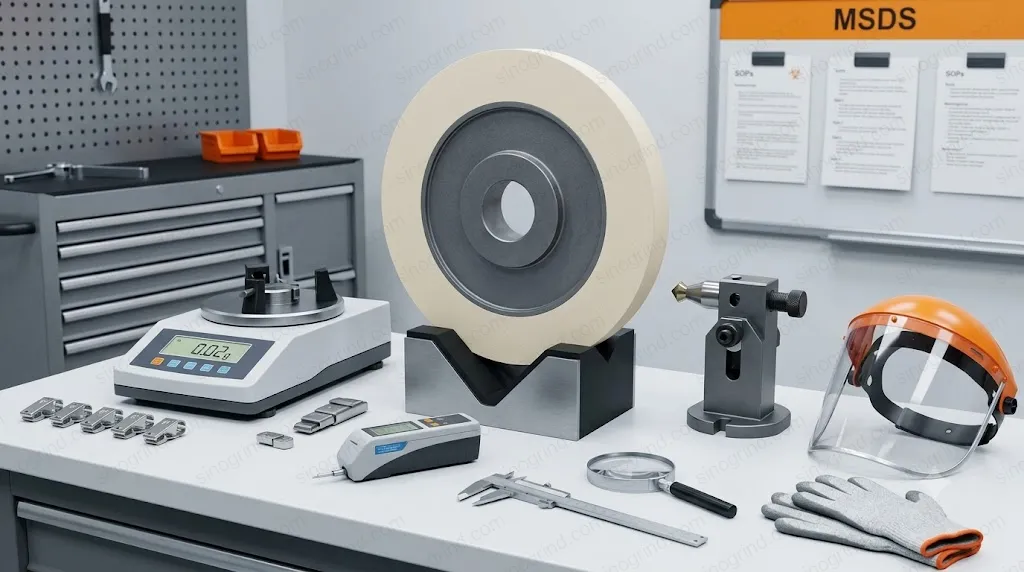
Chatter leaves regular marks on the part and accelerates wheel wear. Check the simple things first: clean flanges, a burr-free bore, even flange pressure and a wheel that is balanced for the speed. Then check the machine: spindle run-out, bearing play, fixture rigidity and table movement. A wheel that vibrates after mounting should be trued and rechecked; if it still vibrates, stop and inspect the spindle and wheel.
Never force a wheel onto a spindle or over-tighten the flanges. Use the correct flange size, a clean blotter and the manufacturer’s mounting instructions. A cracked or chipped wheel must be removed from service regardless of how small the damage looks.
What to change first
- Dress. It is quick, cheap and fixes the majority of face problems.
- Coolant. Restore flow and aim before touching the wheel specification.
- Feed and speed. Reduce infeed, check surface speed, remove dwell.
- Grade and structure. Go softer or more open if the wheel still glazes or loads.
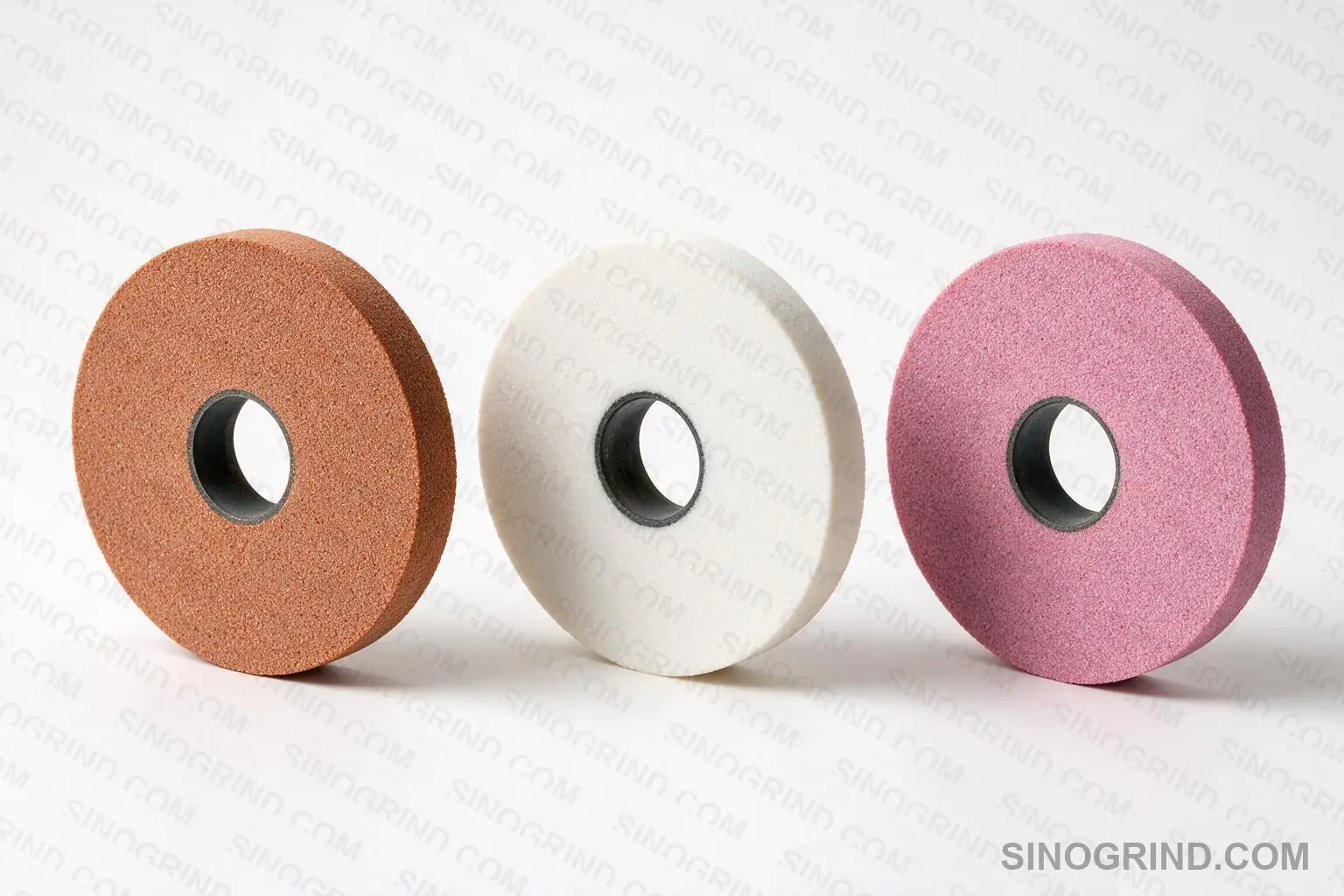
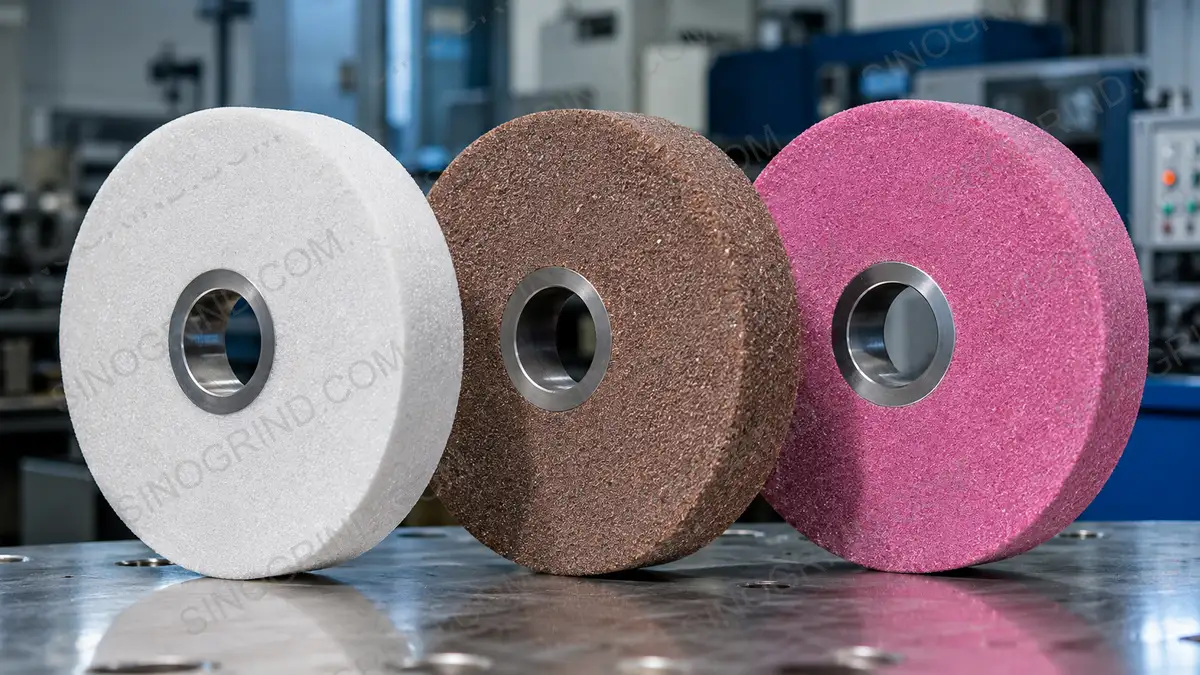
- Abrasive type. Move from brown to white for stainless or hardened work; consider pink or chrome for form retention.
- Process or machine. If none of the above holds, the limitation may be rigidity, coolant capacity or the machine itself.
If you have tried the checks and the wheel still misbehaves, send us the wheel marking, workpiece material and hardness, machine type, wheel speed, coolant and photos of the wheel face and part. Our engineers can usually narrow it down from that. Use the contact page or the specification generator to organise the details.