: +86 15874211461

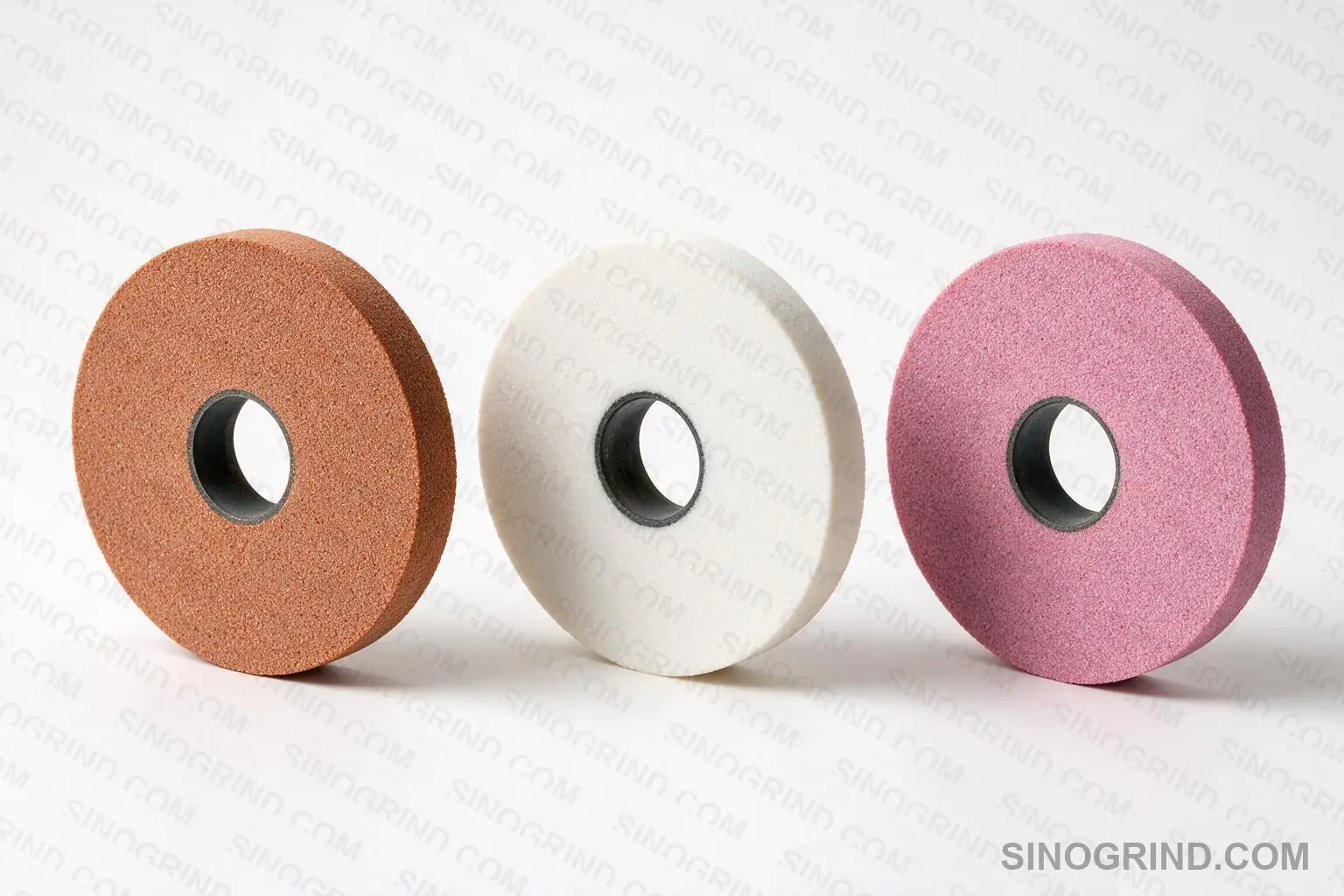
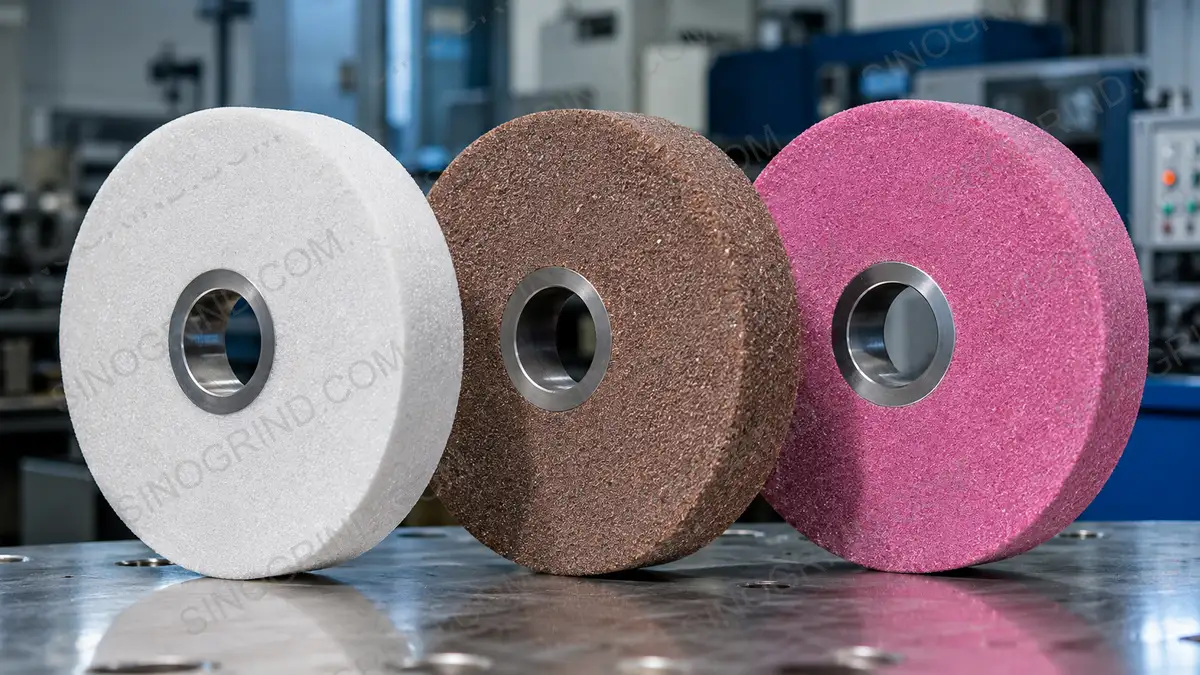
Quick answer: grit sets the finish and removal rate, grade sets how quickly dull grains release. For most steel and cast iron work, start at 46#–60# in a medium grade (J–L), vitrified bond. Use brown A for carbon steel and cast iron, white WA for stainless and hardened steel, and pink PA or chrome corundum for alloy steel and production tool grinding. Grade letters are a starting point, not a universal scale.
Related reading: Aluminum oxide grinding wheels · Corundum grinding wheel guide · Aluminum oxide vs CBN · Wheel troubleshooting.
What grit and grade actually mean
Two numbers on a wheel marking do most of the work, and they are often confused. Grit describes the size of the abrasive grains: a 46# wheel is made of relatively large grains, a 120# wheel of much smaller ones. Grade (also called hardness or bond hardness) describes how firmly the bond holds those grains. It has nothing to do with how hard the alumina itself is — all white, brown and pink corundum are aluminum oxide, roughly 9 on the Mohs scale.
That distinction matters because the two variables solve different problems. Grit controls the surface you leave and the rate at which you remove stock. Grade controls the self-sharpening behaviour: whether a dull grain is released so a fresh edge can cut, or held until it is worn flat. A wheel that is too hard for the job glazes and burns; a wheel that is too soft wears away before it has done useful work.
On bonded alumina wheels the grit number usually follows the FEPA F scale or the older ANSI/CAMI grit scale. The two are close but not identical, so quote the full marking and the standard when you order, rather than a bare number. For most shop-floor work the difference is small; for precision finishing it is worth confirming.
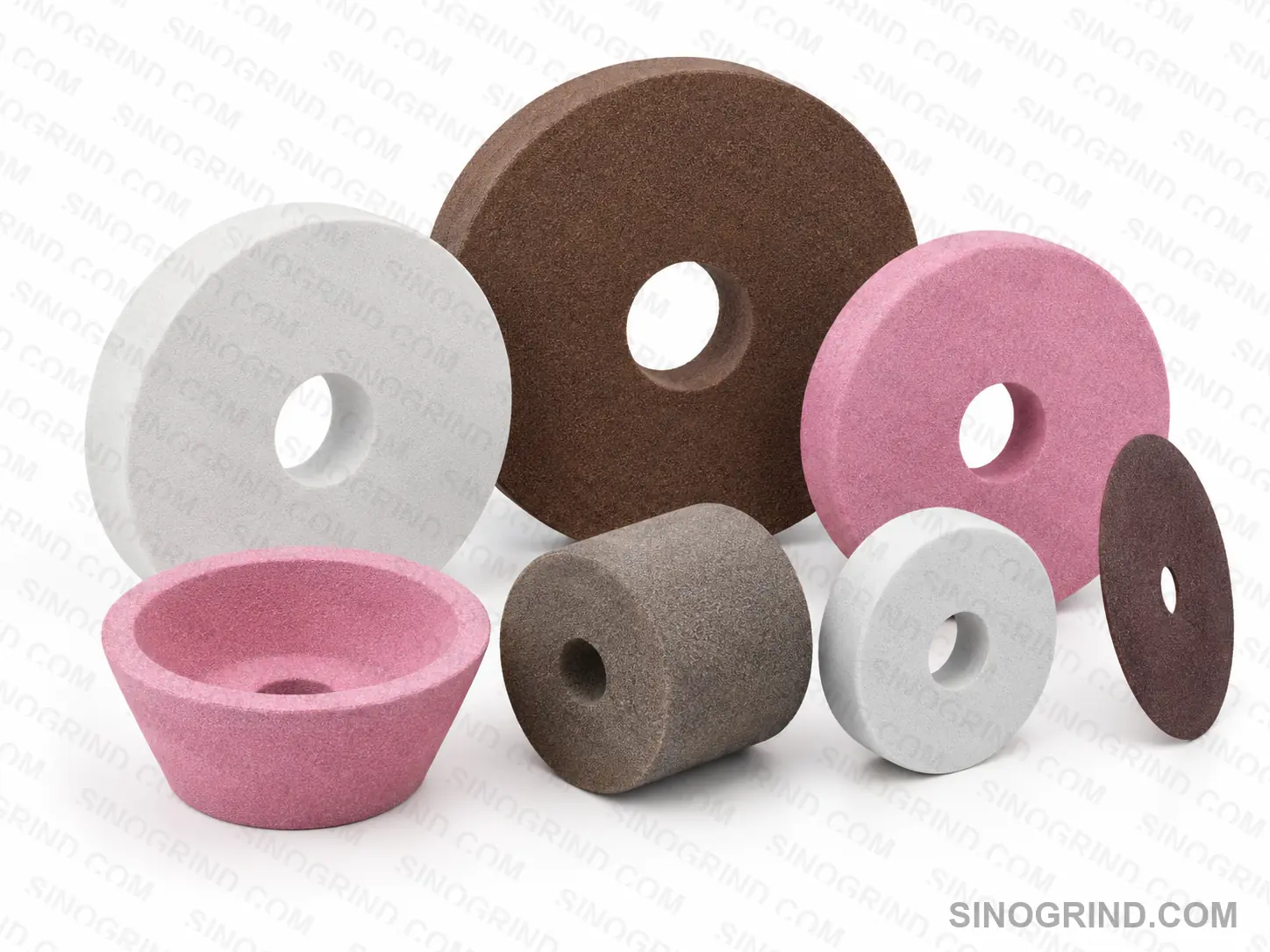
White, brown, pink and chrome corundum
All four are fused aluminum oxide, but the purity and doping change the grain shape and how it fractures. Grain that fractures into sharp sub-edges is called friable; grain that resists fracture is called tough. Friable grain cuts cooler and finishes better; tough grain survives high pressure and removes more stock per wheel.
| Type | Marking | Character | Typical work | Watch out for |
|---|---|---|---|---|
| Brown aluminum oxide | A | Tough, blocky, economical; contains a little titania | Carbon steel, alloy steel, cast iron, forgings, snagging, bench grinding | Glazes on stainless and hard tool steel if run too hard |
| White aluminum oxide | WA | High purity, friable, sharp; cuts cool | Stainless, hardened steel, HSS, tool and cutter grinding, finishing | Wears faster under heavy pressure; higher cost than A |
| Pink aluminum oxide | PA | Lightly chrome-doped; balance of toughness and sharpness | Alloy steel, tool steel, production tool grinding, cylindrical work | Not a universal upgrade; confirm against WA on your job |
| Chrome / ruby corundum | PA / chrome | Higher chrome content; dense, strong grain, good form retention | Precision cylindrical, form grinding, high-production alloy steel | Naming varies by maker; ask for the grade data, not just the colour |
Pink and ruby/chrome overlap commercially. Treat the colour as a family name and confirm purity, grain toughness and bond with the supplier.
A practical way to think about it: brown is the default when the material is forgiving and the priority is cost per kilogram removed. White is the problem-solver when heat, loading or finish is the constraint. Pink and chrome are the production grades when you need a bit more form retention than white without giving up cool cutting.
Grit ranges and what they do
Grit choice is a trade between removal rate and finish. Coarse grain takes bigger bites and leaves a rougher surface; fine grain takes smaller bites, cuts cooler at the same infeed and leaves a smoother surface, but removes stock more slowly and is more prone to loading if the wheel is too hard.
| Grit range | Typical role | Finish expectation | Notes |
|---|---|---|---|
| 16# – 24# | Snagging, weld dressing, heavy stock removal | Rough | High pressure; use a tough A grain and a hard grade |
| 30# – 36# | Rough cylindrical and surface grinding | Rough to medium | Good bridge between removal and control |
| 46# – 60# | General-purpose production grinding | Medium | The most common starting range for steel and iron |
| 70# – 80# | Medium finishing, tool grinding | Medium-fine | Often used for HSS and alloy tool steel |
| 100# – 120# | Fine finishing, sharpening, edge work | Fine | Keep the wheel open; avoid hard grades |
| 150# – 180# | Precision finishing | Very fine | Light infeed, good dressing and filtration matter |
| 220# – 400# | Fine lapping-type work | Very fine | Loading risk rises; coolant cleanliness is critical |
| 600# – 1000# | Micro-finishing and special applications | Mirror-like | Narrow application window; trial first |
Ranges are typical starting points. The achievable finish also depends on machine rigidity, dressing, coolant and wheel speed.
A common mistake is to jump two grit steps at once. If a 46# wheel is leaving too rough a finish, try 60# before going to 80# or 100#. Each step changes the balance of removal rate, heat and dressing frequency, and it is easier to see which variable helped if you move one step at a time.
Grade: the letter that controls self-sharpening
Grade letters run from soft to hard, usually G to P for alumina wheels. Soft grades have less bond between the grains, so worn grains are released sooner. Hard grades hold them longer. The right grade keeps the wheel cutting without either glazing or disappearing.
| Grade band | Behaviour | Typical use | Risk if misapplied |
|---|---|---|---|
| G – I | Soft; grains release readily | Hardened steel, stainless, large contact area, thin work | Rapid wear and loss of form if the workpiece is soft |
| J – K | Medium-soft; free cutting | Alloy steel, tool steel, general precision work | Edge breakdown on sharp forms |
| L – M | Medium; balanced | Carbon steel, general surface and cylindrical grinding | Glazing if coolant or dressing is poor |
| N – P | Hard; strong grain retention | Cast iron, mild steel, small contact area, high pressure | Burn and loading on hard or gummy materials |
Grade letters are not interchangeable between bonds or manufacturers. Use them within one product family and confirm by trial.
The classic rule is hard workpieces need soft wheels, soft workpieces need hard wheels. The reason is contact pressure. A hard workpiece resists penetration, so the grain dulls instead of biting; a soft grade lets that dull grain go. A soft workpiece lets the grain sink in, so a hard grade is needed to stop the wheel from shedding before the grain has done its work. The same logic applies to contact area: a large area (internal grinding, wide surface passes) needs a softer grade than a small area at the same pressure.
How bond and structure change the grade
The grade letter describes the bond’s grip, but the bond type and wheel structure decide how that grip behaves in the cut. This is why a resin-bond K and a vitrified-bond K are not the same wheel.
| Bond | Character | Best for | Effect on grade selection |
|---|---|---|---|
| Vitrified (V) | Rigid, porous, glass-like; easy to dress and true | Surface, cylindrical, centerless, tool grinding | Wide grade range; open structure improves coolant flow |
| Resin (B) | Flexible, shock-resistant, cooler cutting | Cut-off, snagging, portable grinding, high speed | Feels softer in the cut; grade letters are resin-specific |
| Rubber (R) | Dense, smooth, very thin sections possible | Thin cut-off, regulating wheels, precision slots | Limited grade range; choose by application |
| Magnesite (M) | Soft, cool-cutting, low strength | Some surface and segment work, non-critical grinding | Not for high speed or heavy shock |
Structure is the third variable. It describes how closely the grains are packed, usually on a numbered scale where a higher number is more open. Open structure gives chips and coolant somewhere to go, which reduces loading and burn on gummy stainless or deep cuts. Dense structure holds form and produces a finer finish, but it needs cleaner coolant and a well-dressed face. If a wheel is burning and the grade is already soft, opening the structure is often more effective than going softer still.
Application selection table
Use this table to build a first specification, then adjust one variable at a time. It assumes a conventional alumina wheel on a ferrous workpiece and a machine in reasonable condition.
| Workpiece / operation | Type | Grit | Grade | Bond / structure |
|---|---|---|---|---|
| Carbon steel roughing | Brown A | 24# – 46# | K – N | Vitrified, medium-open |
| Carbon steel general surface grinding | Brown A | 46# – 60# | J – L | Vitrified, medium |
| Alloy steel cylindrical grinding | Pink PA or brown A | 46# – 80# | J – L | Vitrified, medium |
| Hardened steel finishing | White WA | 60# – 120# | G – J | Vitrified, open |
| Stainless steel | White WA | 46# – 80# | G – I | Vitrified, open |
| Cast iron surface grinding | Brown A | 36# – 60# | L – P | Vitrified, medium |
| HSS tool and cutter grinding | White WA or pink PA | 46# – 100# | H – K | Vitrified, medium |
| Precision form grinding | Chrome / ruby | 60# – 120# | H – K | Vitrified, dense |
| Bench grinder general use | Brown A or white WA | 36# – 60# | I – L | Vitrified, medium |
| Cut-off and chop saw | Brown A | 24# – 36# | M – P | Resin, dense |
| Weld dressing and snagging | Brown A or zirconia alumina | 16# – 24# | Hard | Resin, dense |
| Thin slot and cut-off (precision) | White WA | 80# – 120# | J – L | Rubber or resin |
Starting points only. Confirm wheel speed rating, maximum RPM and safety requirements for your machine before use.
Reading a marking: WA46K5V
A conventional wheel marking packs the whole specification into a short code. WA46K5V reads as: WA = white aluminum oxide, 46 = grit, K = grade, 5 = structure, V = vitrified bond. Brown is A, pink is PA, and a chrome/ruby grade may appear as PA or with the maker’s own prefix. Some makers add a manufacturer code and a maximum speed after the bond letter.
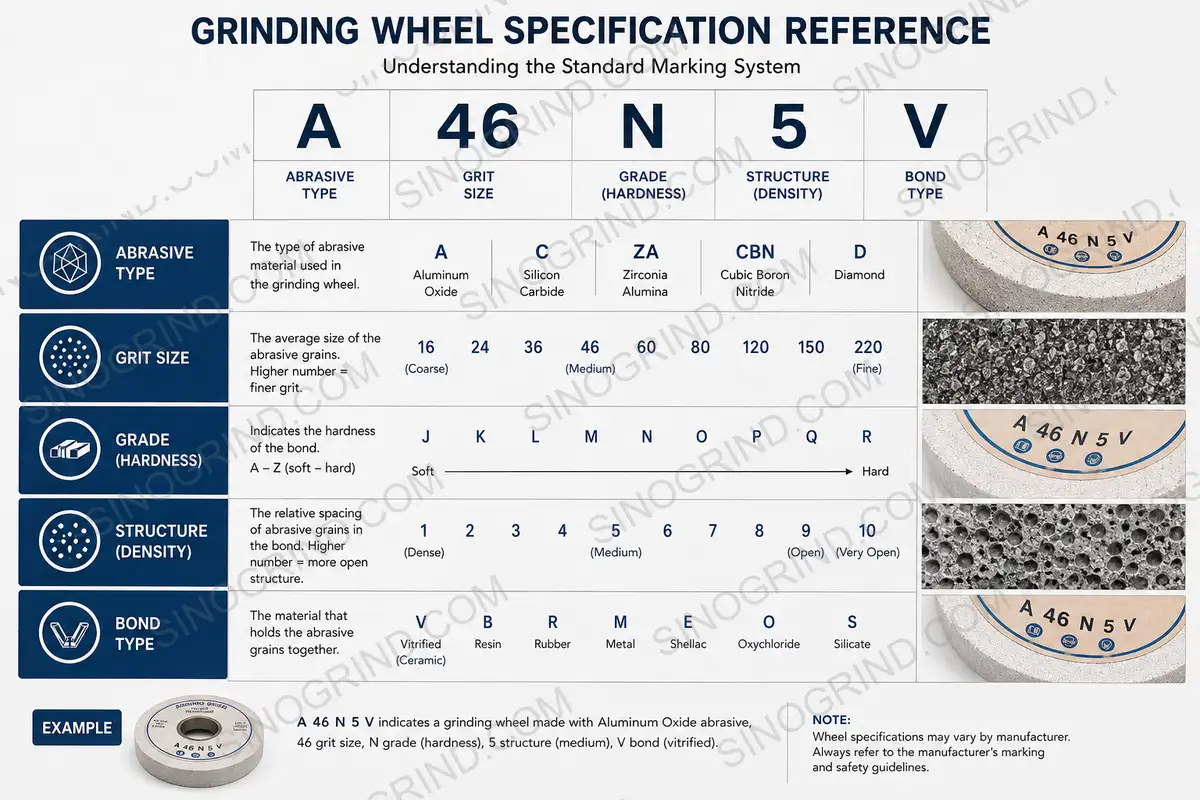
When you request a quote, give the full marking plus the wheel dimensions, bore, maximum operating speed and the job it is doing. If the current wheel is not marked, describe the material, operation, finish target and machine. Our specification generator can help assemble the details, and the bond selection tool is useful when the bond is the open question.
Common mistakes
- Buying hardness by habit. “We always use K” is not a specification. Hardness must match the workpiece and contact area, not the last job.
- Going too fine too early. A 120# wheel cannot do the work of a 46# wheel. Remove stock coarse, then finish fine.
- Using a hard brown wheel on stainless. It glazes, loads and burns. White WA in a softer grade is the usual fix.
- Comparing grade letters across bonds. Resin K and vitrified K are different wheels. Compare within a product family.
- Ignoring structure. If the wheel is burning, opening the structure can help more than softening the grade.
- Dressing with a dull diamond. A blunt dresser polishes the wheel face and seals the pores, which looks like a “bad wheel” but is a dressing problem. See the dressing and truing guide.
- Running beyond the rated speed. Wheel speed is a safety limit, not a tuning parameter. Check the blotter and the machine RPM.
- Using alumina on carbide or ceramic. The abrasive is too soft for the work; use diamond instead.
How to run a first trial
- Record the baseline. Note the current marking, wheel speed, infeed, traverse, coolant and the finish or cycle time you get.
- Change one variable. Start with grit if the finish is wrong, grade if the wheel is burning or wearing too fast, and structure if loading is the issue.
- Dress consistently. Use the same dresser, depth and traverse for every trial, otherwise you are measuring the dressing, not the wheel.
- Run a short batch. Check the first part, then a part after the wheel has warmed up. Alumina wheels often settle after a few minutes.
- Measure what matters. Finish, cycle time, dress frequency, wheel wear and scrap rate. Cost per good part is the only comparison that matters.
- Scale up carefully. A specification that works on one machine may not transfer to a smaller or less rigid machine.
If the wheel burns, loads or glazes after a sensible specification change, work through the troubleshooting guide before changing the wheel again. Most “wrong wheel” problems are actually dressing, coolant or speed problems.