: +86 15874211461

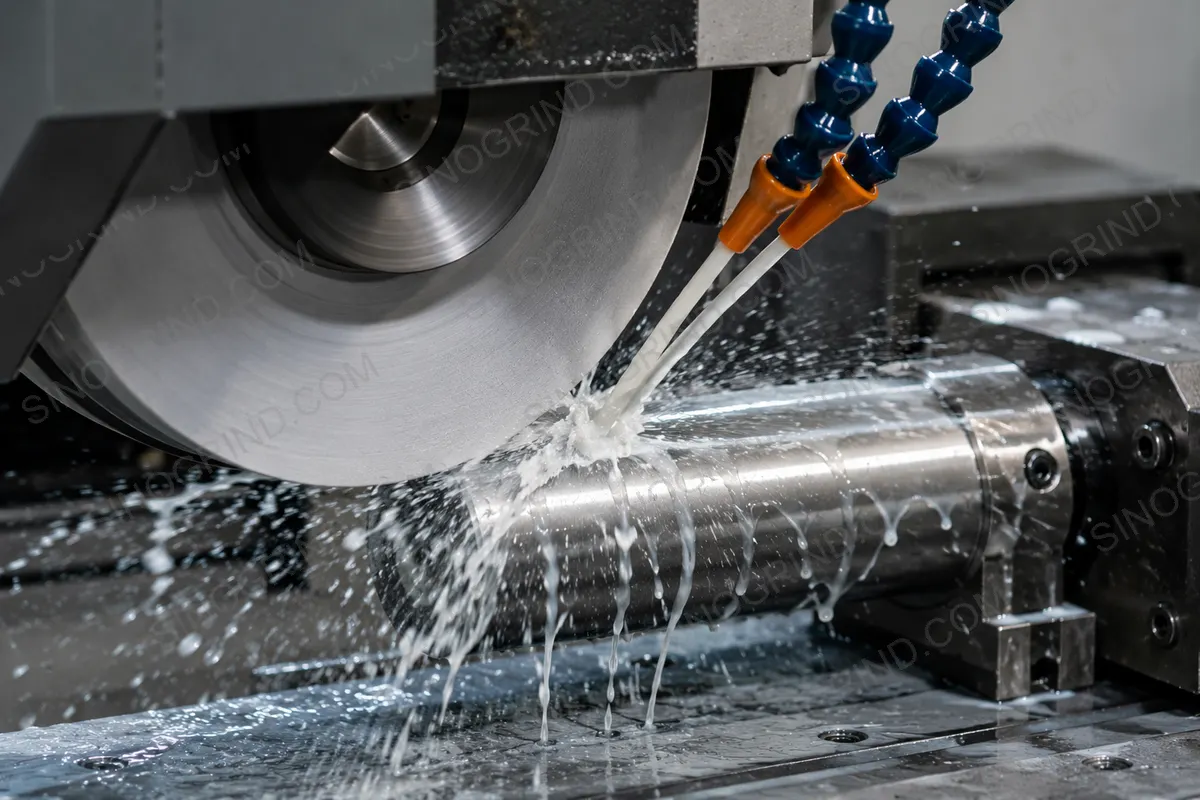
Quick answer: Set CBN speed as a peripheral speed, not an RPM. Typical starting ranges are 25–45 m/s for vitrified and metal bond and 20–35 m/s for resin bond, always below the wheel marking. Use flood coolant aimed at the contact arc, with clean filtration and enough flow to clear heat. If the part burns, fix coolant delivery, infeed and wheel dressing before changing the wheel.
Related reading: CBN grinding wheel guide · CBN dressing and truing · CBN wheel troubleshooting.
Peripheral speed is the number that matters
A CBN wheel is rated by peripheral speed, usually in metres per second. Spindle RPM alone tells you nothing about how fast the abrasive is moving because the same RPM produces a much higher surface speed on a large wheel. The relationship is simple: peripheral speed equals pi times diameter times RPM, divided by 60 when diameter is in metres.
For example, a 400 mm wheel running at 1,670 rpm has a peripheral speed of about 35 m/s. The same spindle speed on a 250 mm wheel gives only about 22 m/s. When you change wheel diameter, recompute the speed. Use the diamond and CBN wheel calculator to convert between RPM, diameter and surface speed without arithmetic errors.
The maximum speed marked on the wheel is a safety limit established for that wheel construction. It is not a recommended operating point. Run below it with margin, and never exceed the lower of the wheel rating and the machine/spindle rating.

Typical speed ranges by bond
| Bond | Typical starting range | Character at higher speed | Cautions |
|---|---|---|---|
| Vitrified CBN | 25–45 m/s | More cuts per second, better finish and form life in controlled production | Brittle bond; balance, guard rating and coolant must support the speed |
| Resin CBN | 20–35 m/s | Cooler cutting at moderate speed; resin limits high-temperature operation | Resin softening and wear accelerate if speed or load is too high |
| Metal-bond CBN | 25–45 m/s | High removal and long form life in creep feed | Heat generation and poor porosity; high-pressure coolant is often needed |
| Electroplated CBN | 20–40 m/s | Thin profiles and small tools at conservative load | Single layer; grain pull-out and plating damage if overloaded |
Starting points only. High-speed CBN systems operate above these ranges where the wheel, spindle, guard, fixture and coolant are specifically rated. Verify with the wheel manufacturer and machine builder.
Setting speed for a new job
Start in the lower half of the range for the bond, establish a stable cut, then increase speed only if the process is stable and the benefit is measurable. Higher speed generally improves finish and reduces the chip thickness per cutting edge, but it also raises the heat input per unit time and demands better coolant delivery. On a machine with marginal coolant or rigidity, a lower speed is often the more productive choice because it avoids burn and dressing downtime.
Watch spindle power and acoustic behaviour as you change speed. A sudden rise in power or a change in sound usually means the wheel is loading or the cut is rubbing rather than cutting. Back off and inspect the face before continuing.
What coolant has to do
Coolant performs four jobs in CBN grinding: it removes heat from the contact arc, flushes chips so the wheel does not load, lubricates the grain-workpiece interface to reduce friction, and keeps the wheel and workpiece at a stable temperature. In form and gear grinding it also carries away dressing debris and helps maintain a clean wheel face.
| Coolant type | Typical use | Strengths | Limits |
|---|---|---|---|
| Water-soluble emulsion, 5–10% | General surface, cylindrical and internal grinding | Good cooling, easy handling, compatible with most steels | Can foam, leave residue, or corrode if concentration is wrong |
| Neat oil | Vitrified CBN gear, profile and creep-feed grinding | Excellent lubrication and heat removal; keeps form clean | Fire risk, mist, higher cost, compatibility with the machine and filters |
| Synthetic / semi-synthetic | Cleaner precision operations | Good stability and cleanliness | Lubricity may be lower than neat oil in heavy form work |
| High-pressure coolant | Creep feed and difficult form grinding | Penetrates the contact arc and clears chips | Needs proper nozzle, filtration and machine drainage |
| Mist / MQL | Light tool grinding and limited-access work | Low volume, good visibility | Not sufficient for heavy or form grinding; health controls required |
Flow, pressure, aim and filtration
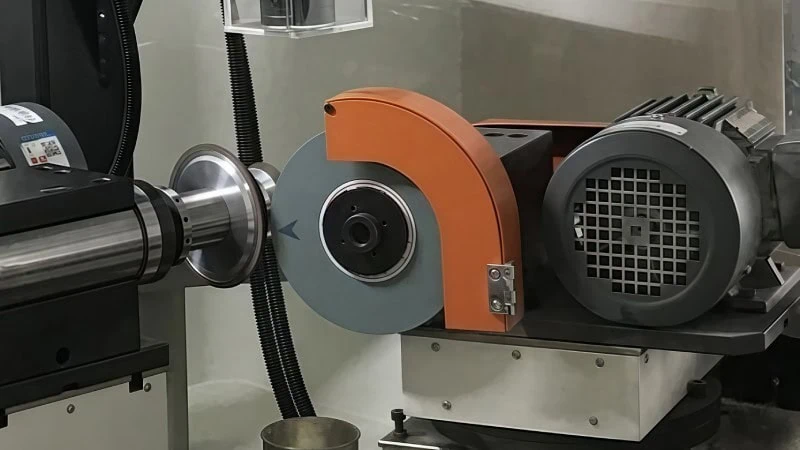
A large tank and a noisy pump do not prove that coolant reaches the cut. The nozzle must be close to the contact arc, aimed in the direction of wheel rotation, and shaped to match the width of the cut. Flow should be enough to flood the arc and flush chips, not merely wet the guard. Pressure should be high enough to penetrate the boundary layer of air that the wheel carries, especially at higher speed.
| Parameter | Typical starting point | What to check |
|---|---|---|
| Flow, surface and cylindrical | 20–60 L/min | Arc is flooded; chips leave the zone; no dry patches |
| Flow, creep feed and form | Higher, application-specific | High-pressure nozzles, adequate tank and chiller capacity |
| Nozzle position | Close to the contact arc | Aim in the direction of rotation; avoid shadows cast by the guard |
| Nozzle velocity | Approximately matching wheel speed | Too low and the coolant is thrown away; too high and it splashes |
| Filtration, general | 20–50 µm | Remove fine steel and bond particles that cause scratches |
| Filtration, precision / oil | 10 µm or finer | Protect fine grit and form; monitor filter pressure |
| Concentration | Per coolant supplier, typically 5–10% for emulsion | Refractometer check; top up with premix, not neat water |
Values are orientation only. Confirm flow, pressure and filtration with the wheel manufacturer and coolant supplier for your operation.
Burn: what it looks like and what causes it
Burn is thermal damage to the workpiece surface. On hardened steel it may appear as straw, brown or blue temper colours, but colour is not a reliable test: a lightly burned surface can look normal. Other signs include a drop in hardness, a white or dark layer under etching, micro-cracks, a sudden rise in spindle power, a change in grinding sound, and a finish that drifts even though the wheel has not worn noticeably.
| Sign | Likely cause | First fix | Then check |
|---|---|---|---|
| Temper colours on hardened steel | Heat input exceeds coolant removal | Restore nozzle aim and flow; reduce infeed | Wheel hardness, concentration and speed |
| Power rises steadily | Wheel loading or glazing | Dress the wheel; increase coolant flow | Filtration, grit and bond openness |
| Burn only on one side of the wheel | Coolant shadow or wheel taper | Reposition nozzle; true the wheel | Spindle alignment and wheel balance |
| Burn at the start of the cut | Cold wheel, dry contact, too much infeed | Prime the cut with coolant; ramp infeed | Machine thermal stability |
| Burn after a dress | Face too closed or dresser too dull | Condition the face; replace or rotate the dresser | Dressing parameters |
| Burn with fine grit at normal load | Concentration or bond too tight | Open the structure or reduce concentration | Coolant pressure at the arc |
If burn appears, stop and inspect before running more parts. A burned surface may still measure within size, so dimensional checks alone will not catch it. Use a hardness check or a controlled etch on a sample when the process is new or when the material changes.
The CBN wheel troubleshooting guide extends this table to loading, chatter, short life and form loss.
Coolant maintenance that prevents burn
- Check concentration weekly with a refractometer and top up with premix. Dilution changes cooling and corrosion protection.
- Remove tramp oil and sludge before they emulsify. Dirty coolant both cools poorly and deposits on the wheel.
- Clean or replace filters on pressure rise, not only on a calendar. A bypassing filter sends debris back to the cut.
- Inspect nozzles for wear and blockage. A partially blocked nozzle can starve one side of a wide wheel.
- Control temperature with a chiller or adequate tank volume on precision work. Coolant temperature swings move the workpiece size.
- Keep the wheel guard and splash guards sealed so flow reaches the arc instead of escaping.
High-speed CBN: extra demands
High-speed CBN grinding can raise productivity and improve finish, but it multiplies the requirements on the whole system. Wheel balance must be better, the guard and spindle must be rated for the speed, the coolant nozzle must penetrate a stronger air barrier, and the fixture must control vibration. A wheel that runs acceptably at 30 m/s may chatter or burn at 60 m/s if balance and coolant are not upgraded.
Do not treat a higher speed as a free productivity gain. Increase it in steps, monitor power, finish, wheel wear and spindle temperature, and stop if the process becomes less stable. The wheel marking is a limit, not a target, and the machine builder may impose a lower limit for the spindle and tooling.
When coolant causes defects
Coolant can create problems as well as prevent them. Dirty coolant deposits fines on the wheel face and scratches the workpiece. Foam reduces effective flow and can starve the pump. Wrong concentration causes corrosion, residue or poor lubrication. Tramp oil emulsified into water-based coolant can cause loading and rancidity. A nozzle aimed at the wrong angle can cool the wheel rim but miss the contact arc entirely.
When a finish or loading problem appears suddenly, inspect the coolant before changing the wheel. Look for a changed colour, smell, foam, sludge or filter pressure. A coolant service is often cheaper and faster than a new wheel specification, and it removes a variable that would otherwise confound the trial.
Speed, coolant and the G-ratio
A process that burns is not efficient, even if the wheel lasts a long time. The useful target is a stable G-ratio at a finish and surface integrity level the part can accept. Increasing speed or infeed may raise removal rate but can push the process into burn and scrap. Reducing speed and improving coolant often raises good-part output because it eliminates rework and dressing downtime.
Record speed, flow, pressure, coolant concentration, dress frequency and power for each job. Those records turn a wheel change from guesswork into a controlled experiment.