: +86 15874211461

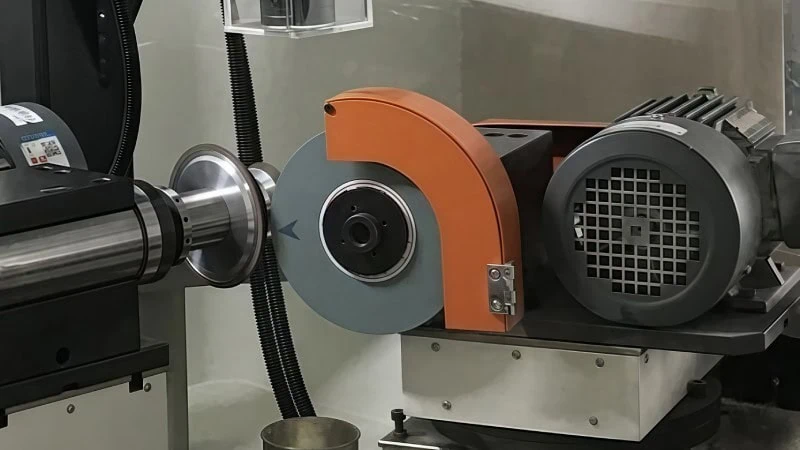
Quick answer: True the CBN wheel with a sharp diamond dresser at light infeed to restore geometry, then dress or condition the face with an alumina stick, soft steel or a controlled diamond pass until fresh grains cut freely. Use the smallest depth that restores performance, keep the traverse consistent, and dress on a trigger such as power rise, finish drift, loading or burn — not only on a fixed schedule.
Related reading: CBN grinding wheel guide · CBN wheel bond types · CBN speed and coolant.
Truing and dressing are not the same operation
Truing is about geometry. It removes enough material to make the wheel round, concentric and correctly profiled relative to the spindle. Dressing is about the cutting surface. It removes bond or debris so that sharp CBN grains are exposed and the wheel cuts freely instead of rubbing. A wheel can be perfectly true and still cut badly because the face is glazed; it can also be sharp but out of round.
On CBN wheels both operations consume the working layer, which is thin and expensive. The objective is therefore to achieve geometry and sharpness with the minimum removal. Heavy, frequent dressing is one of the most common ways to turn a long-life CBN wheel into a short-life one.
Dresser types
| Dresser | Best for | Character | Cautions |
|---|---|---|---|
| Single-point diamond | Straight-face vitrified and resin CBN | Simple, accurate, widely used | Point wears; rotate or index; do not use a dull point |
| Blade / chisel diamond | Straight faces and form touch-up | More contact, faster truing | Higher force; keep passes light on CBN |
| Rotary diamond roller | Vitrified CBN form, gear and production wheels | Consistent profile, good for CNC dressing | Requires speed-ratio control and rigid dressing spindle |
| Diamond disc | Face and cup wheels | Broad contact, efficient | Heat and force; verify coolant and direction |
| Diamond dressing gear | Threaded vitrified CBN gear wheels | Generates the worm profile | Profile-specific; alignment and ratio are critical |
| Alumina stick / soft steel | Conditioning vitrified and resin CBN | Opens the face without significant profile change | Not a substitute for truing; use light pressure |
| SiC stick / electrolytic | Metal-bond CBN | Opens a closed metal bond | Process-specific; confirm with the wheel maker |
Stationary diamond dressing
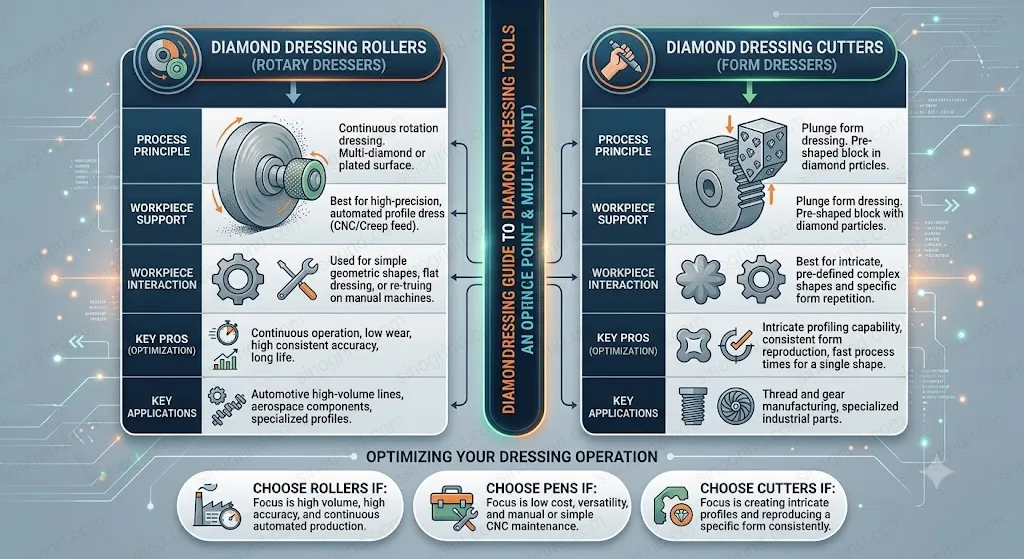
For a straight-face vitrified CBN wheel, mount a sharp single-point or blade diamond rigidly and set it slightly below centre, depending on the machine and dresser design. Use a small depth of cut, a consistent traverse and several spark-out passes. The first pass establishes contact; the following passes remove the minimum needed to clean up. Feeding too deep in one pass generates force, chips the bond and may damage the diamond.
Keep the dresser sharp. A dull diamond rubs, burns the bond and produces a glazed face that will burn the workpiece. Index or rotate the diamond according to its design, and replace it when it stops cutting. Never use a cracked or poorly brazed dresser.
Rotary dressing and form wheels
Rotary diamond rollers are used where the profile must be generated accurately and repeatedly, especially on vitrified CBN gear, profile and creep-feed wheels. The dresser and wheel rotate in a controlled speed ratio, and the infeed is programmed in small increments with spark-out. The setup is less forgiving than stationary dressing: roller run-out, alignment, ratio, coolant and machine rigidity all affect the result.
For threaded gear wheels, a diamond dressing gear or profile roller generates the worm form. The dresser must match the required module and pressure angle, and the dressing program must account for wheel wear. Inspect the first parts after dressing, not just the wheel.
Touch dressing
Touch dressing removes a very small amount of bond to restore sharpness without changing the profile significantly. It is useful in production when the wheel is still geometrically good but has begun to glaze. Infeed is typically a few micrometres, with one or two passes and no attempt to correct size. Because the depth is so small, machine resolution, thermal stability and dresser condition matter more than on a conventional dress.
Touch dressing is not a fix for a wheel that is out of round or loaded deep in the pores. In those cases, true the wheel and clean the coolant system first.
Conditioning after truing
A freshly trued CBN wheel can be too closed to cut. Conditioning opens the bond bridges and exposes grain. On vitrified and resin CBN, an alumina stick or a soft steel block applied lightly across the face is a common method. On metal bond, a silicon carbide stick or an electrolytic process may be needed. The goal is a uniform, open face, not a polished one.
Condition with coolant running and at a conservative wheel speed. Stop when the face looks even and the wheel cuts without rubbing. Over-conditioning rounds the grain and removes bond that was doing useful work.
Typical dressing parameters
| Parameter | Typical starting point | Notes |
|---|---|---|
| Depth per pass, stationary diamond | 0.005–0.02 mm | Lighter for fine grit and form; several passes rather than one deep pass |
| Traverse rate | Moderate and consistent | Too fast leaves a helical pattern; too slow burns the bond |
| Spark-out passes | 1–3 | Clean up without additional infeed |
| Touch dressing depth | A few µm | Restore sharpness, not geometry |
| Rotary dresser speed ratio | Set by wheel and dresser design | Follow the wheel maker's recommendation; verify on the first part |
| Coolant during dressing | On, aimed at the contact | Flush dressing debris; protect the dresser and wheel |
Starting points only. The correct values depend on bond, grit, concentration, wheel size, machine and dresser. Confirm with the wheel manufacturer.
When to dress
Dress on evidence, not habit. Useful triggers include a rise in spindle power of roughly 20–30% above the stable baseline, a drift in Ra or visual finish, loading visible on the wheel face, burn or temper colours, chatter, or a change in grinding sound. In high-volume production, a fixed interval may be appropriate once the wear curve is known, but the interval should be based on measured behaviour.
| Trigger | What it suggests | Action |
|---|---|---|
| Power rise with stable infeed | Face dulling or loading | Touch dress; inspect coolant and filtration |
| Finish drift | Grain flattening or wheel glazing | Dress and condition; check grit and bond |
| Burn | Heat, dull face or coolant starvation | Fix coolant, dress, reduce infeed |
| Form/size drift | Wheel wear or dresser wear | True the wheel; inspect the dresser |
| Chatter after a wheel change | Balance, mounting or dresser run-out | Balance and indicate before dressing further |
Dressing a form wheel without losing the profile
Form wheels carry the part geometry in a narrow rim, so every dressing pass is a withdrawal from a finite profile budget. Establish the wheel position and dresser reference before the first pass, and record the offsets. Use a CNC dressing cycle with small increments rather than manual jogging, and let the machine spark out at the end of the cycle. If the profile is complex, inspect a dressed part or a profile trace before running production.
Dresser wear changes the profile gradually. A diamond roller that has lost a corner will produce a rounded form that may still pass a visual check. Track the number of dresses per dresser and inspect the roller or dressing gear at a defined interval. For gear wheels, check the first article for profile slope and pressure-angle error, not only size.
Check the dress before blaming the wheel
After dressing, run a short test and look at four things: does the wheel cut freely, is the power stable, is the finish uniform across the face, and is the geometry correct. A wheel that cuts on one side only may have a taper or a coolant shadow. A wheel that sparkles and rubs may be too closed. A wheel that produces a helical pattern may have been traversed too fast.
Record the dresser type, dress depth, traverse, speed ratio and number of spark-out passes. When the job repeats months later, that record is the difference between a quick setup and a day of trial and error.
Safety and handling
CBN wheels are safe when treated as precision abrasive tools, but they store significant energy at operating speed. Inspect for cracks or chipped rims before mounting, use the correct flanges and torque, and never exceed the marked speed. Stand clear during the first run after mounting or dressing, and use the machine guard. Diamond dressers are brittle and can shatter if overhung or misaligned, so mount them with minimum overhang and the recommended support.
Store wheels in a dry, stable place and protect the working layer from impact. A chipped CBN rim is not a cosmetic problem; it changes balance and can propagate. When in doubt, remove the wheel from service.
Common mistakes
- Dressing too deep. It removes expensive working layer and shortens life without improving the cut.
- Using a dull diamond. The dresser rubs, the face glazes and the next part burns.
- Dressing without coolant. Heat damages the bond and the dresser, and debris stays in the face.
- Conditioning until the wheel is polished. A closed, shiny face is not sharp.
- Changing the wheel before checking the dresser. Many “bad wheels” are bad dresser setups.
- Ignoring run-out. Truing cannot compensate for a poorly mounted wheel or a damaged spindle taper.
If dressing does not restore performance, work through the troubleshooting sequence before ordering a different wheel. The cause is often mounting, coolant or parameter related.