: +86 15874211461

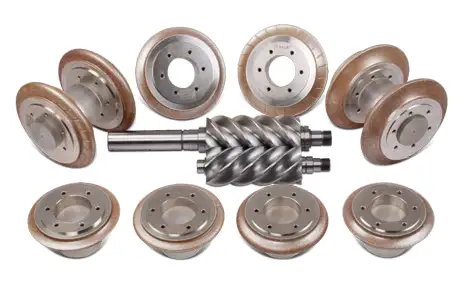
Quick answer: Use a CBN (cubic boron nitride) wheel for ferrous work — hardened steel, HSS, tool and die steel, cast iron, bearing and gear steel. Start with a vitrified bond, B91–B126 grit and 100–125% concentration for general precision work; use resin bond for cool-cutting tool grinding and metal bond for heavy removal or long form life. Never use diamond on steel.
Related reading: CBN grinding wheel selection for hardened steel, HSS and cast iron · CBN wheel bond types compared · CBN grit and concentration guide.
What is a CBN grinding wheel?
CBN is cubic boron nitride, a synthetic superabrasive first commercialised as Borazon. It is the second-hardest material in common industrial use after diamond, with a Knoop hardness in the region of 4,500–4,700 kg/mm² depending on the crystal grade. More important for grinding, CBN is chemically stable against iron at normal grinding temperatures, which is exactly where diamond fails.
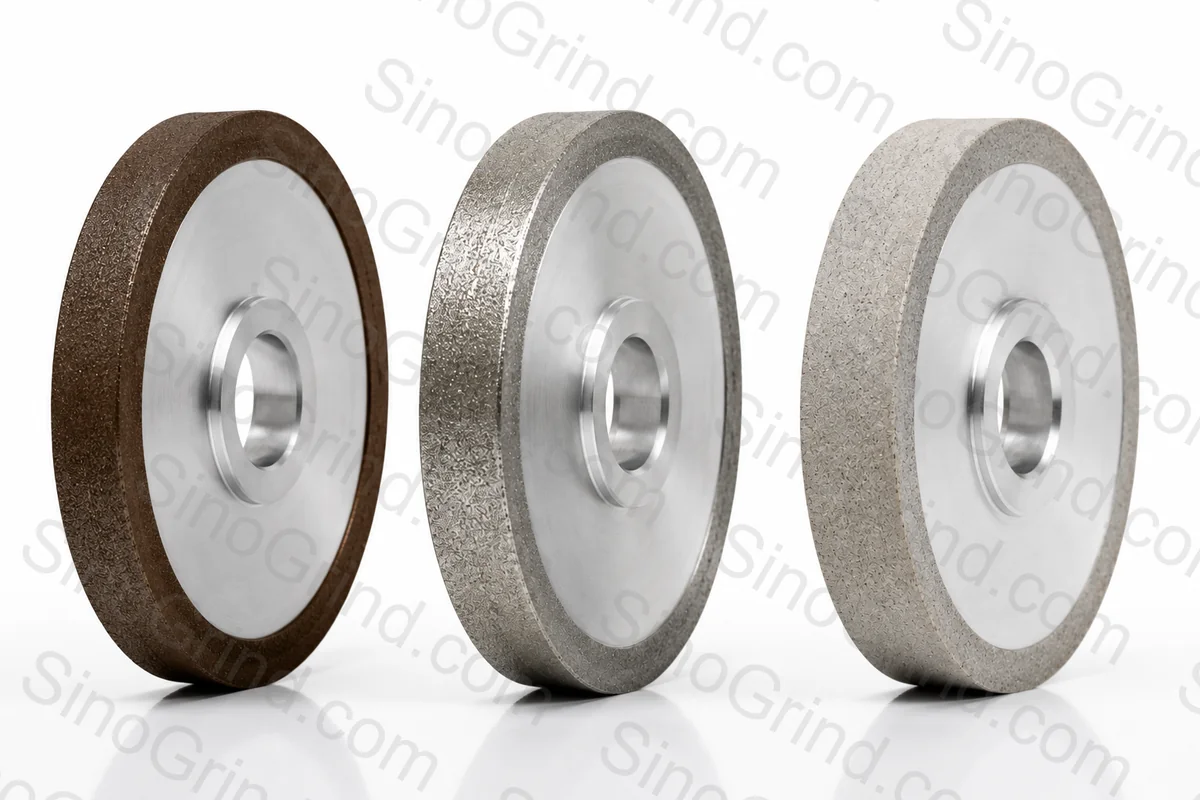
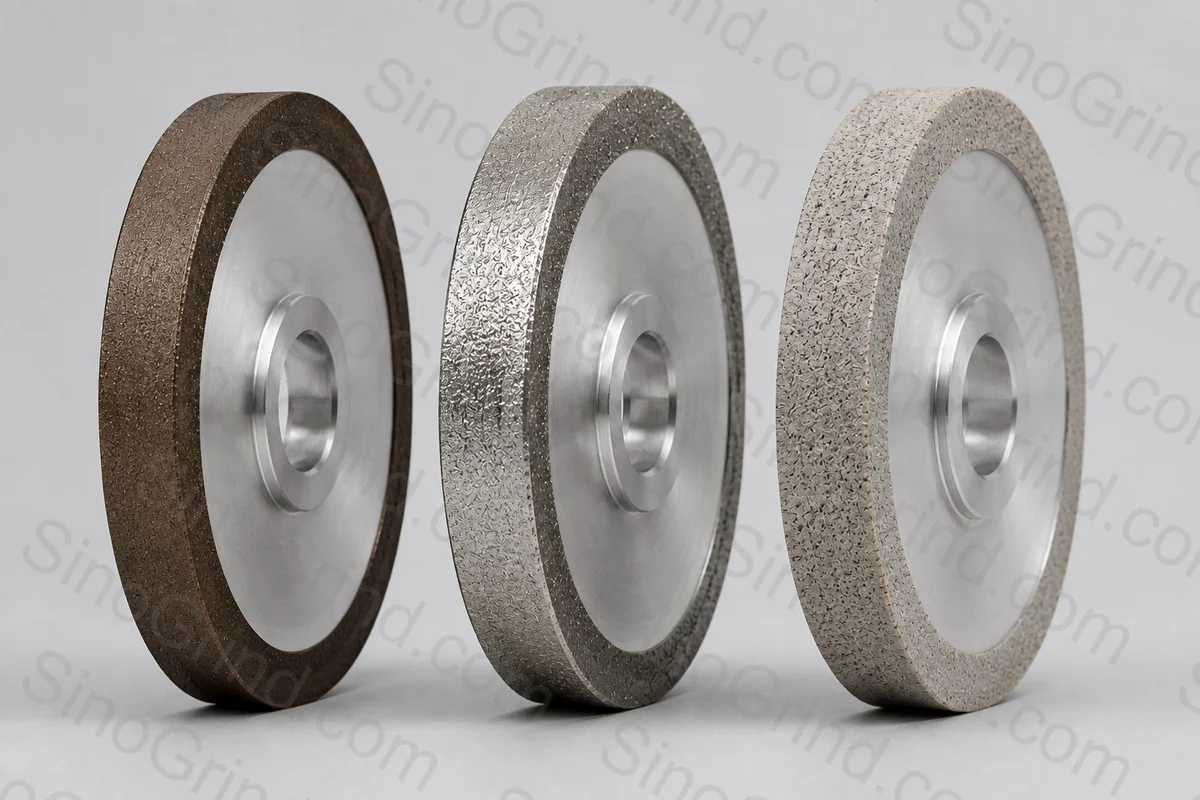
A CBN wheel is a composite: a thin working layer of CBN grains held in a bond, mounted on an aluminium, steel or Bakelite core. The core carries the load and transmits spindle torque; the working layer does the cutting. Wheel behaviour is therefore set by four things: the abrasive grade, the bond, the grit size and the concentration. Shape and core quality decide whether that behaviour reaches the workpiece accurately.
| Property | CBN (Borazon) | Diamond |
|---|---|---|
| Hardness | Very high, second only to diamond | Highest of all abrasives |
| Ferrous workpieces | Correct choice — chemically stable against iron | Not suitable — carbon reacts with iron |
| Non-ferrous workpieces | Generally not economic | Correct choice — carbide, ceramic, glass, graphite |
| Thermal behaviour | Tolerates higher grinding temperatures | Graphitises at high temperature, especially in air |
| Typical uses | Hardened steel, HSS, cast iron, bearing and gear grinding | Carbide tools, ceramics, optics, wafers, composites |
Property values are indicative; exact grade behaviour depends on crystal type, coating and bond.
Why CBN is the ferrous abrasive
At grinding temperatures, carbon from diamond dissolves into iron and forms iron carbide. The diamond surface graphitises, the grain dulls rapidly and the wheel stops cutting long before it has done useful work. CBN does not share that reaction with iron, so it keeps a sharp cutting edge on steel and cast iron. This is the single most important selection rule in superabrasive grinding.
Boundary rule — diamond must not grind steel
Use CBN for steel, hardened steel, cast iron, HSS and other ferrous alloys. Use diamond for cemented carbide, ceramics, glass, silicon, sapphire, ferrite, graphite and composites. Diamond on steel wears abnormally and can destroy the wheel and the part. For mixed parts, grind each feature with the correct abrasive.
Nickel- and cobalt-based superalloys are a nuanced case. CBN is widely used, especially in vitrified form for creep-feed and profile grinding, but some alloys are abrasive and chemically aggressive enough that the optimum may be a ceramic abrasive or a specific CBN grade. Treat supplier recommendations as a starting point and confirm with a trial on your machine.
CBN wheel bond types
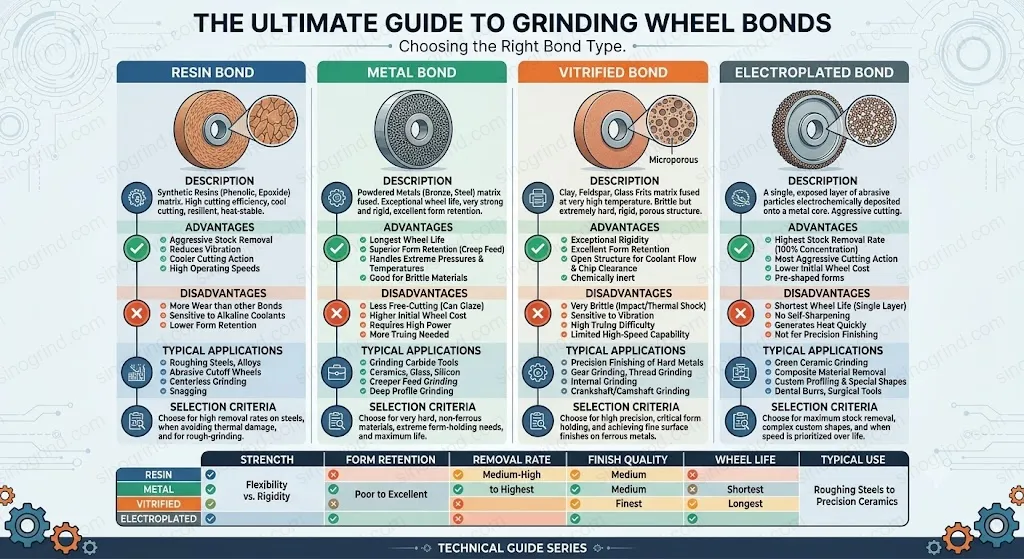
The bond controls grain retention, porosity, heat generation and the way the wheel is maintained. Four bond families cover most industrial work.
| Bond | Character | Best for | Limitations |
|---|---|---|---|
| Vitrified | Glass-ceramic, rigid, porous, self-sharpening | Precision surface, cylindrical, internal, gear and profile grinding; form retention with cool cutting | Brittle; needs flood coolant; sensitive to thermal shock and impact |
| Resin | Phenolic resin, slightly flexible, easy to dress | Tool and cutter grinding, flute and gash work, general finishing | Lower form retention and heat resistance; wears faster under heavy load |
| Metal | Sintered bronze or cobalt matrix, very strong | Heavy removal, creep feed, long form life, high-volume production | Hard to dress; runs hotter; needs rigid machine and good coolant |
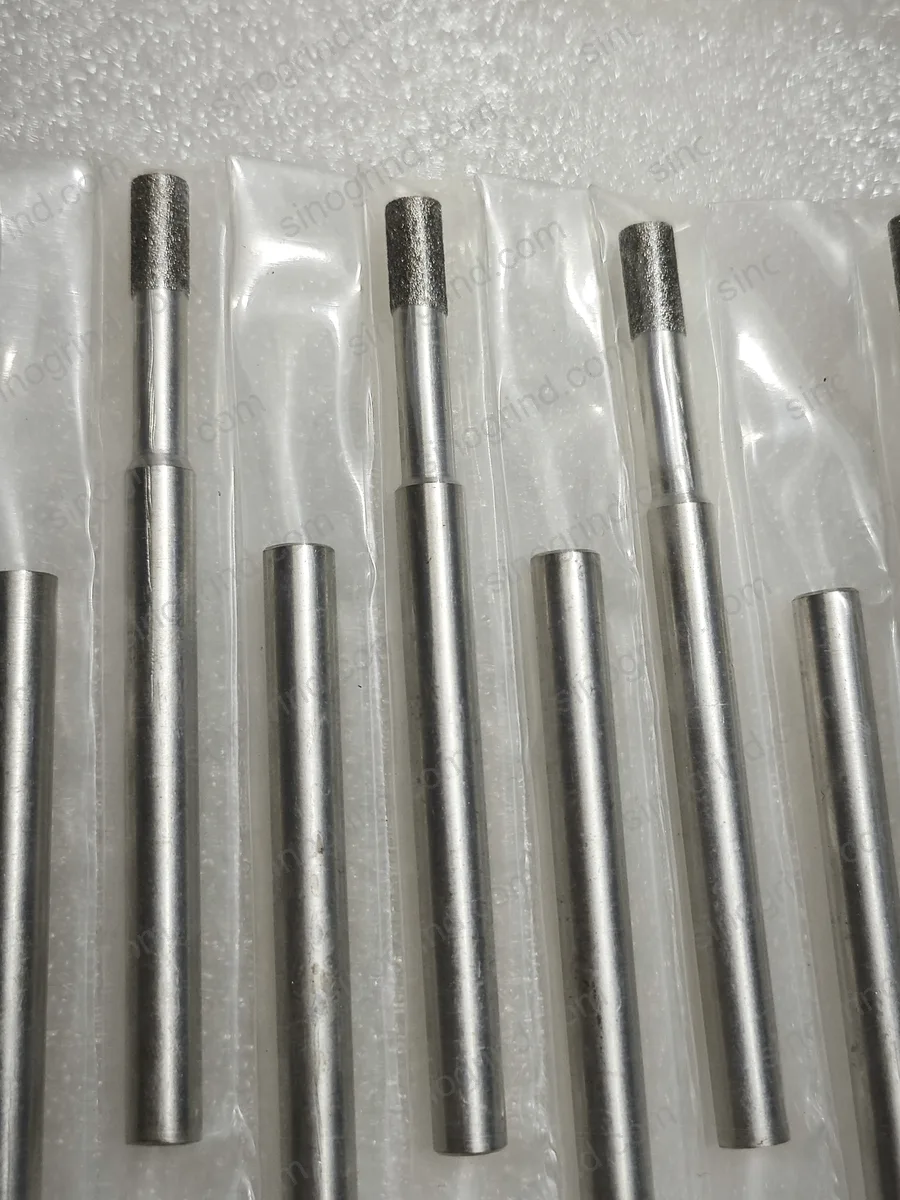
| Electroplated | Single layer of grains on a plated shank or rim | Thin profiles, internal work, mounted points, small form tools | One layer only; cannot be re-profiled; life ends when grains dull |
The detailed comparison, including selection rules by operation, is in the CBN wheel bond types guide. If the application is precision gear or bearing work, the vitrified bonded wheel guide covers porosity, structure and dressing in more depth.
Grit size: the FEPA B scale
CBN grit is normally specified on the FEPA B scale, where a higher number means a coarser grain. The number is a nominal median size in micrometres, not a maximum particle size. Coarse grains remove stock quickly and leave a rougher surface; fine grains improve finish and edge quality but load more easily and remove less per pass.
| FEPA B grit | Nominal median size | Typical role |
|---|---|---|
| B181–B251 | ~180–250 µm | Heavy roughing, large stock allowance, soft-to-medium steels |
| B126–B151 | ~125–150 µm | Rough and semi-finish production grinding |
| B91–B107 | ~90–106 µm | General-purpose starting point for hardened steel |
| B64–B76 | ~63–75 µm | Finish grinding and form detail |
| B46–B54 | ~45–53 µm | Fine finish, bearing races, gear flanks |
| B25–B36 | ~25–35 µm | Precision finishing, small form radii |
| B15–B20 | ~15–20 µm | Very fine finishing, polishing passes |
Sizes are nominal FEPA designations; confirm the actual grade and size distribution with the wheel manufacturer. Use the diamond and CBN grit size converter when comparing FEPA, mesh and micron values.
Concentration: how much CBN is in the layer
Concentration describes how much superabrasive is packed into the working layer. A concentration of 100 corresponds to roughly 4.4 carats per cm³ of layer volume (about 0.88 g/cm³), with other values scaled in proportion. Higher concentration puts more cutting points in the arc, which usually raises removal rate and form life but reduces the bond fraction and chip clearance.
| Concentration | Behaviour | Typical use |
|---|---|---|
| 75% | Free cutting, more bond and porosity per unit volume | Fine finishing, fragile profiles, low-power machines |
| 100% | Balanced general-purpose starting point | Surface, cylindrical and tool grinding |
| 125% | More cutting edges, better form life | Production grinding, gear flanks, bearing races |
| 150% | High removal and strong form retention | Heavy stock removal, creep feed, small contact areas |
| 175–200% | Maximum cutting-point density, reduced bond fraction | Special high-load or narrow-form applications; confirm with the maker |
Concentration and grit interact. A fine grit at high concentration can starve the bond of space for chips and coolant, producing loading and burn. A coarse grit at low concentration may not hold form. The grit and concentration guide works through the combinations.
Wheel speed and coolant
Speed is always a starting point, not a universal setting. Vitrified CBN is commonly run in the 25–45 m/s range, with high-speed systems above that where the wheel, spindle, guard and fixture are rated for it. Resin bond generally prefers 20–35 m/s; metal bond 25–45 m/s; electroplated tools 20–40 m/s. The maximum marked speed on the wheel is a limit, never a target.
| Parameter | Typical starting point | Notes |
|---|---|---|
| Peripheral speed, vitrified CBN | 25–45 m/s | Higher speeds suit production and form grinding when the system is rated |
| Peripheral speed, resin CBN | 20–35 m/s | Lower speed helps protect resin and reduce burn |
| Peripheral speed, metal CBN | 25–45 m/s | Rigidity and coolant delivery matter more than raw speed |
| Coolant, general | Flood, water-soluble 5–10% | Aim at the contact arc, not the wheel centre |
| Coolant, form and gear | Neat oil or high-performance emulsion | Oil is common for vitrified CBN gear grinding |
| Filtration | 20–50 µm general; 10 µm or finer for precision | Remove fines that cause scratches and loading |
Verify speed, coolant type, pressure and flow with the wheel manufacturer and the machine builder. Coolant chemistry must suit the workpiece and any subsequent coating or assembly process.
Burn is the most common CBN failure mode on hardened steel, and it is usually a coolant-delivery problem before it is a wheel problem. Check nozzle aim, flow, pressure, filtration and the condition of the wheel face before changing the specification. The speed and coolant guide covers burn signatures and fixes.
Dressing and truing
Truing restores geometry; dressing opens the face so fresh CBN stands proud of the bond. Vitrified CBN is normally trued with a stationary single-point diamond, a blade or a rotary diamond dresser, then conditioned with an alumina stick or a soft steel block. Resin CBN is dressed similarly but with lighter passes. Metal bond is harder to dress and often needs a diamond roller, a SiC stick or an electrolytic process. Electroplated tools are not dressable in the usual sense.
Dress when spindle power rises, finish drifts, the wheel loads or burn appears — not only on a fixed calendar. The dressing and truing guide gives infeed, traverse and frequency guidance.
Where CBN wheels are used
- Cutting tools: HSS drills, end mills, reamers and taps; hardened tool steel; some PCBN edge preparation.
- Bearing components: inner and outer ring raceways, rollers and bearing steel bores, where finish and form life are critical.
- Gears: profile and threaded-wheel grinding of case-hardened gears, usually with vitrified CBN and oil coolant.
- Dies and moulds: hardened die steels, punches and inserts; CBN for the steel, diamond for any carbide insert.
- Automotive: camshafts, crankshafts, transmission parts, valve stems and fuel-system components.
- Hydraulics and general precision: hardened sleeves, spools, guideways and spindle bores.
Gear and bearing work is specialised enough to have its own guide: CBN wheels for gear and bearing grinding.
Selection rules that work
- Confirm the workpiece is ferrous. If it is carbide, ceramic, glass or graphite, stop and use diamond.
- Choose the bond from the operation. Vitrified for precision and form; resin for cool tool grinding; metal for heavy removal and life; electroplated for thin profiles.
- Set grit from the finish and allowance. Coarse enough to remove the stock in cycle time, fine enough to hit Ra without a second wheel.
- Set concentration from the contact area and form demand. Start at 100–125%; go higher for narrow forms and heavy loads, lower for fragile edges.
- Check machine capability. Spindle power, stiffness, coolant flow, filtration and the maximum wheel speed must all support the specification.
- Trial one feature, not a batch. Measure burn, Ra, form and wheel wear before committing.
Troubleshooting at a glance
| Symptom | Likely cause | First fix |
|---|---|---|
| Burn or temper colours | Coolant starved, too much infeed, dull face | Restore coolant aim and flow; dress; reduce infeed |
| Loading | Too fine or too hard a wheel, poor filtration | Open the face; coarser grit or lower concentration; filter coolant |
| Chatter | Wheel or fixture imbalance, wheel too hard, poor support | Balance and indicate; reduce wheel contact; improve rigidity |
| Short wheel life | Bond too soft for the load, excessive speed, contaminated coolant | Harder bond or higher concentration; verify speed; clean coolant |
| Poor finish | Dull or loaded wheel, wrong grit, dressing too coarse | Dress finer; use finer grit; check dresser condition |
| Form loss | Concentration or bond too weak, excessive dress depth | Higher concentration; stronger bond; lighter dressing |
The full diagnostic sequence is in the CBN wheel troubleshooting guide.
Cost, life and the G-ratio view
CBN wheels cost more than conventional abrasives, so the useful comparison is cost per good part, not wheel price. G-ratio — volume of workpiece removed divided by volume of wheel worn — is the usual measure of efficiency. Published values vary enormously with the process: conventional alumina wheels often sit in the single digits to low tens, resin CBN is typically higher, vitrified CBN higher again, and metal-bond CBN can be higher still in creep-feed work. These are orientation bands, not guarantees. Measure your own G-ratio with the diamond and CBN wheel calculator and compare total cost including dressing, downtime and scrap.
A wheel that lasts twice as long but burns 2% of parts is not cheaper. A slightly faster-wearing wheel that holds finish and eliminates a polishing operation often is.