: +86 15874211461


Quick answer: Choose FEPA B grit from the stock allowance and finish target — roughly B126–B151 for roughing, B91–B126 for general work and B46–B76 for finishing. Then choose concentration from the contact area and form demand — 75–100% for fine or fragile work, 125% for production, 150% for heavy removal or narrow forms. Verify the combination with the wheel manufacturer.
Related reading: CBN grinding wheel guide · CBN wheel bond types · CBN wheel speed and coolant.
Grit and concentration are different decisions
Grit describes the size of the CBN grains. Concentration describes how many of them are packed into a given volume of the working layer. A wheel can have coarse grains at low concentration or fine grains at high concentration, and those two wheels will not behave alike. Grit primarily sets the achievable surface finish, the edge quality and the depth of cut per grain. Concentration primarily sets the number of cutting edges in the contact arc, the load per grain and the amount of bond available to hold them.
Operators sometimes try to fix a finish problem by raising concentration, or a form-life problem by changing grit. That usually moves the process sideways. Diagnose which variable is actually limiting the result before changing the specification.
FEPA B grit sizes
CBN is normally designated on the FEPA B scale. The number is a nominal median size in micrometres. The actual distribution around that median matters, especially for fine grits, so two suppliers offering “B91” may not deliver identical cutting behaviour. ISO 6106 and FEPA 61 provide the checking and designation framework.
| FEPA B | Nominal median | Removal character | Typical finish role | Typical use |
|---|---|---|---|---|
| B251 | ~250 µm | Very high | Rough | Heavy roughing, large allowances |
| B181 | ~180 µm | Very high | Rough | Roughing, soft-to-medium steel |
| B151 | ~150 µm | High | Rough to medium | Production roughing, tool grinding |
| B126 | ~125 µm | High | Medium | General-purpose starting point |
| B107 | ~106 µm | Medium-high | Medium | General grinding, form roughing |
| B91 | ~90 µm | Medium | Medium-fine | Hardened steel, bearing and gear work |
| B76 | ~75 µm | Medium | Fine | Semi-finish, form detail |
| B64 | ~63 µm | Medium-low | Fine | Finish grinding, raceways |
| B54 | ~53 µm | Low | Fine | Fine finish, small radii |
| B46 | ~45 µm | Low | Very fine | Precision finish, gear flanks |
| B36 | ~35 µm | Very low | Very fine | Fine finishing, edge quality |
| B25 | ~25 µm | Very low | Extra fine | Polishing passes, delicate forms |
| B15 | ~15 µm | Minimal | Mirror-oriented | Superfinishing, fine edge preparation |
Nominal values for orientation; confirm the grade and size distribution with the manufacturer. Convert between systems with the diamond and CBN grit size converter.
How grit affects finish, removal and life
| Change | Removal rate | Surface finish (Ra) | Wheel life / form | Risk |
|---|---|---|---|---|
| Coarser grit | Increases | Rougher | Generally longer in open dressing; lower form detail | Edge chipping, visible scratch pattern |
| Finer grit | Decreases | Smoother | Shorter if the wheel loads | Loading, glazing, burn, higher power |
| Narrow grit distribution | More uniform | More consistent | Predictable wear | Higher cost; less forgiving of dressing |
| Wide grit distribution | Higher initial cut | Less consistent | Uneven wear | Scratches from outlier grains |
A useful rule is to use the coarsest grit that still meets the finish and edge requirement. Going finer than necessary reduces removal rate and increases the chance of loading, especially on soft or gummy ferrous alloys. If the finish target is demanding, it is often better to rough with a coarser wheel and finish with a separate fine wheel than to force one fine wheel to do both jobs.
What concentration means
Concentration is a measure of abrasive content in the working layer. A concentration of 100 corresponds to approximately 4.4 carats of superabrasive per cubic centimetre of layer volume, equivalent to about 0.88 g/cm³. Other concentrations scale in proportion: 75% has three-quarters of that abrasive content, 150% has one and a half times. Because CBN and diamond have similar densities, the convention works for both.
| Concentration | Relative abrasive content | Effect on Ra | Effect on removal | Effect on life / form | Typical use |
|---|---|---|---|---|---|
| 75% | 0.75× | Finer for the same grit | Lower | Lower form life but more bond and porosity | Fine finishing, fragile profiles, low power |
| 100% | 1.0× | Reference | Reference | Balanced | General surface, cylindrical and tool grinding |
| 125% | 1.25× | Slightly rougher or unchanged | Higher | Better form retention | Production grinding, gears, bearing races |
| 150% | 1.5× | Can roughen if dressing is poor | Higher | Strong form life | Heavy removal, creep feed, narrow contact |
| 175–200% | 1.75–2.0× | Depends on bond and dress | Highest potential | High, but less bond to hold grains | Special high-load or small-contact applications |
The effect on Ra is not automatic. A higher concentration puts more grains in the cut, which can reduce the load per grain and sometimes improve finish, but it also reduces the bond fraction and can make dressing less effective. The net result depends on the bond, the dress and the coolant.
Grit and concentration together
| Combination | Behaviour | Watch out for |
|---|---|---|
| Coarse grit + high concentration | Maximum removal and strong form | High forces, burn, spindle power limit |
| Coarse grit + low concentration | Free cutting with chip clearance | Form loss and shorter life |
| Fine grit + high concentration | Many cutting edges, good finish potential, strong form | Loading and burn if the bond is not open enough |
| Fine grit + low concentration | Cool, free-cutting finishing | Rapid form loss on precision profiles |
How the bond changes the answer
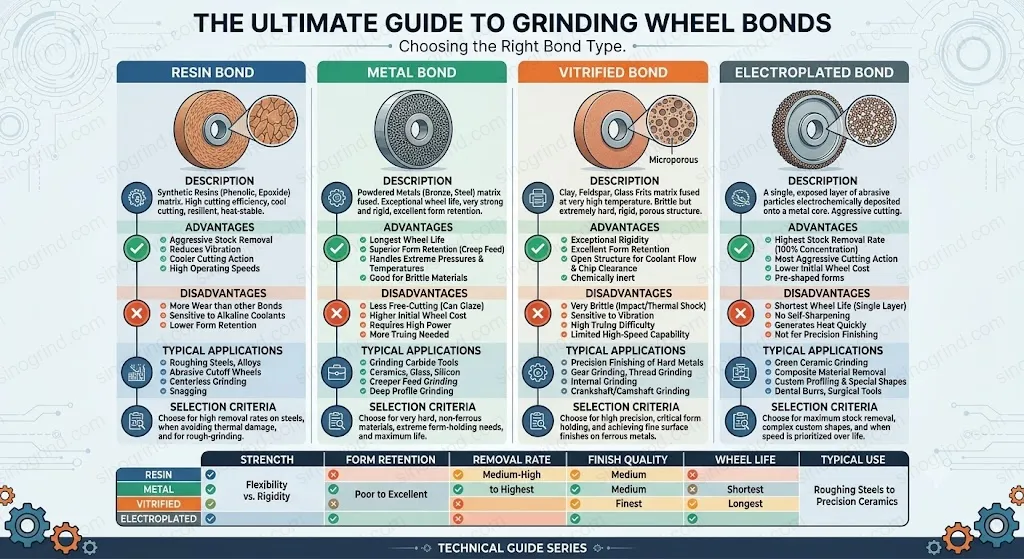
A vitrified bond has porosity that can accommodate chips and coolant, so it tolerates a finer grit or higher concentration better than a closed metal bond. A resin bond is softer and more forgiving of a fine grit at low concentration, but it cannot hold a high-concentration fine-grit form for long. A metal bond can carry high concentration and coarse grit for aggressive removal, but it needs help to stay open.
This is why specification tables always need a bond column. “B91, 125%” is incomplete without knowing whether the bond is vitrified, resin or metal. The bond types guide explains the differences in detail.
Reading a CBN wheel specification
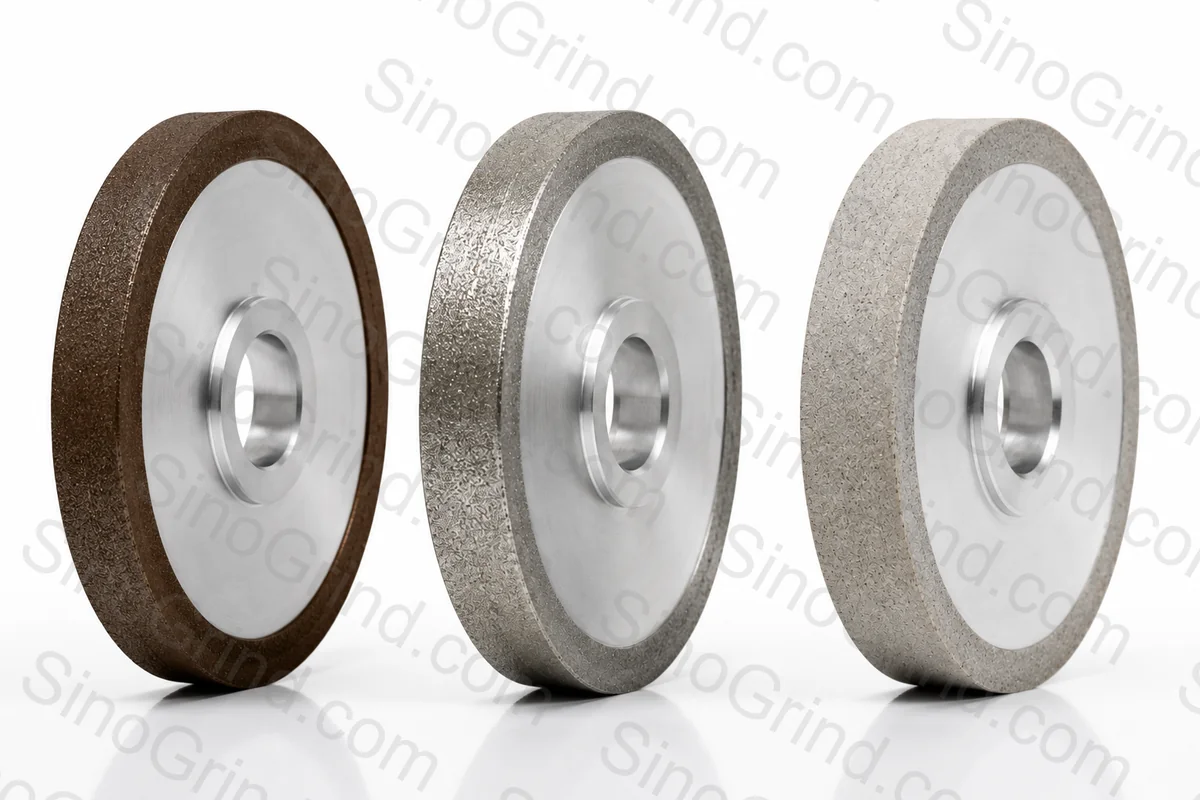
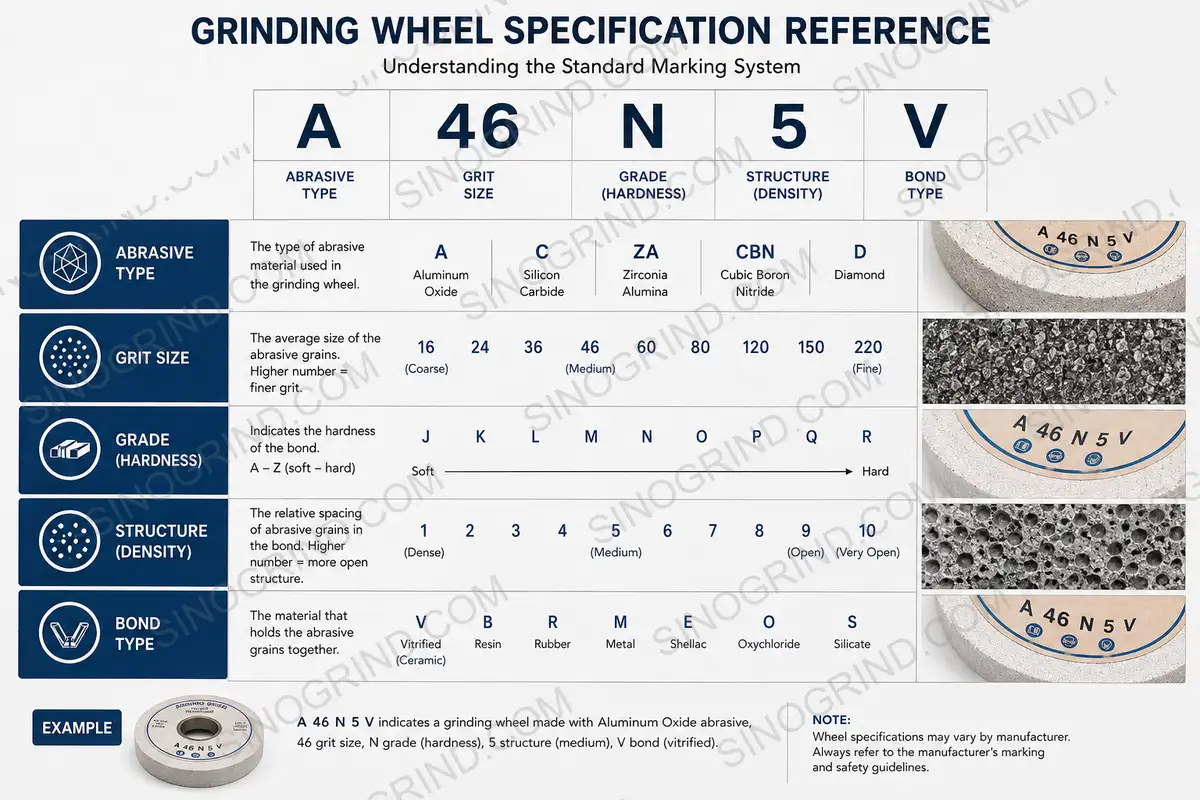
A complete CBN specification reads something like: vitrified bond, B91, concentration 125, 1A1 shape, 400 × 40 × 127, maximum speed 50 m/s. Each element answers a different question. The bond answers how the grains are held and cooled; the grit answers the finish and removal scale; the concentration answers how many cutting edges are available; the shape answers which feature can be reached; the dimensions answer the machine interface; the speed marking answers the safe operating limit.
When requesting a quote, include all of these plus the workpiece material and hardness, the operation, the machine, the coolant and the finish target. A request that says only “B91 CBN wheel” cannot be quoted correctly because the bond is missing. The grinding wheel specification generator builds a structured RFQ code from these inputs.
Concentration, wear and cost
Higher concentration puts more CBN into the wheel, so the initial cost rises and the wear behaviour changes. The extra cutting edges share the load, which can reduce grain fracture and improve form life, but the reduced bond fraction can also shorten life if grains are pulled out before they dull. The economically optimal concentration is the one that minimises cost per good part, not the one with the most abrasive.
Track three numbers during a trial: wheel wear per part, dressing frequency and scrap rate. If wear is low but dressing frequency is high, the wheel may be too hard or too closed. If wear is high and finish is stable, a higher concentration or stronger bond may pay for itself. If scrap is driven by burn, concentration is not the first lever — coolant and dressing are.
Running a grit and concentration trial
Change one variable at a time. Start with the grit recommended for the finish, run a short cycle, and record Ra, power, burn, form and wear. Then change concentration only if the limiting issue is form life or removal rate. Keep the dressing procedure identical between trials, because a different dress can easily outweigh a grit change.
Grind a representative feature rather than a scrap slug whenever possible. Edges, radii and interrupted features behave differently from a flat test block. If the trial must use a test block, repeat it at least twice and measure the same location so that setup variation does not masquerade as a wheel difference.
Selection table by application
| Application | Typical grit | Typical concentration | Bond note |
|---|---|---|---|
| HSS end mills and drills | B126–B151 | 100–125% | Resin, cool cutting |
| Hardened steel surface | B91–B126 | 100–125% | Vitrified, open structure |
| Hardened steel cylindrical | B91–B126 | 100–125% | Vitrified or metal |
| Internal grinding | B64–B107 | 100–125% | Vitrified, small wheel |
| Bearing raceways | B64–B91 | 125% | Vitrified, fine dress |
| Gear profile grinding | B76–B126 | 125–150% | Vitrified, oil coolant |
| Creep-feed form | B126–B181 | 125–175% | Metal or vitrified, high-pressure coolant |
| Fine edge preparation | B25–B46 | 75–100% | Resin or vitrified, light passes |
Starting points only. Confirm with the wheel manufacturer and a trial on the actual machine, coolant and fixture.
Common mistakes
- Using concentration to fix finish. Finish is primarily grit, bond openness and dressing. Raising concentration can make loading worse.
- Using finer grit to fix burn. A finer grit usually increases heat. Fix coolant delivery, dress and infeed first.
- Ignoring the size distribution. Two B91 grains can cut differently if one has outliers or a wider spread.
- Copying a specification without the bond. Grit and concentration numbers mean little without the bond and grade.
- Skipping the trial. A one-feature trial costs far less than a batch of burned parts.