: +86 15874211461

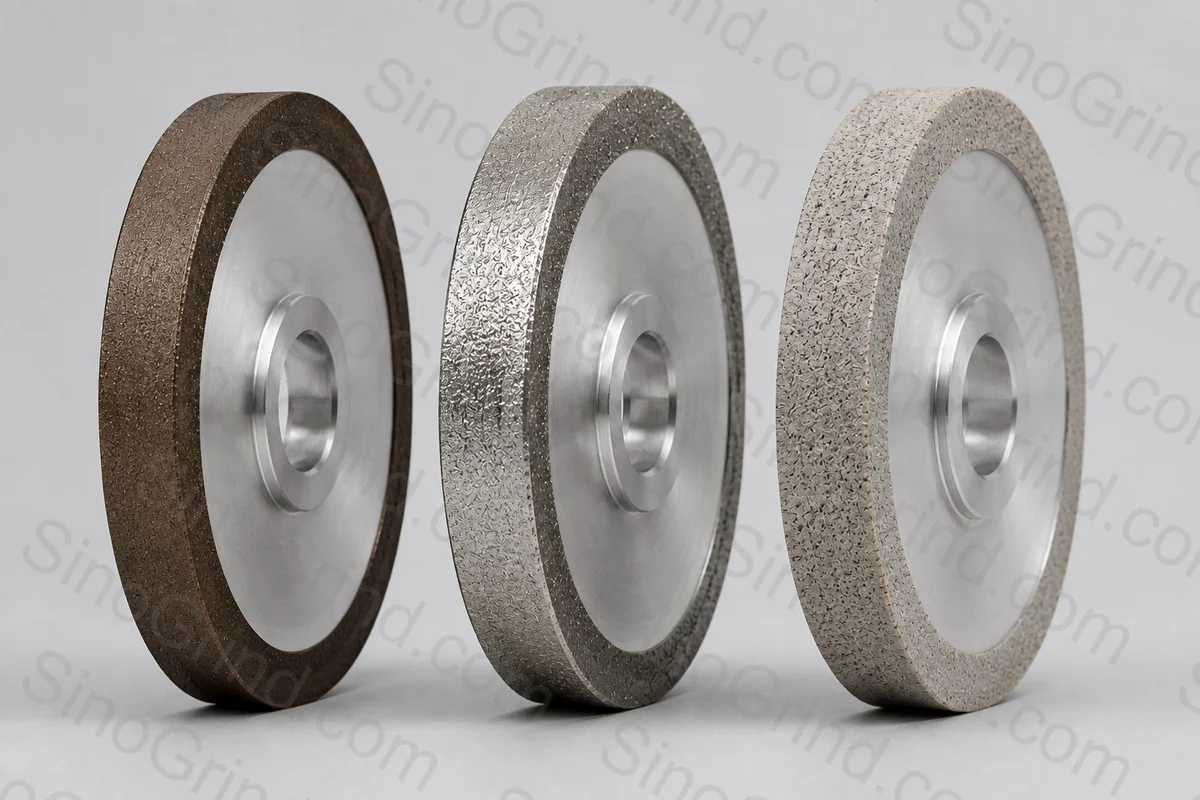
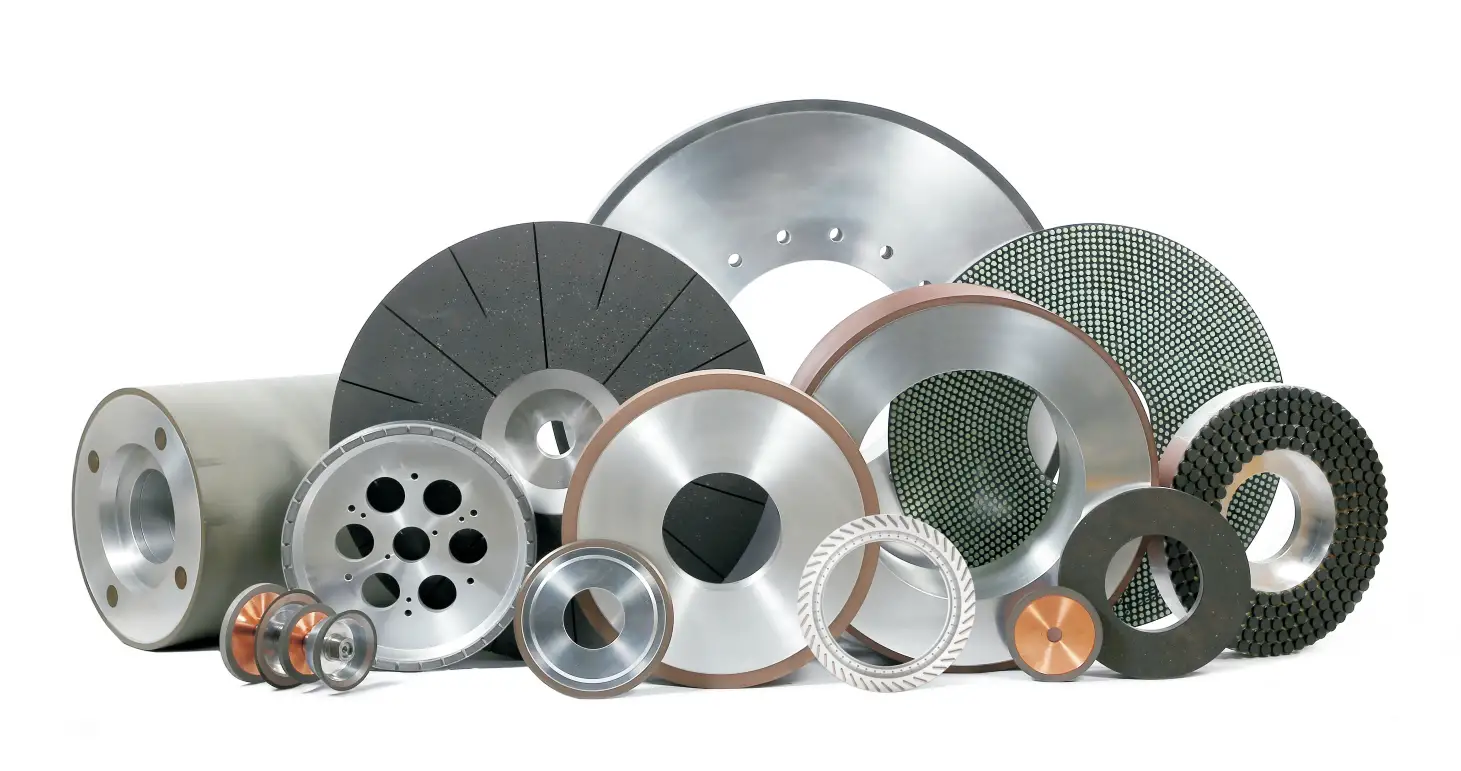
Quick answer: Choose vitrified CBN for precision, gear, profile and form grinding where rigidity and coolant flow matter. Choose resin CBN for cool-cutting HSS tool grinding and general finishing. Choose metal-bond CBN for heavy removal, creep feed and maximum form life. Choose electroplated CBN for thin profiles, internal work and single-layer tools that cannot be dressed.
Related reading: CBN grinding wheel guide · Vitrified bonded diamond and CBN wheels · CBN grit and concentration.
What the bond actually does
A CBN grain cuts only while it is held firmly enough to withstand the grinding force and exposed enough to touch the workpiece. The bond sets both conditions. It also controls porosity, heat conduction, chemical compatibility with the coolant and the method by which the wheel can be reconditioned. Two wheels with identical CBN grain, grit and concentration can behave completely differently because one bond is rigid and porous while the other is tough and closed.
Bond selection is therefore an operation decision before it is a price decision. A vitrified wheel forced into heavy interrupted cutting may chip or break down too fast; a metal-bond wheel used for a delicate finishing pass may burn the part because it cannot be opened easily. The practical question is: what does this operation need from the bond — form retention, free cutting, coolant access or a single thin layer?
Bond comparison at a glance
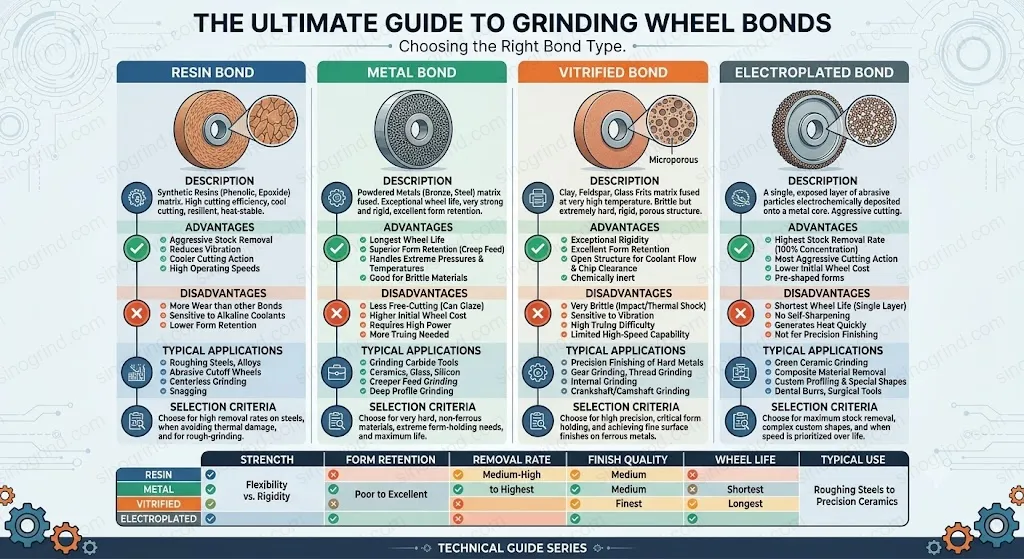
| Property | Vitrified | Resin | Metal | Electroplated |
|---|---|---|---|---|
| Bond strength | High, rigid but brittle | Moderate, slightly flexible | Very high, tough | Mechanical plated layer |
| Sharpness / free cutting | Good when open and dressed | Very good, cool cutting | Moderate; can glaze if not opened | Very sharp when new |
| Form holding | Very good | Moderate | Excellent | Set by the plated form |
| Porosity and coolant access | High, interconnected porosity | Low to moderate | Low | Open grain surface, no reservoir |
| Heat resistance | High | Limited by resin decomposition | High | Limited by plating and grain |
| Dressing | Diamond dresser, alumina stick, rotary dresser | Diamond dresser, alumina stick, light passes | Diamond roller, SiC stick, electrolytic methods | Not dressable; replace when dull |
| Typical life | Long | Moderate | Longest in heavy duty | Single layer, shortest |
| Best applications | Precision surface, cylindrical, internal, gear and form | HSS tools, flutes, gash, general finishing | Creep feed, heavy removal, form and high volume | Thin profiles, internal, mounted points, small forms |
| Main limitation | Brittle; needs flood coolant | Lower form life; heat sensitive | Hard to dress; runs hot | No re-profiling; limited life |
Ratings are relative and application-dependent; confirm the specific grade with the wheel manufacturer.
Vitrified bond CBN
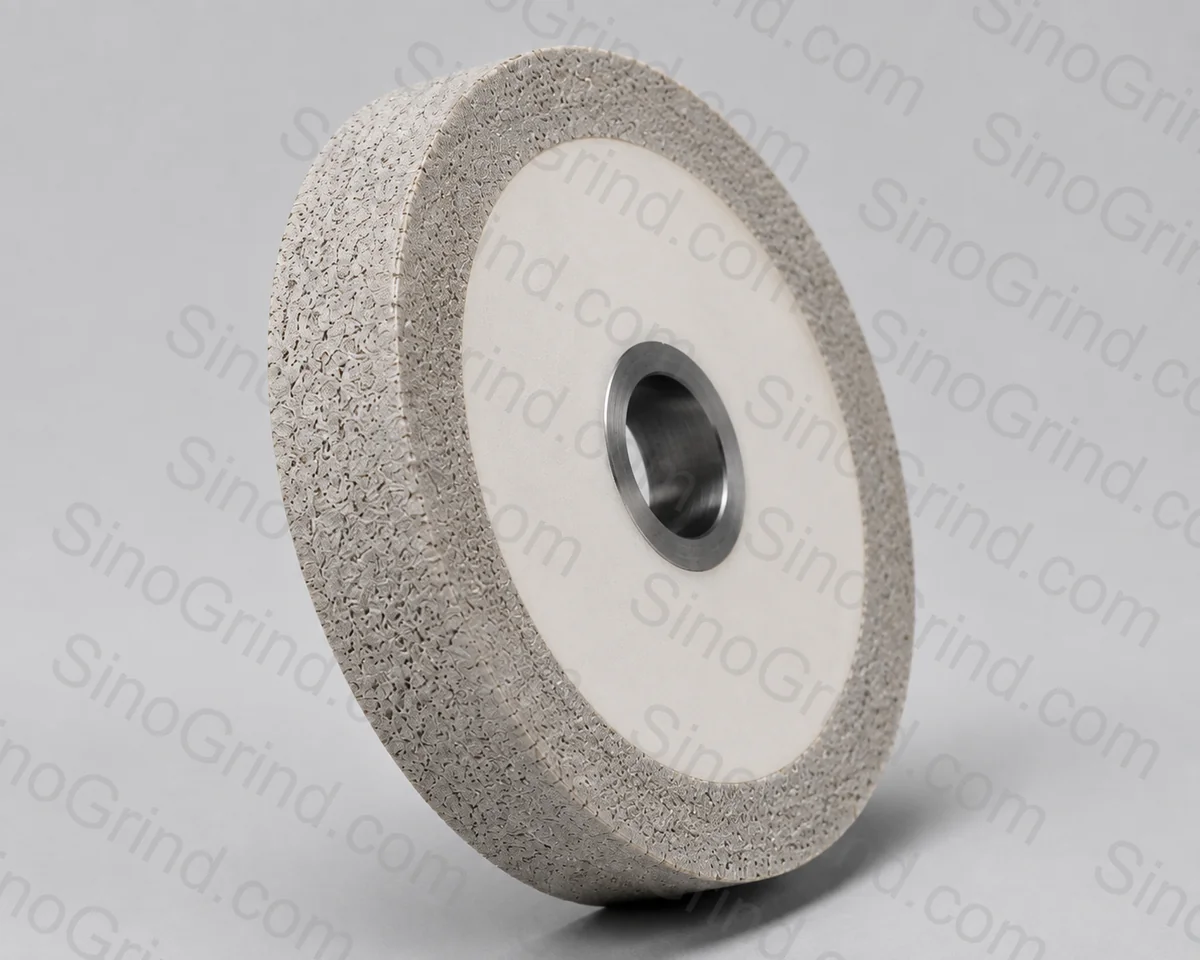
Vitrified CBN uses a glass-ceramic bond fired at a temperature low enough to protect the CBN grain. The bond is rigid, so the wheel holds profile and size well, and it is porous, so coolant reaches the contact arc and chips have somewhere to go. The controlled brittleness of the bond bridges gives the self-sharpening behaviour that makes vitrified CBN so effective in production grinding.
The weakness is mechanical: vitrified bond is brittle. It does not like impact, interrupted cuts, thermal shock or a machine with poor stiffness. It also needs consistent coolant. Used properly, it is the best general answer for hardened steel cylindrical, surface, internal, gear and profile grinding, particularly where both finish and form life matter.
Porosity can be specified. A more open structure improves coolant flow and chip clearance but reduces the number of grains in contact; a tighter structure improves form and finish but makes burn more likely. That trade-off is covered in the vitrified bonded wheel guide.
Resin bond CBN
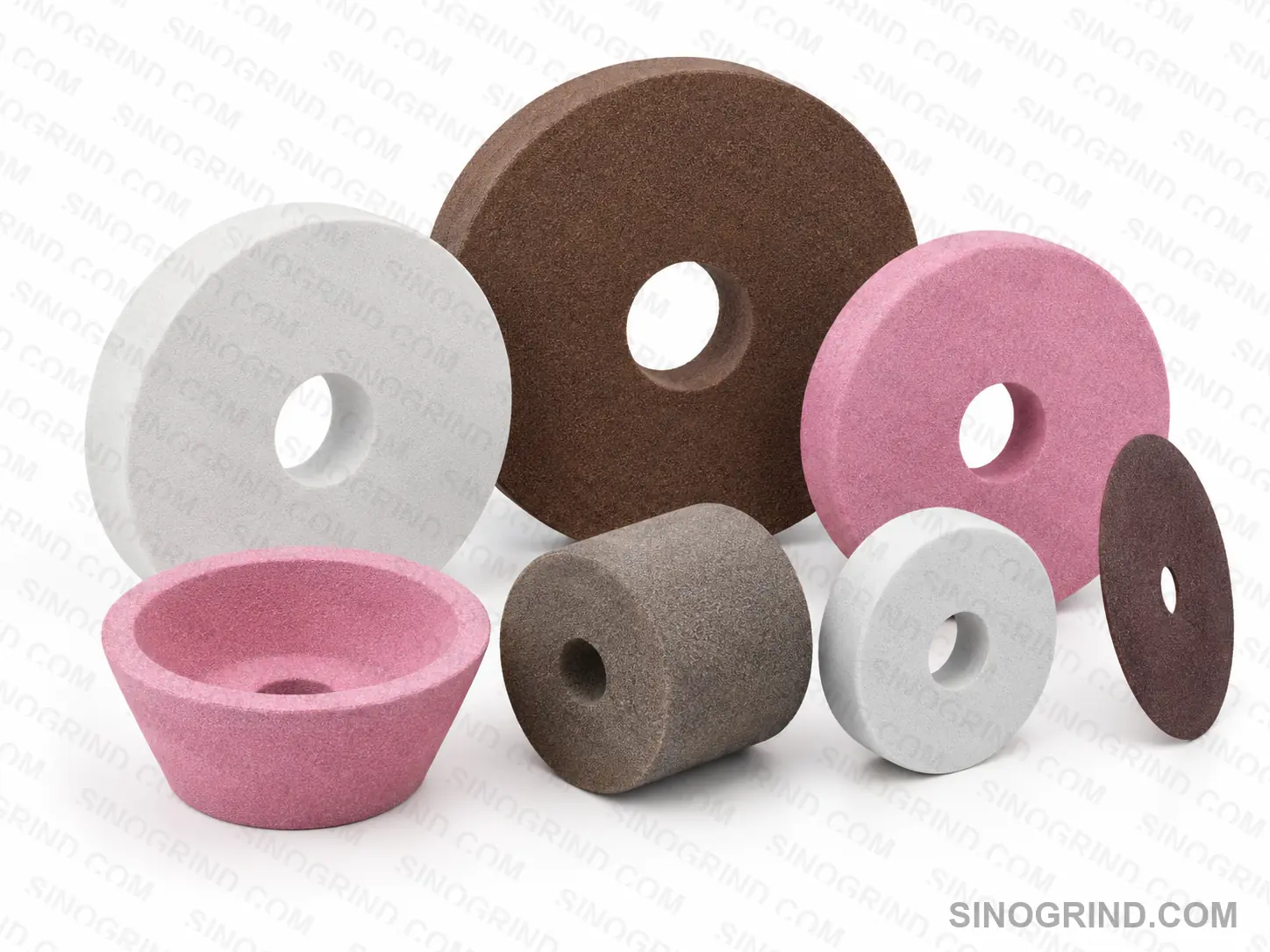
Resin-bond CBN uses a phenolic or, for higher temperature resistance, polyimide resin. It is slightly flexible, cuts cool and is forgiving of minor misalignment. It is easy to dress and relatively economical. These properties make it a natural fit for HSS and tool-steel tool grinding, where the wheel often runs dry or with mist and the edge quality of the tool matters more than extreme form life.
Resin does have limits. It softens and decomposes at temperatures well below those tolerated by vitrified or metal bonds, so it is a poor choice for dry creep feed or heavy form grinding. It also wears faster, which shows up as form drift on precision profiles. If the operation needs both cool cutting and form retention, a vitrified wheel is usually the better compromise.
Metal-bond CBN
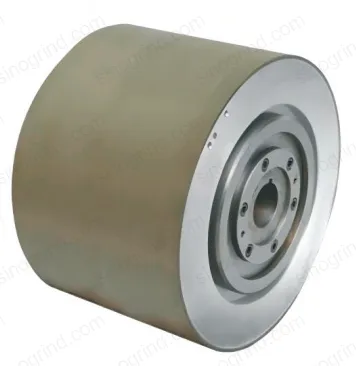
Metal-bond CBN sinters CBN grains into a bronze, cobalt or nickel-based matrix. Grain retention is very high, so the wheel can take aggressive infeed and hold form for a long time. It is the usual choice for creep-feed grinding, heavy stock removal, difficult form work and high-volume production where wheel changes and dressing time dominate cost.
The trade-off is that metal bond is not free cutting by nature. It has little porosity, generates more heat and is difficult to dress. It depends on a rigid machine, high coolant pressure and a well-designed coolant nozzle. When a metal-bond wheel loads or glazes, the operator cannot simply open it with a light stick pass in the same way as vitrified. Rotary diamond dressing, SiC sticks or electrolytic in-process dressing may be needed.
Electroplated CBN
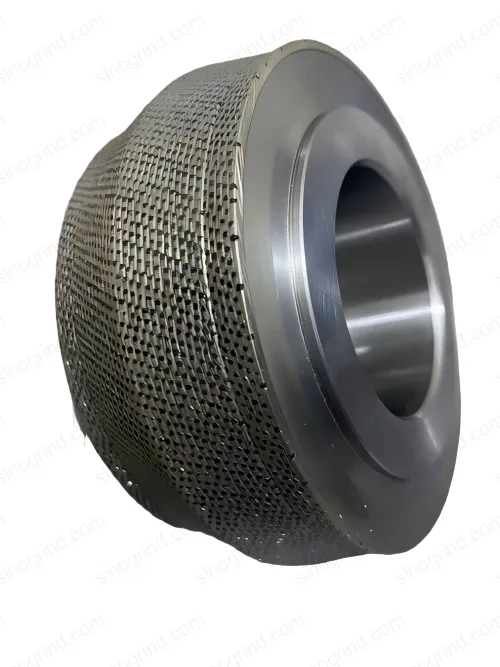
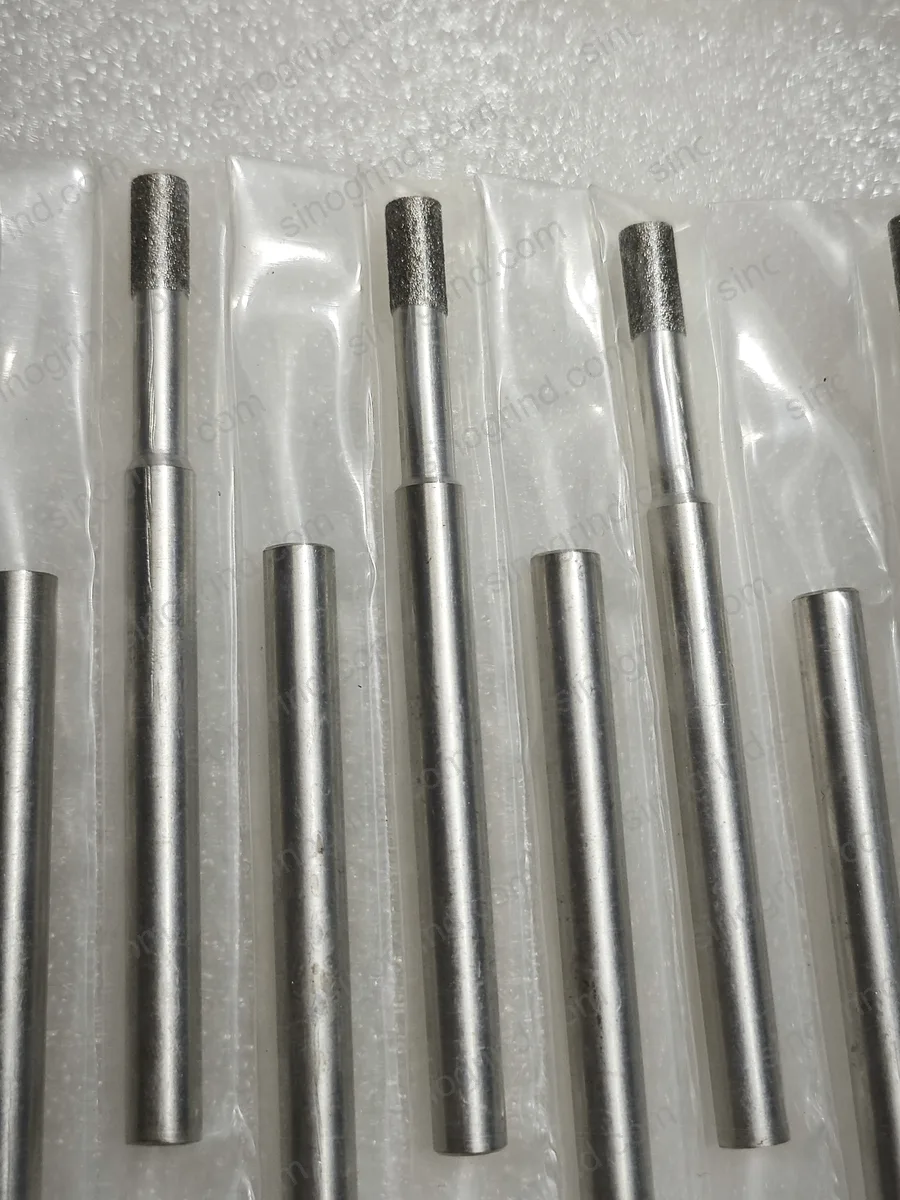
Electroplated CBN is a single layer of grains anchored in nickel on a steel or carbide body. There is no working layer to wear back into, so the form is fixed from the first cut. This makes it ideal for thin slots, small internal features, mounted points, form tools and low-force finishing where a bonded wheel would be too bulky or too expensive to make in a custom profile.
Because there is only one layer, life is finite and predictable. Once the grains dull or pull out, the tool is replaced or stripped and re-plated. Electroplated tools are not trued or dressed in the conventional sense; at most they are lightly conditioned. They also run best at conservative infeed with excellent coolant, because there is no bond reservoir to absorb heat.
Hybrid and special bonds
Hybrid bonds combine resin and metal or vitrified and metal characteristics to balance form life against free cutting. They are useful in specific production niches, but they are not a universal upgrade. Treat a hybrid recommendation as an application-specific solution and ask for the wear mechanism, dressing method and expected life evidence rather than assuming it will outperform a standard bond everywhere.
Which bond for which operation?
| Operation | First choice | Alternative | Why |
|---|---|---|---|
| HSS drills, end mills, reamers | Resin CBN | Vitrified CBN | Cool cutting and easy edge control |
| Hardened steel cylindrical | Vitrified CBN | Metal CBN | Balance of finish, form and coolant flow |
| Internal grinding | Vitrified CBN | Resin or electroplated | Small wheel, high speed, coolant access |
| Surface grinding | Vitrified CBN | Resin CBN | Flatness and finish with cool cutting |
| Creep-feed form grinding | Metal CBN | Vitrified CBN | Form retention and high removal |
| Gear profile and threaded wheels | Vitrified CBN | Metal CBN | Profile accuracy with oil coolant |
| Bearing raceways | Vitrified CBN | Resin CBN | Fine finish and raceway form |
| Thin slots and internal forms | Electroplated CBN | Metal CBN | Fixed thin profile, single layer |
Bond and wheel grade are not the same thing
Operators often talk about a “hard” or “soft” wheel, meaning how readily the bond releases dull grains. Bond type is only one input. Grain type, grit, concentration, bond modification and firing all affect that behaviour. A vitrified wheel can be made relatively hard or relatively soft within the same bond family. This is why a specification copied from another shop may not transfer: the bond name is the same, but the grade is not.
Coolant and rigidity: the hidden bond variables
Two shops can run the same vitrified CBN wheel and get different results because the bond is only half of the system. A rigid machine with a well-aimed, filtered flood coolant keeps the bond in its intended self-sharpening range. A flexible machine with a weak nozzle forces the operator to reduce infeed, which dulls the grains instead of releasing them, and the wheel glazes. The bond then gets blamed for a process problem.
Before changing bond family, check wheel balance and run-out, spindle stiffness, fixture support, nozzle position and coolant concentration. On internal grinding, the wheel arbor and quill are often the weakest link. On surface grinding, magnetic chuck flatness and wheel balance dominate. These are cheap checks compared with a new wheel specification.
When one wheel must do two operations
Roughing and finishing on one wheel is a compromise. A vitrified CBN wheel can rough and semi-finish effectively if the machine has enough power and the dress is refreshed between phases. Metal bond can remove stock quickly but may leave a finish that needs a second wheel. Resin bond finishes well but loses form during a long roughing cycle.
If the cycle time allows, two wheels are usually cheaper than one compromised wheel: a coarser, stronger wheel for stock removal and a finer, open wheel for the finish. If only one spindle is available, choose the bond that protects the critical requirement — usually form and finish — and accept a lower removal rate.
Common bond-selection mistakes
| Mistake | What happens | Better approach |
|---|---|---|
| Metal bond chosen for a finishing pass | Burn, loading and difficult dressing | Use vitrified or resin for the finishing operation |
| Resin bond used for dry creep feed | Resin breakdown and rapid form loss | Vitrified or metal bond with flood coolant |
| Vitrified bond run without adequate coolant | Thermal damage and wheel breakdown | Restore flow and aim before changing the bond |
| Electroplated tool expected to be dressed | Plating damage and loss of form | Treat as a fixed-profile tool and replace when dull |
| Bond changed before the process is stable | New wheel repeats the same failure | Fix rigidity, balance, coolant and dressing first |
How to confirm a bond choice
Start with the operation table, then confirm three things with the supplier: the maximum operating speed and its basis, the recommended dressing method for that specific bond, and the expected wear mechanism. Ask what the wheel is expected to do when it stops cutting — self-sharpen, glaze, or lose form. That answer tells you whether the bond matches the way your machine and operators actually work.
For a structured recommendation, use the grinding wheel bond selection tool, then send the resulting specification through the contact form for an application review.