: +86 15874211461

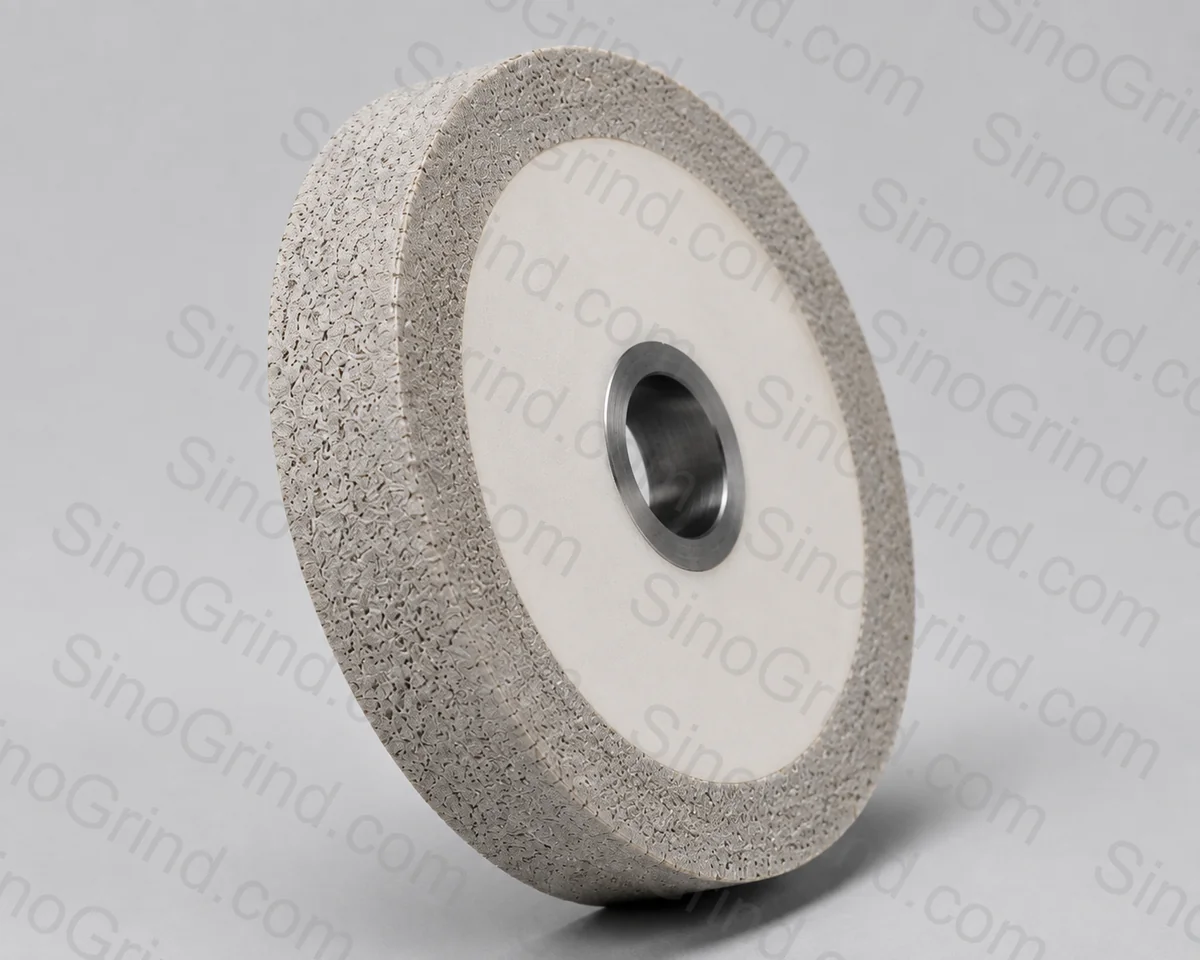
Quick answer: Use vitrified CBN for hardened gear and bearing grinding. Gear profile wheels typically start at B76–B126, 125–150% concentration; threaded CBN worms use a similar range with a profile-specific dresser. Bearing raceways typically start at B64–B91, 125% with fine dressing. Run with oil or high-performance coolant, control burn, and verify speed and dressing with the wheel manufacturer.
Related reading: CBN grinding wheel guide · Vitrified bonded diamond and CBN wheels · CBN dressing and truing.
Why CBN for gears and bearings
Gears and bearing rings are made from through-hardened or case-hardened ferrous steels, usually in the 58–65 HRC range after heat treatment. They are finished after hardening because distortion during heat treatment is larger than the final tolerance. That puts the finishing operation on a hard, wear-resistant, heat-sensitive surface — exactly the combination CBN is designed for.
CBN holds form, cuts cool relative to conventional abrasives and can be dressed to a precise profile. In gear grinding, the wheel profile is the part profile (or its generating counterpart), so form retention directly controls lead and profile accuracy. In bearing grinding, the raceway curvature and finish control noise, life and lubrication behaviour. Both applications punish a wheel that burns or loses form.
Gear grinding methods
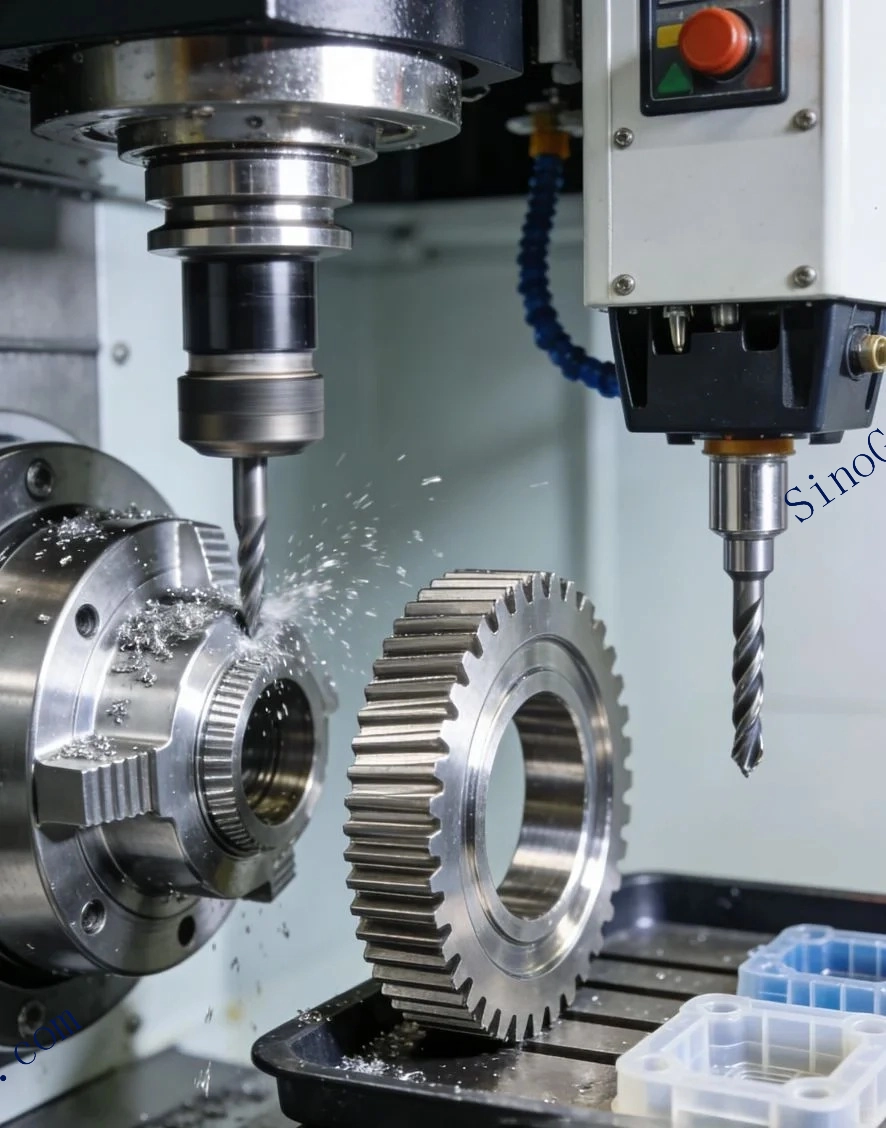
Two methods dominate production gear grinding. Form grinding uses a profiled wheel that matches the tooth space and is plunged or traversed across the face. It is flexible and suits large modules, low volume and complex profiles. Generating grinding uses a threaded CBN worm that meshes with the gear while the gear rotates and the wheel traverses. It is fast and accurate for smaller modules and high volume, but the threaded wheel and its dressing system are more complex.
| Method | Wheel form | Best for | Key requirement |
|---|---|---|---|
| Profile / form grinding | 1A1, 1V1, 14A1 or custom profile | Large modules, low volume, complex or modified profiles | Accurate profile dressing and rigid wheel |
| Threaded-wheel generating | Vitrified CBN worm | Small to medium modules, high volume | Diamond dressing gear or roller, precise ratio control |
| Gear honing / superfinishing | Special bonded or plated tool | Final noise and finish correction | Process-specific; not a standard CBN wheel choice |
Gear wheel shapes and specifications
| Feature | Typical choice | Notes |
|---|---|---|
| Profile wheel shape | 1A1, 1V1, 14A1, cup | Depends on tooth space, module and machine axis layout |
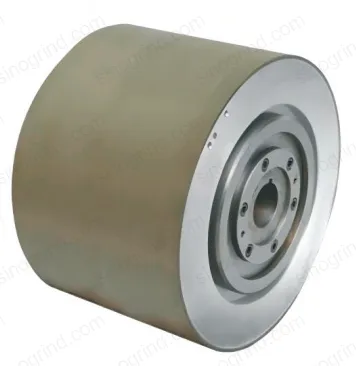
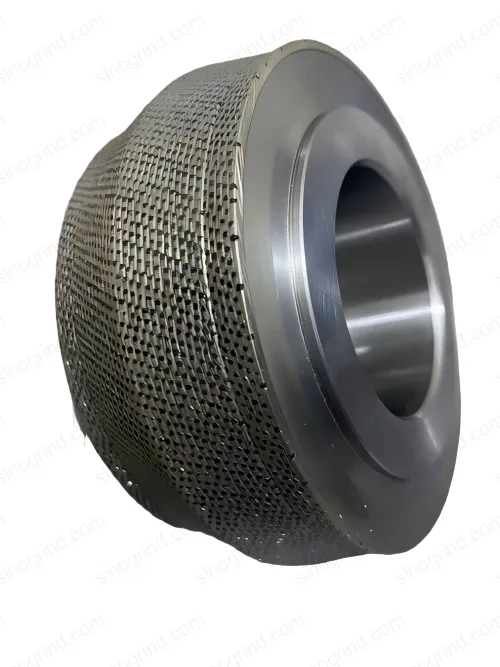
| Threaded wheel | Vitrified CBN worm | Profile generated by a diamond dressing gear or roller |
| Bond | Vitrified | Rigidity, porosity and dressability; metal bond is used in some roughing operations |
| Grit | B76–B126 | Coarser for roughing and large modules, finer for finish and small modules |
| Concentration | 125–150% | Higher concentration supports form retention on narrow profiles |
| Speed | Typical 30–60 m/s | Higher speeds are common in production; confirm wheel and machine ratings |
| Coolant | Neat oil or high-performance emulsion | Oil is common for vitrified CBN gear grinding; filtration is critical |
Starting points only. Gear geometry, module, material, case depth, machine and dresser all affect the final specification. Verify with the wheel manufacturer.
Bearing raceway grinding
Bearing rings are ground on the bore, the outer diameter and the raceway. The raceway is the critical surface: its curvature, roundness, finish and surface integrity determine running noise, friction and fatigue life. Vitrified CBN cup or profile wheels are common because they hold the raceway form and can be dressed to a fine, open face.
The operation is usually high-volume and automated, so consistency matters as much as peak removal rate. Coolant must reach the raceway contact consistently, and the wheel must be dressed on a controlled interval before burn or finish drift appears. Bearing steels are sensitive to tempering and re-hardening, so surface-integrity checks are part of process qualification, not an optional extra.
| Bearing feature | Typical wheel | Grit / concentration | Process note |
|---|---|---|---|
| Inner ring raceway | Vitrified CBN cup / profile | B64–B91 / 125% | Small wheel, high speed, precise coolant aim |
| Outer ring raceway | Vitrified CBN cup / profile | B64–B91 / 125% | Form retention and roundness |
| Bore / inner diameter | Vitrified or resin CBN | B76–B107 / 100–125% | Arbor rigidity and coolant access |
| Outer diameter | Vitrified CBN | B76–B107 / 100–125% | Roundness and taper control |
| Rolling elements | Vitrified CBN or conventional | Application-specific | High volume; finish and size stability |
Material and hardness considerations
Case-hardened gears typically use steels such as 16MnCr5 or 20MnCr5 with a case depth suited to the tooth load. Through-hardened gears may use 42CrMo4 or similar. Bearing rings commonly use 100Cr6 (AISI 52100) or comparable through-hardening steels. The exact grade, hardness, retained austenite and case depth all influence grindability and burn sensitivity.
Harder is not automatically easier. A very hard surface can be brittle and crack-sensitive; a case with retained austenite can be dimensionally unstable. Grinding parameters that work on one heat-treat lot may burn another. Qualify the process on representative parts and monitor hardness and surface integrity when the supplier or heat treatment changes.
Speed, coolant and thermal control
Gear grinding often runs at higher wheel speeds than general surface grinding because the contact length and production rate demand it. Vitrified CBN systems in production may operate in the 30–60 m/s range, with higher speeds in specially rated machines. Treat these as starting points: the wheel marking, spindle, guard, dressing system and coolant delivery must all support the speed.
Neat oil is common for vitrified CBN gear grinding because it lubricates the contact, removes heat and keeps the profile clean. It also requires fire precautions, mist control and compatible filtration. Water-based high-performance coolant can work well in bearing grinding, but concentration, filtration and bacterial control must be managed. In both cases, the nozzle must be designed for the contact geometry, not borrowed from another job.
Dressing for gear and bearing work
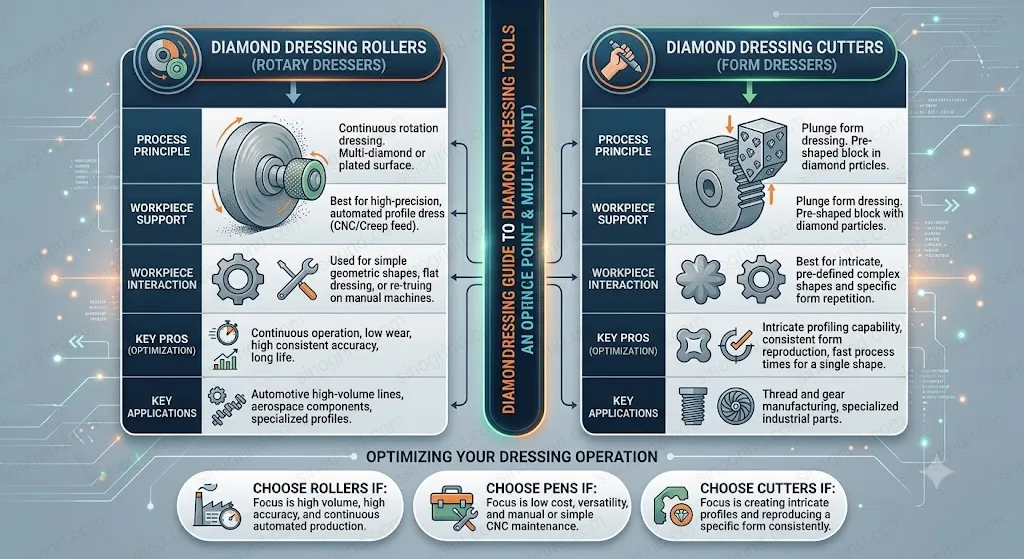
Profile wheels are dressed with a diamond roller, a form dresser or a CNC dressing unit that traces the required profile. Threaded wheels use a diamond dressing gear or profile roller that generates the worm form. Bearing wheels use a diamond dresser or rotary dresser to restore raceway curvature and open the face. In every case, the dresser must be aligned to the wheel and the machine axes, and the first part after dressing must be inspected.
Dressing too deep removes the profile budget; dressing too light leaves a closed face that burns. Use the smallest depth that restores geometry and sharpness, then condition if the bond requires it. The dressing guide covers parameters and common mistakes.
Gear quality metrics that the wheel affects
Gear inspection usually reports profile form and slope, lead form and slope, pitch deviation and cumulative pitch error, plus surface roughness and flank appearance. The wheel influences all of them, but not equally. Profile errors often trace to wheel form and dresser wear. Lead errors often trace to wheel traverse, machine alignment or wheel width. Pitch errors may come from the workholding or the generating motion rather than the abrasive. Knowing which metric moved helps avoid changing the wheel for a machine fault.
The wheel also affects the thermal state of the flank. A burn-free flank with consistent roughness is more valuable than a marginally faster cycle that produces temper colours or a soft layer. Qualify the process on the gear inspection report and a flank etch, not only on size.
Bearing surface integrity and noise
Bearing raceways are finished to very fine roughness and controlled curvature. The wheel must produce a uniform, burn-free surface without feed marks or chatter. Even a small amount of thermal damage can change residual stress and reduce fatigue life, and a periodic pattern can show up as noise or vibration in the assembled bearing.
Use a fine, open wheel face and stable coolant delivery. Inspect raceway appearance under oblique light and check roundness and curvature on a sample. If noise is the complaint, compare the raceway waviness and surface pattern before changing the wheel; the cause may be a dressing interval that is too long or a spindle vibration rather than the abrasive specification.
Machine and fixture requirements
Gear and bearing grinding is unforgiving of weak setups. The wheel spindle, workhead, tailstock, steady rest and dressing axis all contribute to the finished geometry. A CBN wheel that performs well on a rigid machine can chatter on a lighter one, especially at the higher speeds these processes often use. Check run-out, stiffness and thermal stability before optimising the wheel.
Coolant delivery is part of the fixture design in practice. The nozzle should be mounted so it follows the contact zone and does not rely on the operator to reposition it. On internal or confined features, use a nozzle shape that reaches the arc without being crushed or deflected.
Wheel wear and the profile budget
A form wheel has a fixed amount of working layer, and every dress consumes some of it. The profile budget is the total radial wear available before the wheel can no longer hold tolerance. Track it in millimetres of usable layer divided by the average wear and dress per cycle. A wheel that is dressed too deeply or too often will exhaust that budget before its abrasive is worn out, which is an avoidable cost.
Common mistakes in gear and bearing grinding
| Mistake | Consequence | Better approach |
|---|---|---|
| Choosing grit for removal only | Profile error and poor finish | Balance removal and finish; consider rough and finish wheels |
| Ignoring dresser wear | Gradual profile drift that passes a quick check | Track dresses per dresser and inspect the profile |
| Using general-purpose coolant | Burn, loading and poor profile cleanliness | Use oil or a high-performance coolant with correct filtration |
| Running a high-speed wheel on an unrated machine | Safety risk and vibration | Verify wheel, spindle and guard ratings before increasing speed |
| Changing wheel specification after one burned part | Repeats the fault with a new wheel | Check coolant, dressing, fixture and parameters first |
Selection sequence
- Define the feature: gear profile, threaded worm or bearing raceway, with tolerance and finish.
- Confirm material and hardness, including case depth and heat-treat condition.
- Choose the wheel form and bond: vitrified profile or threaded wheel for most gear work; vitrified cup/profile for bearing raceways.
- Set grit and concentration from the finish, form detail and removal requirement.
- Match speed and coolant to the machine, wheel rating and thermal sensitivity of the part.
- Define the dressing method and frequency, then qualify the first article and surface integrity.
For a gear or bearing application review, send the drawing, module or raceway geometry, material and hardness, machine, wheel dimensions, coolant and finish target through the contact form. The wheel selection tool can help assemble the first specification.