: +86 15874211461

Quick answer: Wafer back-grinding and dicing use fine diamond wheels (D126–D400+), usually electroplated or resin bond, engineered for low subsurface damage. Wheel selection is driven by final die strength and finish, not removal rate.
Related reading: Electroplated Diamond Grinding Wheel · Diamond Wheel for Optics, Quartz & Sapphire · Diamond Wheel for Ceramics Grinding.
Why semiconductor grinding is a low-damage process
Wafer thinning and dicing remove material from silicon, SiC or sapphire. The finished surface and subsurface quality determines die strength and device yield, so the process is designed to minimising micro-cracks and residual stress. Fine diamond grit, a tough but free-cutting bond, and careful infeed control are the levers.
Wheel types in the wafer process
| Process | Wheel | Bond | Grit (FEPA D) |
|---|---|---|---|
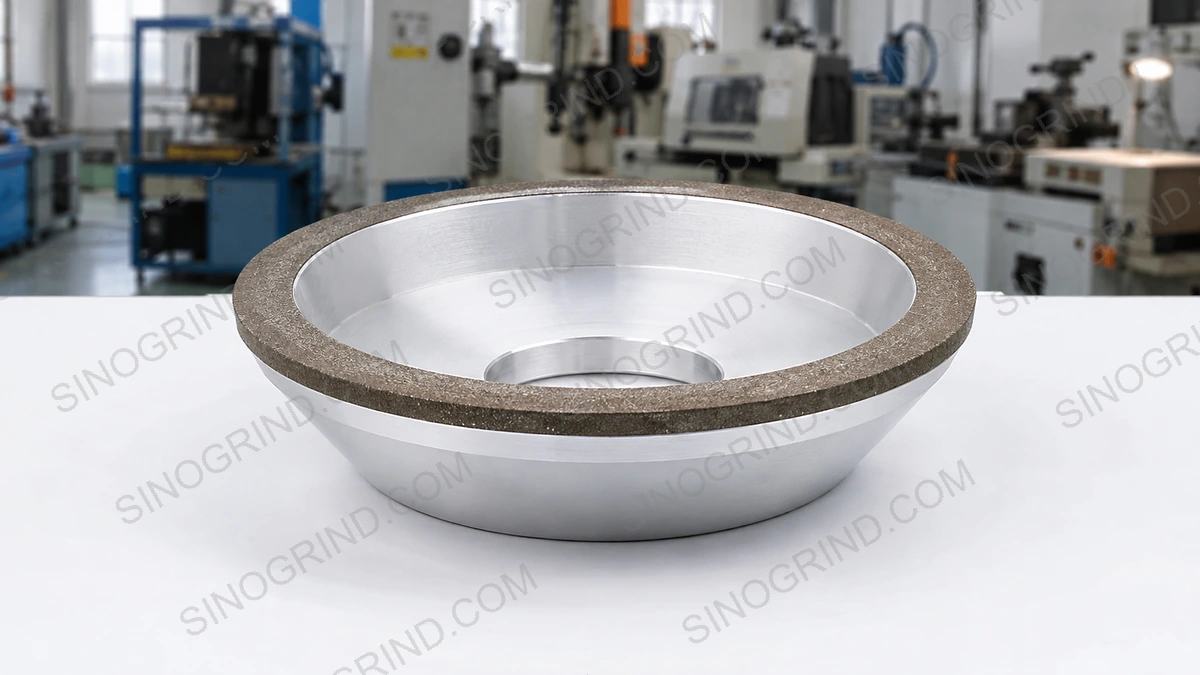
| Rough back-grind | Cup / cup-shaped | Electroplated | D251–D400 |
| Fine back-grind | Cup / cup-shaped | Resin / Metal | D126–D252 |
| Polishing / stress relief | Fine cup | Resin / Vitrified | D15–D64 |
| Dicing / singulation | Thin blade | Electroplated | D252–D400+ |
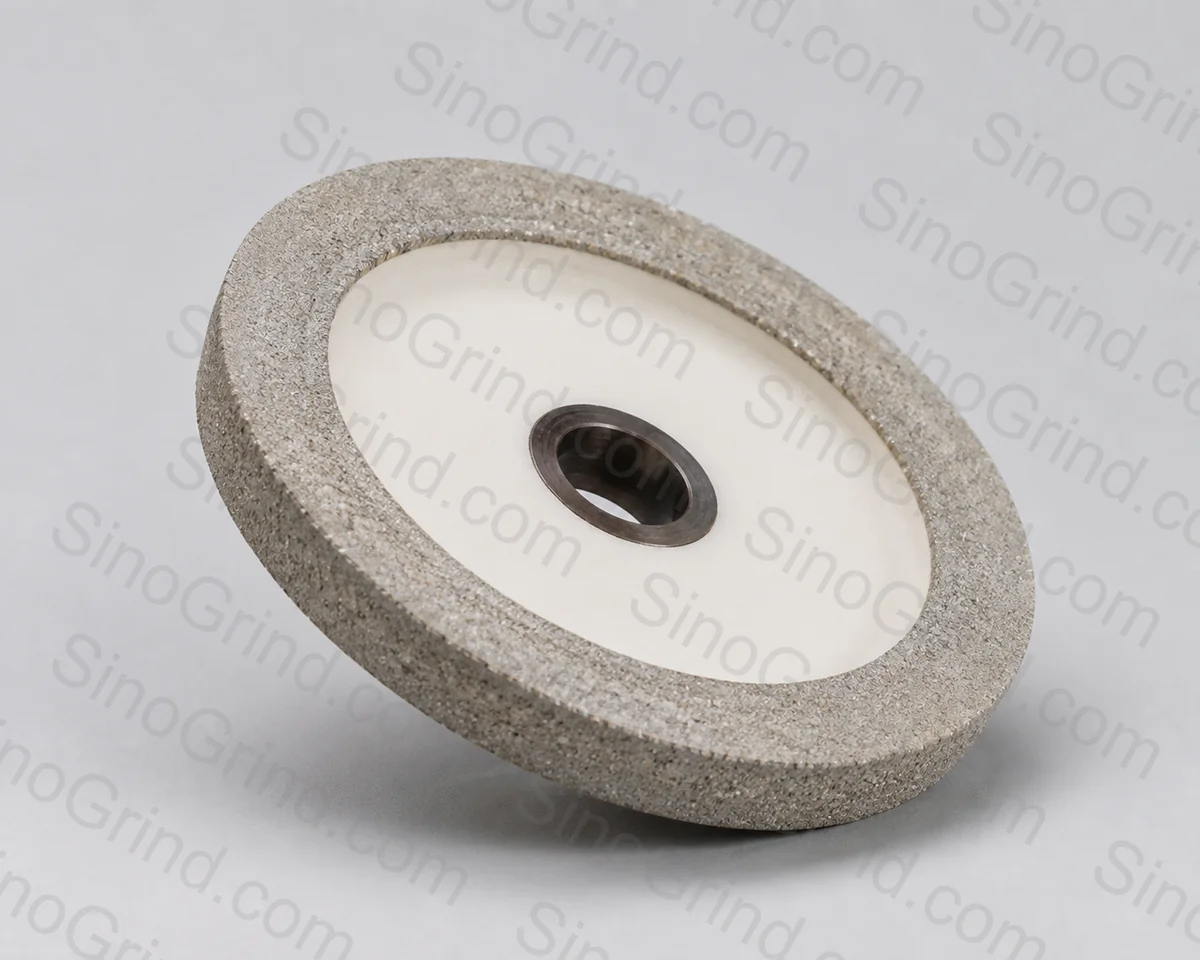
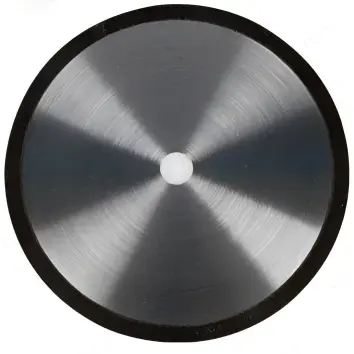
Back-grinding uses large-diameter cup wheels; dicing uses ultra-thin blades that must cut fast with minimal chipping.
Process controls that protect yield
- Ultra-low infeed for the finishing pass to limit subsurface damage.
- Dense coolant and clean, filtered water to flush fine debris.
- In-situ dressing / conditioning for resin and metal cup wheels.
- Balanced, vibration-free spindles — vibration creates cracks.
- Matched rough/fine sequence — removal rate then damage control.
Material affects wheel choice
Silicon is the baseline; SiC and sapphire are much harder and need coarser or higher-concentration diamond and possibly a different bond. Compound semiconductors and packaging substrates may require custom fine-grit wheels. Always trial the sequence end-to-end for die-strength validation.
Which specification should I choose?
| Parameter | Typical value |
|---|---|
| Wheel type | Cup wheel (back-grind) / thin blade (dicing) |
| Bond | Electroplated / Resin |
| Grit (FEPA D) | D126–D400+ (fine D15–D64) |
| Concentration | 100–200% |
| Coolant | DI water, high flow, filtered |
| Priority | Low subsurface damage, high yield |
Final grit is set by the die-strength and finish specification.
Damage depth is the hidden cost
Wafer grinding removes material quickly, but it also leaves a damaged layer below the surface. That layer is invisible on the gauge and shows up later as die strength loss or breakage. The process is therefore built around a fine final wheel and a controlled spark-out, not around the fastest possible removal.
Two operations dominate: back-grinding, where a cup wheel thins the wafer, and dicing, where a thin blade separates the die. Both use diamond in a bond designed to release grains cleanly, and both depend on coolant and spindle accuracy more than on wheel price.
How do I set up the job?
- Check spindle run-out. On back-grinders, run-out in the micron range is normal practice; anything larger shows as thickness variation across the wafer.
- Select the wheel pair. A coarse wheel for bulk removal and a fine wheel for the finish pass, with the fine wheel doing only a few micrometres.
- Set the feed. Feed in small increments with an in-situ dressing step between wafers to keep the face open.
- Control the coolant. Temperature-stabilised water at the right flow; thermal drift changes the final thickness.
- Measure damage, not just thickness. Use the agreed inspection method to confirm the damaged layer is within specification.
- Log wheel life. Record wafers per wheel and the thickness trend, so replacement happens before yield drops.
How do I fix common problems?
| Symptom | Most likely cause | What to change |
|---|---|---|
| Thickness variation across the wafer | Spindle run-out, wheel not dressed, thermal drift | Re-dress, check run-out, stabilise coolant temperature |
| Edge chipping on the wafer | Too coarse a finish wheel or excessive feed | Finer grit, lower feed, add spark-out |
| Scratches from the grinding step | Swarf in the coolant or a loaded wheel | Improve filtration, dress the wheel, flush the lines |
| Low die strength | Subsurface damage from the finish pass | Reduce the finish-wheel depth, add a polish step |
| Wheel loads quickly | Bond too hard for the removal rate | Softer bond or more frequent in-situ dressing |
Yield losses in wafer grinding usually appear downstream, which is why damage depth is measured, not assumed.
What should an RFQ include?
- Wafer: diameter, material (Si, SiC, sapphire, glass) and target thickness.
- Operation: back-grind, dicing or edge trim, and the machine model.
- Wheel: cup or blade type, grit, bond and the specified damaged-layer limit.
- Coolant: supply temperature, flow and filtration.
- Acceptance: TTV, chipping and die-strength criteria.
- Volume: wafers per week and current wheel life, to size the order.
Browse the matching Diamond & CBN Grinding Wheels range for this application.
In semiconductor grinding, a wheel that lasts longer but leaves a deeper damaged layer is a false economy: the cost of the extra polish step or the lost die strength is far larger than the wheel price. Specify the damage limit first, then choose the wheel that meets it.
Ferrous parts are different
Diamond is the abrasive for silicon, silicon carbide, sapphire and glass. For steel or cast-iron fixtures and wear parts in the same shop, use CBN instead.
Sub-table 1 — by material family
| Material | Typical operation | Recommended bond | Grit (FEPA D) | Concentration | Typical Ra |
|---|---|---|---|---|---|
| Cemented carbide (WC-Co) | Cutter & tool grinding | Resin / Metal | D91–D181 | 100–150% | 0.1–0.4 µm |
| PCD / PCBN | Edge prep, peripheral | Metal / Vitrified | D46–D91 | 125–150% | 0.05–0.2 µm |
| Advanced ceramics (Al₂O₃, ZrO₂, Si₃N₄) | Surface / form | Vitrified / Resin | D64–D151 | 75–125% | 0.2–0.6 µm |
| Optical / flat glass, quartz | Edge, bevel, CNC | Metal / Resin | D64–D126 | 75–125% | 0.05–0.3 µm |
| Semiconductor (Si, SiC, sapphire) | Back-grind, dicing | Electroplated / Resin | D126–D400+ | 100–200% | <0.02 µm (fine) |
| Ferrite / soft magnetic | Surface / form | Resin / Metal | D91–D181 | 100–150% | 0.2–0.8 µm |
| Graphite / carbon | Form / cut-off | Electroplated / Metal | D181–D301 | 75–125% | — |
| CFRP / composites | Cut, slot | Electroplated | D252–D400 | — | — |
| Thermal-spray coatings | Grind, polish | Resin / Metal | D126–D252 | 75–100% | 0.1–0.4 µm |
| Stone / engineered quartz | Edge, calibrate | Metal / Electroplated | D181–D400 | — | — |
| Zirconia (dental / medical) | Finish, polish | Resin / Vitrified | D46–D126 | 75–100% | 0.1–0.3 µm |
| Steel / cast iron (ferrous) | — | Not diamond — use CBN | — | — | — |
Representative values for planning; confirm final grit, concentration and bond with a grinding trial on your machine.
Boundary rule — when not to use diamond
Diamond is the hardest abrasive and the correct choice for hard, brittle, non-ferrous materials such as cemented carbide, ceramics, glass, silicon, sapphire, ferrite, graphite and composites. It must not be used on ferrous metals — steel, cast iron, and their alloys — because carbon in diamond reacts with iron at grinding temperatures (roughly above 700 °C / 1300 °F). This chemical affinity causes rapid, abnormal diamond wear (graphitisation) and destroys the wheel. For steel, hardened steel, cast iron and other ferrous workpieces, use CBN (cubic boron nitride) instead.