: +86 15874211461

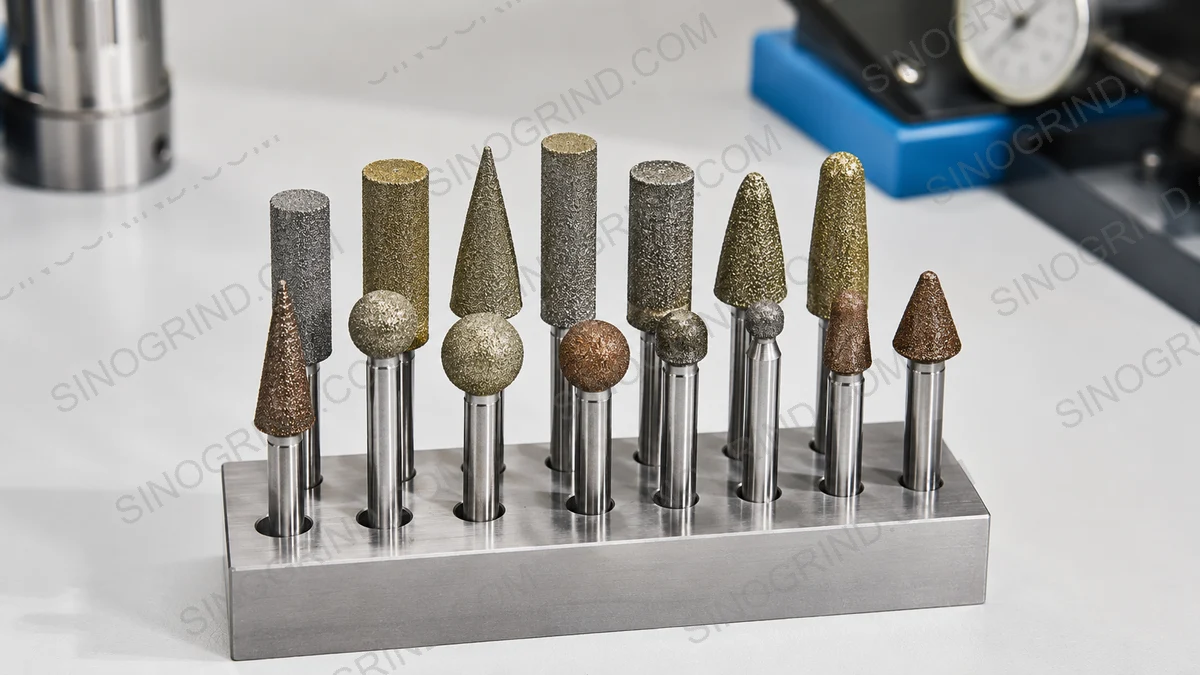
Quick answer: Dental zirconia and ceramics are finished with fine diamond tools — usually resin bond at D46–D126 grit, 75–100% concentration — using coolant. The goal is low damage to preserve fit and strength, not fast removal.
Related reading: Resin Bond Diamond Grinding Wheel · Diamond Wheel for Ceramics Grinding · Diamond Grit Size Selection.
Why dental ceramics need diamond and care
Zirconia and glass-ceramics are hard and brittle, and the finished part must fit precisely and survive biting loads. Grinding damage — micro-cracks and phase change in zirconia — can weaken the restoration, so fine diamond grit, low force and coolant are used to keep the surface and subsurface intact.
Which bond and grit should I use?
| Operation | Bond / type | Grit (FEPA D) | Concentration |
|---|---|---|---|
| CAD/CAM sprue / block work | Metal / Electroplated | D91–D126 | 100% |
| Adjustment / fitting | Resin | D46–D91 | 75–100% |
| Finishing | Resin | D30–D64 | 75% |
| Polishing | Resin / Vitrified | D15–D46 | 50–75% |
Fine resin bond diamond is the norm for adjustments and finishing because it cuts cool and gently.
Protecting fit and strength
- Fine grit and light pressure limit surface damage.
- Use coolant or water spray to avoid local overheating.
- Follow manufacturer protocols for zirconia finishing and sintering.
- Do not over-grind the margins or thin the restoration.
- Polish after adjusting to remove any grinding damage.
Where is it used?
- Zirconia crowns, bridges and frameworks.
- Lithium disilicate and feldspathic ceramics.
- CAD/CAM milling and finishing.
- Dental lab and chairside adjustments.
Which specification should I choose?
| Parameter | Typical value |
|---|---|
| Bond | Resin (finish) / Metal (block work) |
| Grit (FEPA D) | D15–D126 |
| Concentration | 75–100% |
| Coolant | Water spray |
| Priority | Low damage, correct fit |
| Note | No ferrous material - diamond is ideal |
Follow the material maker's finishing protocol alongside the tool choice.
Zirconia is strong because it is stressed
Dental zirconia is tough because its tetragonal phase converts to monoclinic under stress, which consumes energy and stops cracks. Grinding that generates too much heat or too much force triggers that transformation prematurely, and the restoration loses strength exactly where it needs it.
The practical rules are therefore simple: fine diamond, low speed, constant water, light pressure. A sharp bur that cuts freely is safer than a worn one that rubs, because rubbing is what generates the heat.
How do I set up the job?
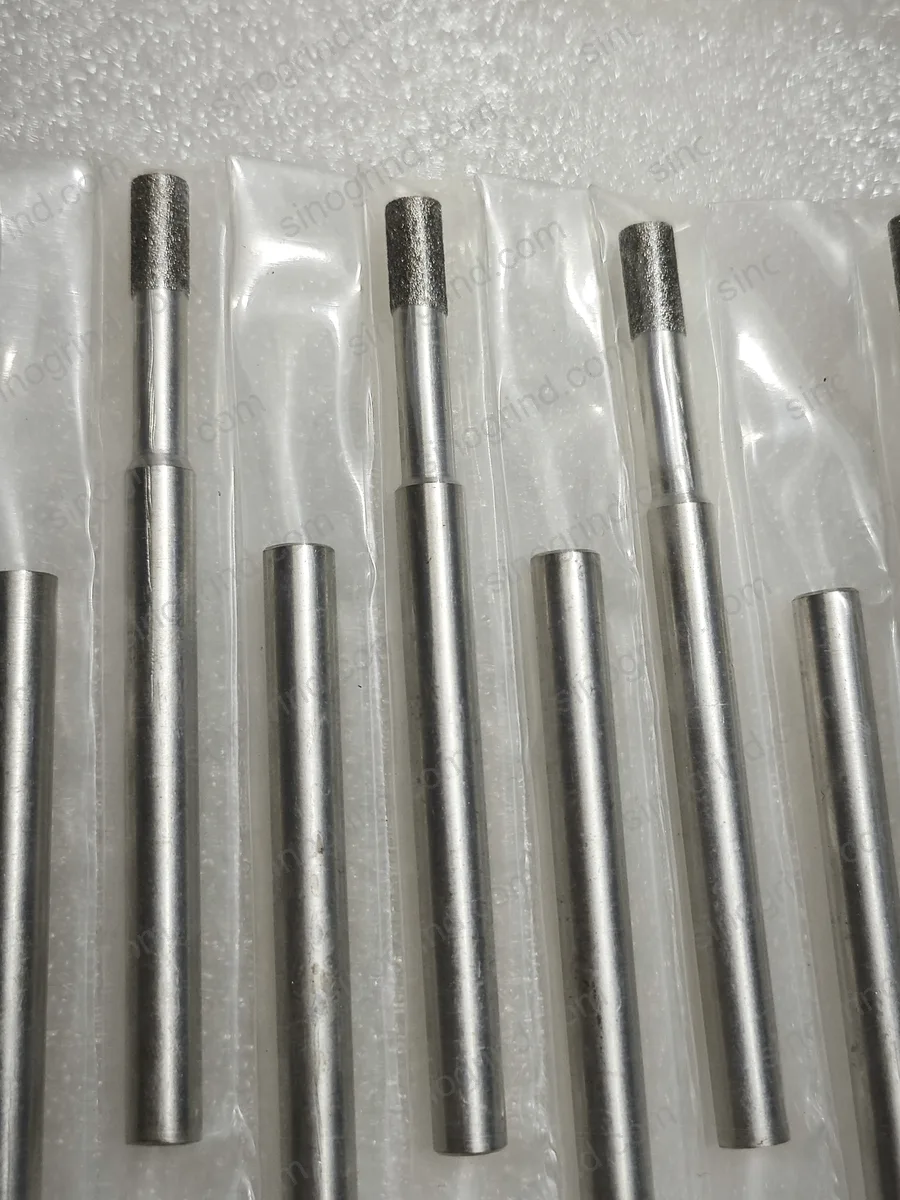
- Use the right bur. Fine-grit diamond with a shape that matches the anatomy; do not use a coarse bur to save time on a thin margin.
- Set a low speed. Follow the bur and unit manufacturer's speed; high speed without water is the main cause of damage.
- Keep water on the contact. Continuous spray, aimed at the cutting edge, not at the handpiece head.
- Use light, intermittent pressure. Let the bur cut; do not lean on the restoration.
- Check the margin. Inspect fit and margin thickness before firing or cementing.
- Clean and dry correctly. Remove grinding debris; contamination affects bonding.
How do I fix common problems?
| Symptom | Most likely cause | What to change |
|---|---|---|
| Chipped margin | Coarse bur or too much pressure | Finer grit, lighter touch, support the crown |
| White, opaque patch after grinding | Heat-driven phase change | Reduce speed, increase water, use a sharp bur |
| Poor fit after adjustment | Removing too much at the margin | Adjust the axial wall, not the margin, and re-check |
| Bur stalls and burns | Worn bur rubbing instead of cutting | Replace the bur early |
| Surface too rough for bonding | Wrong grit for the final step | Finish with the specified fine grit and clean |
Heat is the enemy of zirconia; water and a sharp bur are the two controls that matter most.
What should an RFQ include?
- Material: zirconia grade and whether it is pre-sintered or fully sintered.
- Step: adjusting a green-state coping, a sintered crown or a bridge.
- Bur: grit, shape, shank and recommended speed.
- Equipment: handpiece or milling unit, water supply and extraction.
- Quality: margin fit and surface finish requirements.
- Volume: units per week, so the bur grade can be matched to throughput.
Browse the matching Diamond & CBN Grinding Wheels range for this application.
In dental work the restoration is the cost, not the bur. Replace burs on schedule and keep the water supply clean; both are cheaper than remaking a crown.
Diamond or carbide burs for zirconia?
Carbide burs cut zirconia, but they wear quickly and generate more heat at the margin, which is exactly where the restoration is weakest. Diamond burs stay sharp longer and cut with lower force, which is why they are the default for adjusting sintered zirconia.
The exception is coarse stock removal on a green-state coping, where a carbide bur can be efficient if it is fresh and water-cooled. For any adjustment near the margin, or on a sintered crown, use a fine diamond and let the bur do the work.
Sub-table 1 — by material family
| Material | Typical operation | Recommended bond | Grit (FEPA D) | Concentration | Typical Ra |
|---|---|---|---|---|---|
| Cemented carbide (WC-Co) | Cutter & tool grinding | Resin / Metal | D91–D181 | 100–150% | 0.1–0.4 µm |
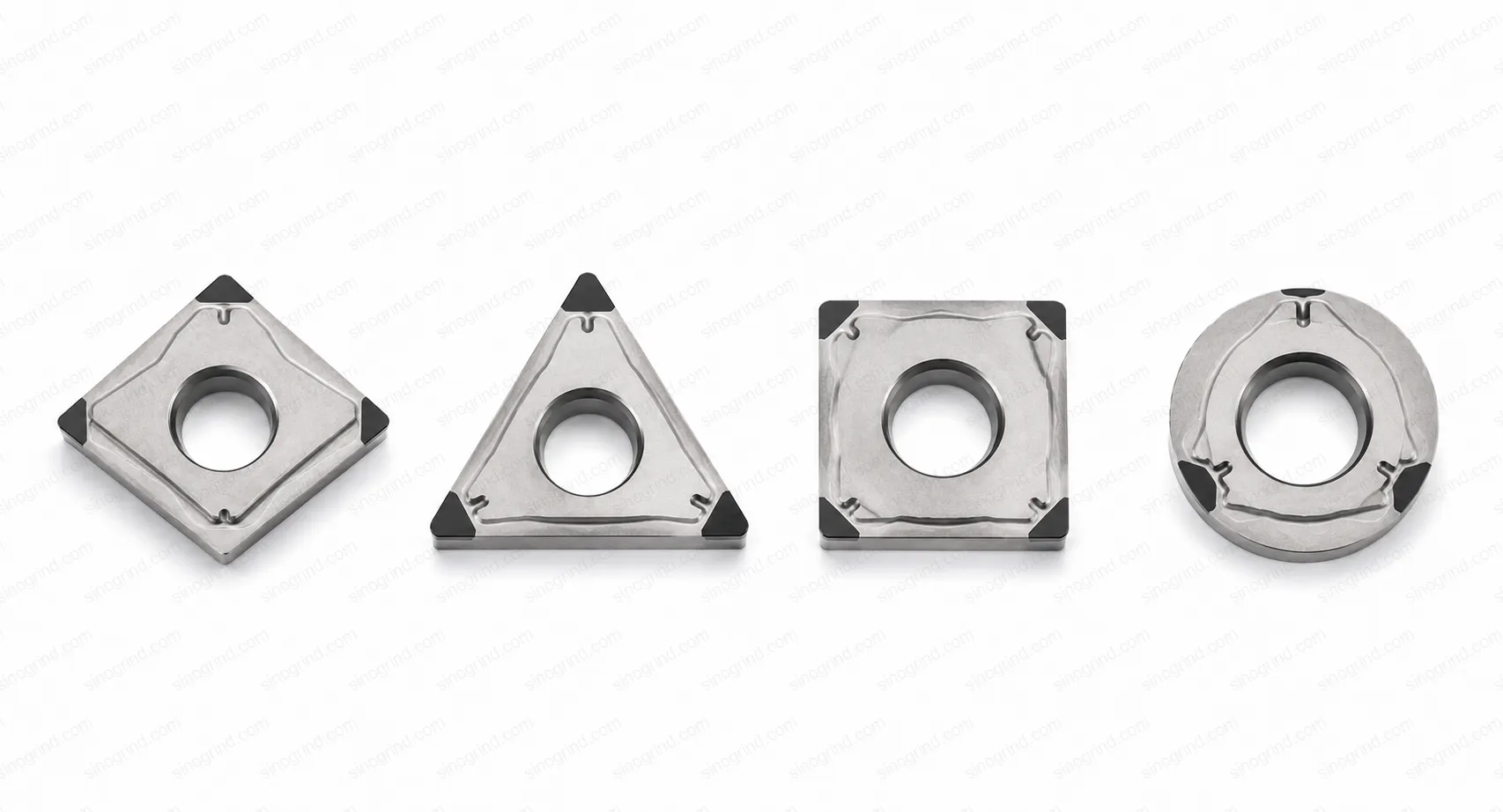
| PCD / PCBN | Edge prep, peripheral | Metal / Vitrified | D46–D91 | 125–150% | 0.05–0.2 µm |
| Advanced ceramics (Al₂O₃, ZrO₂, Si₃N₄) | Surface / form | Vitrified / Resin | D64–D151 | 75–125% | 0.2–0.6 µm |
| Optical / flat glass, quartz | Edge, bevel, CNC | Metal / Resin | D64–D126 | 75–125% | 0.05–0.3 µm |
| Semiconductor (Si, SiC, sapphire) | Back-grind, dicing | Electroplated / Resin | D126–D400+ | 100–200% | <0.02 µm (fine) |
| Ferrite / soft magnetic | Surface / form | Resin / Metal | D91–D181 | 100–150% | 0.2–0.8 µm |
| Graphite / carbon | Form / cut-off | Electroplated / Metal | D181–D301 | 75–125% | — |
| CFRP / composites | Cut, slot | Electroplated | D252–D400 | — | — |
| Thermal-spray coatings | Grind, polish | Resin / Metal | D126–D252 | 75–100% | 0.1–0.4 µm |
| Stone / engineered quartz | Edge, calibrate | Metal / Electroplated | D181–D400 | — | — |
| Zirconia (dental / medical) | Finish, polish | Resin / Vitrified | D46–D126 | 75–100% | 0.1–0.3 µm |
| Steel / cast iron (ferrous) | — | Not diamond — use CBN | — | — | — |
Representative values for planning; confirm final grit, concentration and bond with a grinding trial on your machine.
Boundary rule — when not to use diamond
Diamond is the hardest abrasive and the correct choice for hard, brittle, non-ferrous materials such as cemented carbide, ceramics, glass, silicon, sapphire, ferrite, graphite and composites. It must not be used on ferrous metals — steel, cast iron, and their alloys — because carbon in diamond reacts with iron at grinding temperatures (roughly above 700 °C / 1300 °F). This chemical affinity causes rapid, abnormal diamond wear (graphitisation) and destroys the wheel. For steel, hardened steel, cast iron and other ferrous workpieces, use CBN (cubic boron nitride) instead.