: +86 15874211461

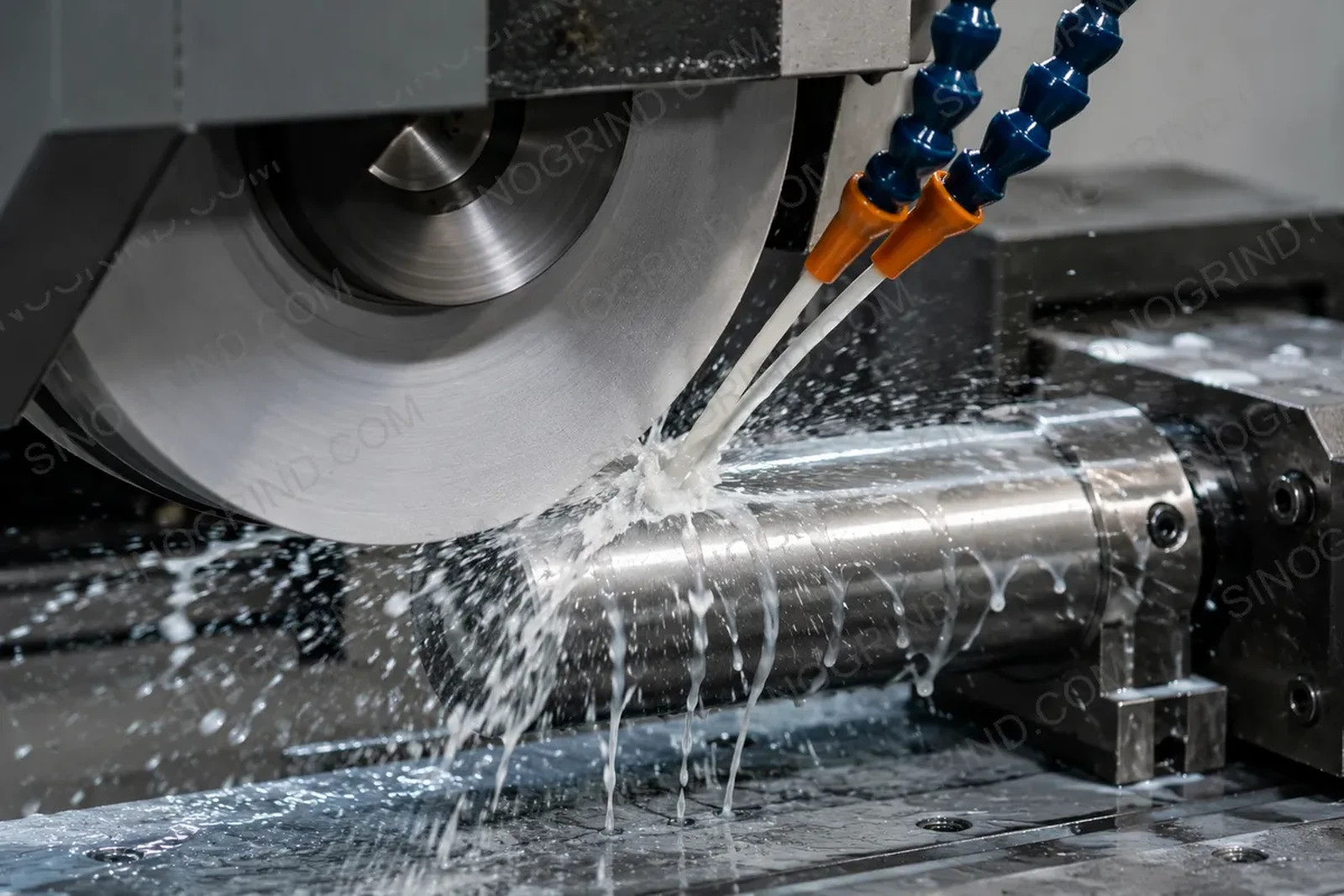
Quick answer: Use wet grinding when heat, finish, wheel life or chip removal matter: hardened steel, CBN, vitrified bond, high stock removal and tight tolerances. Dry grinding can be acceptable for light finishing with resin-bond diamond wheels, some composites and situations where coolant would contaminate the part — but only with dust extraction, conservative depth of cut and temperature control.
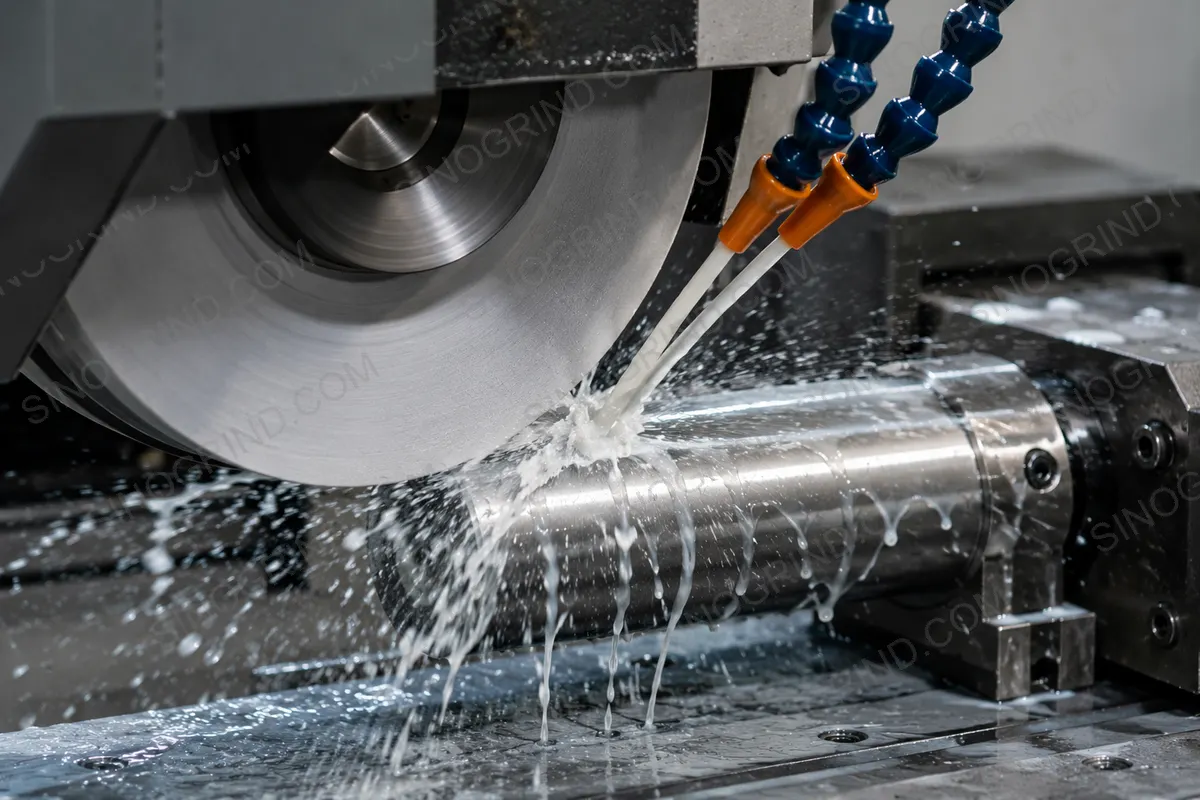
What coolant actually does
Coolant is not only for cooling. It performs four jobs at the contact zone:
- Removes heat from the wheel and workpiece to prevent burn, cracks and tempering.
- Flushes swarf so it does not re-enter the cut and scratch the surface.
- Lubricates the chip/bond interface, reducing friction and wheel wear.
- Keeps the wheel face clean, reducing loading and glazing.
Wet vs dry at a glance
| Factor | Wet grinding | Dry grinding |
|---|---|---|
| Heat control | Excellent with correct flow and placement | Limited; relies on low depth of cut and air/dust extraction |
| Surface finish | Usually better and more consistent | Can be good on light passes; risk of burn and thermal damage |
| Wheel life | Longer for CBN, vitrified and metal bond | Shorter where heat damages bond or grit |
| Chip removal | Flushes swarf away | Requires vacuum/dust extraction and frequent cleaning |
| Tolerance | Better thermal stability | Part growth from heat can drift |
| Cost | Coolant, filtration, disposal | Lower fluid cost but higher risk and cleaning |
| Best fit | Steel, CBN, vitrified, high MRR, production | Light finishing, resin diamond, some composites, contamination-sensitive parts |
When wet grinding is the safer choice
- Ferrous workpieces: steel, cast iron and superalloys are sensitive to grinding burn.
- CBN and vitrified wheels: these bonds and abrasives perform best with controlled heat.
- High material removal rates or deep cuts: heat generation rises quickly with depth and speed.
- Tight tolerance and fine finish: thermal growth and wheel wear both need control.
- Production runs: consistent coolant is part of a repeatable process.
When dry grinding can work
Dry grinding is not automatically wrong. It can be practical for light finishing with a resin-bond diamond wheel, for some composite or coated parts where fluid is undesirable, and in workshops where coolant management is not available. The conditions are strict: low depth of cut, moderate wheel speed, sharp wheel, good dust extraction and a process that stops before the part overheats.
Never use dry grinding as a shortcut for a process that is already burning. Burn is a sign that heat input exceeds removal; reduce depth of cut, increase feed rate or add coolant.
Coolant type and delivery
| Coolant | Typical use | Notes |
|---|---|---|
| Water-based emulsion | Most ferrous grinding, CBN, vitrified | Good cooling; control concentration and bacterial growth |
| Neat oil | Honing, some precision and carbide work | Good lubrication and rust protection; fire and mist management needed |
| Synthetic / semi-synthetic | General grinding | Cleaner and more stable; check lubricity for heavy cuts |
| Mist / MQL | Light finishing, difficult-to-flood zones | Low flow; not a substitute for flood cooling at high MRR |
| Air / dust extraction | Dry grinding | Removes dust and chips; does not remove heat from the contact zone |
Flow matters as much as chemistry. Aim the nozzle at the contact zone, not the top of the wheel, and use enough flow to cover the full arc of contact. A common mistake is a large tank with a weak pump and a nozzle that misses the cut.
Troubleshooting
| Symptom | Likely cause | Action |
|---|---|---|
| Burn or discolouration | Too little coolant, too deep a cut, dull wheel | Increase flow, reduce depth, dress the wheel |
| Loading | Soft workpiece, poor filtration, wrong coolant | Improve filtration, adjust coolant, open the wheel structure |
| Chatter | Wheel imbalance, poor support, interrupted cut | Balance and true the wheel, improve rigidity |
| Rapid wheel wear | Wrong bond/grit, excessive speed, chemical mismatch | Check specification and speed; use CBN for steel |
| Foam / poor settling | Coolant concentration or contamination | Check concentration, skim tramp oil, replace if degraded |
Safety
Dry grinding of aluminium, magnesium, titanium and some composites creates combustible dust. Use wet collection, grounded equipment and housekeeping; do not rely on a shop vacuum alone.
Boundary rule — when not to use diamond
Diamond is the hardest abrasive and the correct choice for hard, brittle, non-ferrous materials such as cemented carbide, ceramics, glass, silicon, sapphire, ferrite, graphite and composites. It must not be used on ferrous metals — steel, cast iron, and their alloys — because carbon in diamond reacts with iron at grinding temperatures (roughly above 700 °C / 1300 °F). This chemical affinity causes rapid, abnormal diamond wear (graphitisation) and destroys the wheel. For steel, hardened steel, cast iron and other ferrous workpieces, use CBN (cubic boron nitride) instead.